There’s something about the idea of a city under the sea that stays in your mind a little longer than it should. Not in a dramatic way, but quietly. You hear about it once, maybe in a story or during a temple visit, and it just sits there in your thoughts. That’s exactly how Underwater Dwarka Gujarat first felt to me.
At first, it sounded like one of those stories people repeat without thinking too much about it. A lost city, ancient connections, something linked to Lord Krishna. But then, the more I looked into it, the more it started feeling less like a story and more like something that sits between belief and evidence.
And that space in between… that’s where things get interesting.
What People Usually Imagine About Underwater Dwarka Gujarat
When most people hear about Underwater Dwarka Gujarat, they picture something very clear—a complete city beneath the sea, perfectly preserved, almost like it’s waiting to be discovered fully.
But the reality is not that simple.
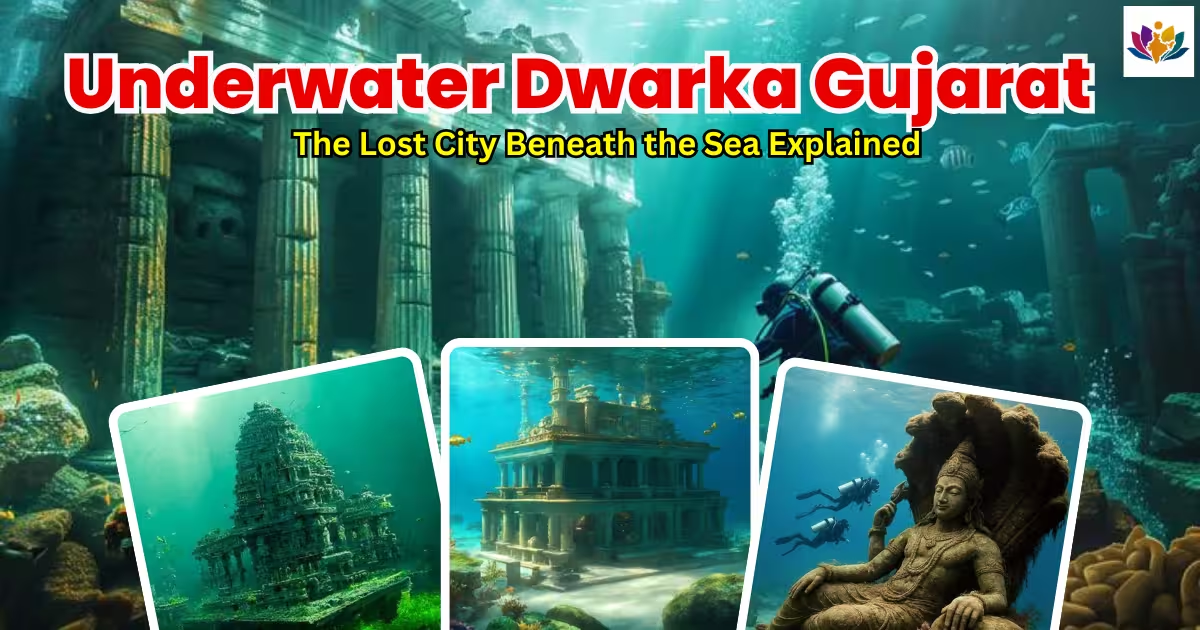
There are underwater remains, structures, and formations found near the coast of Dwarka. However, they are not laid out like a visible city you can walk through or clearly map in your mind. Instead, they appear in fragments—stone blocks, walls, and shapes that suggest something once existed there.
And that’s where the curiosity begins.
The Underwater City of Dwarka History – Where Belief Meets Exploration
The underwater city of Dwarka history is deeply tied to ancient texts. According to tradition, Dwarka was the kingdom of Lord Krishna, a grand city built near the sea. It is believed that after Krishna left the earth, the city submerged into the ocean.
Now here’s where things shift.
For a long time, this was seen purely as a mythological narrative. But then, marine archaeological studies began exploring the seabed near modern Dwarka.
What they found didn’t prove everything. But it didn’t dismiss it either.
Stone structures, anchors, and formations started appearing in research reports. And suddenly, the story didn’t feel as distant.
Dwarka Underwater Ruins Gujarat – What Has Actually Been Found
The discoveries related to Dwarka underwater ruins Gujarat are not dramatic in the way movies show lost cities. They are subtle.
- Stone blocks arranged in patterns
- Remains of what appear to be walls
- Ancient anchors suggesting maritime activity
- Structural alignments that don’t feel natural
At first glance, these might not seem like much. But when studied closely, they suggest human involvement.
And this is where many people pause. Because it raises a quiet question—what exactly existed here before?
Submerged Dwarka Archaeological Findings – What Experts Say
The submerged Dwarka archaeological findings come mainly from marine explorations conducted over the past few decades.
Experts have pointed out:
- Evidence of ancient port-like structures
- Materials that date back thousands of years
- Indications of human settlement near the coastline
However, they are also careful in their conclusions. They don’t claim a fully preserved city. Instead, they describe it as a site with strong indications of ancient habitation.
That cautious approach makes the findings feel more real.
Why This Story Feels Different from Other Historical Discoveries
There are many ancient sites across India. Some are well preserved, some partially lost. But Underwater Dwarka Gujarat feels different because it sits under water, out of direct reach.
You cannot walk through it. You cannot stand there and look around.
And maybe that’s why it stays in the imagination longer.
Because you never fully see it.
Visiting Dwarka – Where the Surface Meets the Story
When you visit Dwarka today, nothing immediately tells you there’s a submerged past beneath the sea.
The Dwarkadhish Temple stands firmly, the ghats are active, and the town feels alive.
But then, if you stand near the coast for a while, something changes.
You look at the sea differently.
You don’t just see water. And you start thinking about what might be beneath it.
And that thought stays with you.
What Most People Don’t Notice
There’s something subtle that many visitors miss.
They come to Dwarka for darshan, for temple visits, for spiritual reasons. And rightly so.
But very few pause long enough near the coastline to reflect on the idea of Underwater Dwarka Gujarat.
Not because they don’t care, but because it’s not visible.
And maybe that’s the point. Some things are not meant to be seen directly.
The Balance Between Faith and Evidence
One of the most interesting aspects of this topic is how it sits between faith and research.
- Faith says the city existed and submerged
- Archaeology suggests there were ancient structures
- But neither fully explains everything
And instead of conflicting, they seem to coexist quietly.
You don’t feel the need to prove one over the other. You just accept that something existed, even if you don’t fully understand it.
Best Time to Visit Dwarka with This Perspective
If you are visiting Dwarka with the curiosity of Underwater Dwarka Gujarat, timing your visit slightly differently helps.
- Early morning: Calm environment, less crowd
- Evening near the coast: Better for reflection
- Avoid peak rush hours if you want quiet time
The place feels different when you are not rushing.
Crowd Behaviour – Something That Changes Your Experience
Crowds in Dwarka are generally steady, especially near the temple.
- Temple areas: Constant flow
- Coastal areas: Comparatively quieter
- Festivals: High movement and energy
If you want to experience the deeper side of the place, stepping away from the main crowd helps.
Planning Support Partner
Exploring a destination like Dwarka becomes more meaningful when you understand both its visible and hidden aspects. That’s where Somnath Dwarka Tour Package supports travellers who want a balanced experience instead of just surface-level visits. However with practical planning and local understanding, they help you move beyond crowded temple routes and experience the coastal and historical side of Dwarka as well, making your journey feel more complete and less rushed.
Contact: Somnath Dwarka Tour Package Today:
Call Us: +91 7300620809
WhatsApp Us: +91 7300620809
Visit Our Website: Somnath Dwarka Tour Package
Somnath Dwarka Tour Package is a Unit of Experience My India
Experience My India Trip Advisor Review
How to Reach Dwarka
🚗 By Car
- Well connected with major Gujarat cities
- Smooth highway access
- Suitable for flexible travel
🚆 By Train
- Dwarka Railway Station is well connected
- Direct trains from major cities
- Easy local transport available
✈️ By Air
- Nearest airport: Jamnagar
- Distance: Around 130 km
- Road journey required after landing
Reaching Dwarka is simple. Understanding it takes a bit more time.
FAQs – Underwater Dwarka Gujarat
Underwater Dwarka Gujarat refers to the submerged remains found near the coast of Dwarka, which are believed to be linked to the ancient city associated with Lord Krishna.
It is a mix of both belief and research. While ancient texts describe Dwarka as a grand city that submerged, marine studies have also found structures that suggest human settlement.
Archaeologists have found stone structures, anchors, and formations that indicate possible ancient habitation and maritime activity.
No, the underwater site is not open for direct tourist visits. It remains a research area, and the remains are not visible like regular monuments.
The findings suggest that an ancient settlement existed near the coast, but they do not fully confirm the exact city described in mythology.
It is located off the coast of present-day Dwarka in Gujarat, beneath the Arabian Sea.
It holds both spiritual and historical significance, connecting ancient beliefs with modern archaeological exploration.
Major explorations began in the late 20th century, especially in the 1980s and later, with ongoing research over time.
While you cannot see the underwater remains directly, visiting Dwarkadhish Temple and the coastal areas helps you connect with the story.
There is no complete scientific confirmation yet. However, the discoveries support the possibility of an ancient coastal settlement, keeping the connection open for interpretation.
Conclusion
The idea of Underwater Dwarka Gujarat doesn’t give you clear answers. It leaves you with something else.
You don’t walk away with certainty. You walk away with curiosity.
And maybe that’s what makes it stay with you, Not because you saw everything, but because you didn’t.