Adi Kadi Vav and Navghan Kuvo: Uparkot's Ancient Stepwells
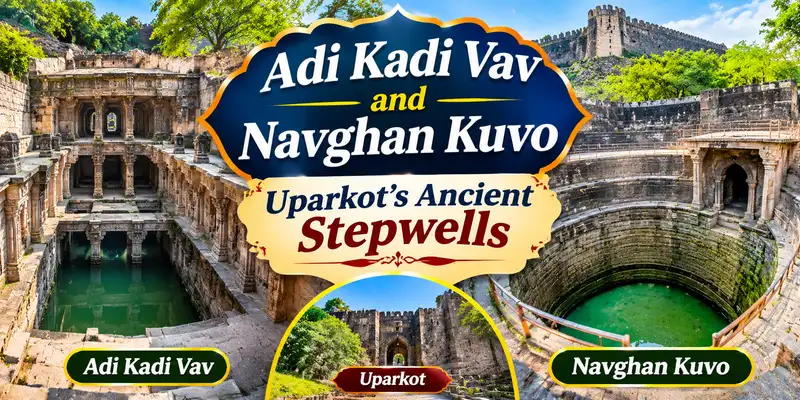
Adi Kadi Vav and Navghan Kuvo are two ancient rock-cut stepwells inside Uparkot Fort in Junagadh. Adi Kadi Vav descends a straight, narrow corridor of around 120 to 166 steps to about 41 metres, while Navghan Kuvo spirals around a circular shaft of around 170 to 195 steps to about 52 metres. Both are entered on the Uparkot Fort ticket, open roughly 8:00 AM to 6:00 PM. This guide, from Experience My India, covers both wells, their history and legends.
Hidden within the ramparts of Uparkot Fort in Junagadh are two of Gujarat's most remarkable ancient water structures: the stepwells of Adi Kadi Vav and Navghan Kuvo. Carved deep into solid rock to sustain the fort through long sieges and dry spells, they are feats of ancient engineering wrapped in legend and no visit to Uparkot is complete without them. This guide, from the team behind Somnath Dwarka Tour Package, a unit of Experience My India, covers both stepwells: their design and depth, their history and the famous legends attached to them and the timings, entry and tips for visiting. They sit within the larger Uparkot Fort, so they are best seen as part of a tour of the citadel.
Location and visiting info
Both stepwells are located inside Uparkot Fort, in the Mullawada area of Junagadh, near Girnar Hill and they are reached as part of a visit to the fort. The fort and the wells within it, are generally open daily from around 8:00 AM or 9:00 AM to about 6:00 PM, with last entry usually around 4:00 PM, though seasonal timings and last-entry rules vary, so it is worth checking at the gate. Entry to the stepwells is included in the Uparkot Fort admission, so there is no separate ticket; fort entry rates start at around Rs 25 to 50 for children and local residents, Rs 100 for Indian adults and Rs 500 for foreign visitors, with extra charges for cameras or electric vehicles. The best time to visit is October to March, with mornings offering cooler weather and better light for photography in the deep wells. You reach the fort by auto-rickshaw, taxi or local bus from Junagadh city, part of the wider Junagadh and Girnar circuit.
Adi Kadi Vav and Navghan Kuvo compared
Though often mentioned together, the two stepwells are quite different in design, which is part of what makes seeing both so interesting. Here is how they compare:
Feature | Adi Kadi Vav | Navghan Kuvo |
Stairway | Straight, narrow corridor cut into solid rock | Spiral staircase around a circular shaft |
Steps | Around 120 to 166 steps | Around 170 to 195 steps |
Depth | About 123 to 135 feet (37 to 41 metres) | About 170 feet (50 to 52 metres) to the water |
Build | Monolithic rock-cut, no ornate pillars | Excavated in soft rock, irregular forecourt and niches |
Age | Often dated to the 15th century | Linked to Ra' Navaghana, 11th century |
In short, Adi Kadi Vav is a dramatic straight descent down a narrow rock-cut corridor, while Navghan Kuvo is a deeper, spiralling well winding around a circular shaft. Seeing both, within a short walk of each other inside the fort, shows two distinct approaches to the same ancient challenge of reaching water deep below a hilltop citadel.
Adi Kadi Vav
Adi Kadi Vav is a striking monolithic rock-cut stepwell, entered by a long, straight, narrow corridor of steps carved directly into the solid rock, commonly cited at around 120 to 166 steps, descending to a depth of roughly 123 to 135 feet, about 37 to 41 metres. Unlike the ornate, pillared stepwells found elsewhere in Gujarat, Adi Kadi Vav is austere and raw, its beauty lying in the sheer scale of the rock-cutting rather than in carved decoration. It is widely attributed to the 15th century, though some accounts link it to the earlier Chudasama rule or even older eras. Descending the long flight into the cool depths, with the rough rock walls rising on either side, is an atmospheric and slightly eerie experience and it conveys vividly the effort and ingenuity that went into securing water for the fort.
The legend of Adi and Kadi
Adi Kadi Vav carries a poignant and well-known legend that gives it its name. According to folklore, when the stepwell was dug, no water appeared and it was prophesied that water would flow only if two unmarried women were sacrificed or in another version, if two royal maids fetched water daily. Two such women, named Adi and Kadi, are said to have been offered or to have served, so that the water would come and the well is named in their memory. To this day, visitors tie pieces of cloth or place bangles on a tree near the well in remembrance of the two women. Whether read as a tale of sacrifice or of devotion, the legend lends Adi Kadi Vav a haunting human dimension, turning a feat of engineering into a place of memory and quiet ritual that still moves those who descend its steps.
Navghan Kuvo
Navghan Kuvo is the deeper and older of the two, an ancient rock-cut well distinguished by its spiral staircase that winds around a deep circular shaft, with around 170 to 195 steps descending roughly 170 feet, about 50 to 52 metres, to the water table. It is excavated into soft stone or rock, with an irregular forecourt, an arched entry and niches cut into the walls. The well is named after the Chudasama ruler Ra' Navaghana of the 11th century and is said to have been completed by his son Khengara, though some scholars date parts of it even earlier. Its deep, rock-cut spiral design was a sophisticated solution to reaching water far below the fort and crucially it helped sustain the fort's inhabitants during the long sieges for which Uparkot is famous. Winding down the spiral into the cool darkness is one of the most memorable experiences inside the fort.
How the wells sustained the fort
The real significance of both stepwells lies in their role as the fort's protected water supply. Uparkot Fort is famous for withstanding multiple sieges, including a legendary twelve-year siege and a secure source of water was essential to surviving such prolonged blockades. By cutting deep into the rock within the fort walls to reach the water table, the builders ensured that the defenders could not be starved of water even when cut off from outside, which was often the decisive factor in whether a hilltop fort could hold out. Adi Kadi Vav and Navghan Kuvo are therefore not merely architectural curiosities but strategic infrastructure, as vital to the fort's defence as its ramparts and cannons. They show how ancient engineers turned the challenge of water deep underground into a military strength, a key reason Uparkot endured for over a thousand years, as our Uparkot Fort entry fee guide covers alongside the ticket details.
The famous Gujarati proverb
So celebrated are these two wells that they feature in a well-known Gujarati saying: Adi Kadi ni Vav Ane Navghan Kuvo, Je Na Juve Te Jivto Muo, which translates roughly as, one who has not seen the Adi Kadi Vav and the Navghan Kuvo is like one living dead. The proverb, affectionate and hyperbolic in the Gujarati manner, captures how essential these monuments are considered to a proper experience of Junagadh, placing them among the must-see sights of the region. It is a charming reminder that long before they were tourist attractions, the wells were a source of local pride and identity. For visitors, the saying is both an invitation and a gentle challenge: to have come to Junagadh and not descended into these ancient wells is, in the eyes of the proverb, to have missed something essential.
Visiting tips
A few practical pointers help you explore the stepwells safely and comfortably:
Wear sturdy footwear: the steps are old and uneven, so non-slip shoes are important for the descent.
Carry a small torch: the lower steps can be dim, so a flashlight or phone torch helps you see your footing.
Watch your step: some sections have uneven steps and low light, so descend carefully and hold any railings.
Go in the morning: cooler weather and better light make the morning the best time to visit the deep wells.
Check conditions on site: some visitors note litter or pigeon droppings in the lower sections, so check current access and safety at the gate.
See both together: the two wells are a short walk apart inside the fort, so visit them as a pair.
Combining with a Junagadh visit
The stepwells are best enjoyed as part of a wider exploration of Uparkot Fort and Junagadh. Within the fort, they sit alongside the Buddhist caves, the great cannons and the ramparts, while the city beyond offers the ornate Mahabat Maqbara and the sacred mountain of Girnar, reached by the Girnar ropeway or its famous steps. A visit to the stepwells, then, is one chapter in a rich day of heritage in Junagadh, a city that rewards slow exploration. Because Junagadh sits on the Saurashtra circuit, close to the Gir forest and Somnath, the fort and its wells slot naturally into a wider Gujarat journey of temples, wildlife and history.
Plan your Junagadh visit
Experience My India can plan a Junagadh visit that includes Uparkot Fort with its stepwells, alongside the Mahabat Maqbara, Girnar and the wider Saurashtra region, with a comfortable stay, a well-paced itinerary and transport that makes sightseeing easy. Our Somnath Dwarka tour packages and wider Gujarat tour packages can weave Junagadh into a fuller journey taking in Gir and the coast, with a stay at well-placed hotels and comfortable local transport throughout.
Related guides
To plan your Junagadh visit further, these related guides help:
Related guide | What it covers |
The great stairway up Junagadh's sacred mountain. | |
The temples and sights of the Girnar range. | |
The historic zoo and lion breeding centre in the city. |
Plan your visit
Experience My India can arrange your Junagadh visit and wider Gujarat journey. Browse more travel guides, message us on WhatsApp or call +91 73006 20809.

Harsh Rawat
Somnath–Dwarka circuit planning
Harsh Rawat runs Somnath Dwarka Tour Package on the ground in Gujarat, part of Experience My India. Since 2018 he has been planning and driving the Somnath–Dwarka circuit — the darshan timings, the road hours between temples and the stops worth adding — and the routes, fares and timings published across this site are the ones he maintains.