Kirti Mandir Porbandar: Mahatma Gandhi's Birthplace, History and Guide
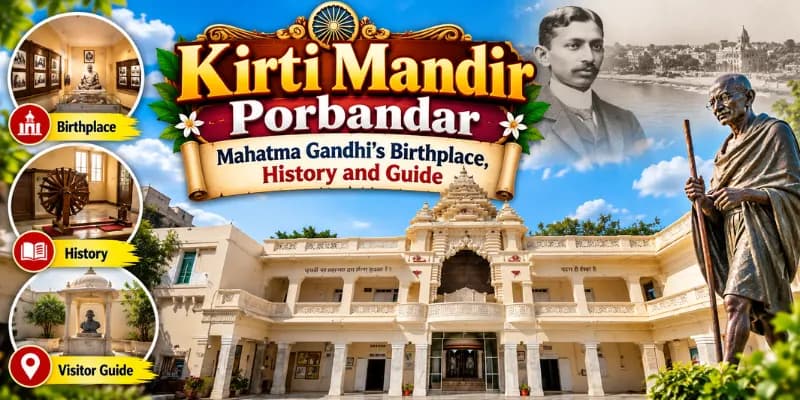
Kirti Mandir in Porbandar, Gujarat, is a national memorial and museum honouring Mahatma Gandhi and Kasturba Gandhi, standing beside the ancestral haveli where Gandhi was born in 1869. Its 79-foot spire marks the 79 years of Gandhi's life, and its design blends six faiths. It is open daily, with free entry, and is Porbandar's main attraction.
In the heart of Porbandar, on the Saurashtra coast, stands the birthplace of the Father of the Nation, a memorial of quiet dignity that draws visitors from across India and the world. This guide, from the team behind Somnath Dwarka Tour Package, a unit of Experience My India, covers the history of Kirti Mandir, its symbolic architecture, the preserved birthplace, the museum and how to visit.
About Kirti Mandir
Kirti Mandir, meaning the Temple of Glory, is a national memorial and museum in Porbandar, built to honour Mahatma Gandhi, the Father of the Nation and his wife Kasturba Gandhi. It stands right beside the ancestral family haveli where Mahatma Gandhi was born on 2 October 1869, so the memorial and the actual birthplace sit side by side, forming one complex. Rather than a temple in the religious sense, Kirti Mandir is a place of national reverence, a museum and memorial that preserves the birthplace and tells the story of Gandhi's life and teachings. With its tall, symbolic spire, its interfaith architecture and its moving exhibits, it is the main attraction of Porbandar and a place of pilgrimage for all who admire Gandhi's message of truth and non-violence. To stand in the room where Gandhi was born and in the memorial raised in his honour, is a profoundly moving experience.
Kirti Mandir at a glance
Memorial | Kirti Mandir, honouring Gandhi and Kasturba |
Location | Kasturba Road, Porbandar, Gujarat |
Timings | About 9 AM to 12 noon and 3 PM to 6 PM |
Entry | Free |
Spire height | 79 feet, for Gandhi's 79 years |
Beside | The haveli where Gandhi was born in 1869 |
The history of Kirti Mandir
The story of Kirti Mandir begins with the Gandhi family's ancestral home. The three-storey haveli, a house of some 22 rooms, was bought in the 18th century by Gandhi's great-grandfather, Harjivan Raidas Gandhi and expanded by later generations. Both Gandhi's grandfather, Uttamchand Gandhi and his father, Karamchand Gandhi, served as Diwans or chief ministers, of the princely state of Porbandar, so the family was one of standing in the town. It was in this house that Mohandas Karamchand Gandhi was born in 1869. After the long freedom struggle, the people of Porbandar resolved to build a memorial at his birthplace. With Gandhi's own consent, the project was taken up by the Maharaja of Porbandar, Natwarsinhji and the industrialist and philanthropist Nanjibhai Kalidas Mehta, with his wife Santokben Mehta, who donated the funds and had the ancestral house purchased and included in the complex. The foundation was laid in 1947, during Gandhi's lifetime, by the Gandhian leader Darbar Gopaldas Desai and the memorial was designed by the architect Purushottam Mistry. By the time it was completed, Gandhi had passed away and Kirti Mandir was inaugurated on 27 May 1950 by Sardar Vallabhbhai Patel, the Iron Man of India and given to the nation.
The architecture of Kirti Mandir
The architecture of Kirti Mandir is rich in symbolism that reflects Gandhi's own ideals. Its most striking feature is the tall central spire, which rises exactly 79 feet high, symbolising the 79 years of Mahatma Gandhi's life and atop it are placed 79 earthen lamps, another tribute to those years. Above all, the building is a monument to interfaith harmony: its design incorporates architectural elements from six religions, Hinduism, Buddhism, Jainism, Islam, Christianity and the Parsi faith, blending a Hindu swastika, a Buddhist pagoda, Islamic latticework, Jain motifs and Christian features into one harmonious whole, to symbolise Gandhi's deep respect for all religions and his belief in their unity. The complex, built around an E-shaped layout with a spacious courtyard, is faced in marble and lined with carved pillars inscribed with Gandhi's thoughts. Every element is designed to express the values Gandhi lived by, so that the building itself teaches his philosophy.
The birthplace: Gandhi's ancestral haveli
Beside the memorial stands the real treasure: the ancestral haveli where Mahatma Gandhi was born, carefully preserved. This three-storey, 18th-century family house, marked by its distinctive green windows and doors, is entered from the Kirti Mandir complex and walking through its rooms is like stepping back in time to Gandhi's childhood. The most sacred spot is the birth room itself, the exact place on the ground floor where Gandhi was born in 1869, which is preserved and marked on the floor with a traditional swastika, the auspicious symbol. Visitors come to stand quietly before this spot, the humble room from which one of history's greatest figures came into the world. A touching detail is that the birth home of Kasturba Gandhi, who became Gandhi's wife, stood nearby, so the two were neighbours before their marriage. The simple, dignified old house tells the human story behind the Mahatma.
The museum and galleries
Within the Kirti Mandir complex is a museum that chronicles the life and work of Mahatma Gandhi. A spacious courtyard leads to galleries displaying rare black-and-white photographs, personal artefacts and documents tracing Gandhi's journey from a boy in Porbandar to the leader of a nation's freedom struggle. At the centre of the memorial are life-size oil paintings of Mahatma and Kasturba Gandhi placed side by side, inscribed with the words Satya and Ahimsa, truth and non-violence, the twin pillars of his philosophy, along with memorials to close associates such as Mahadev Desai and Maganlal Gandhi. The complex also houses the Kasturba Gandhi library, with a rich collection of Gandhian literature and a small shop selling books and souvenirs. Together, the exhibits make Kirti Mandir not just a memorial but a place of learning, where visitors can reflect on Gandhi's life, his ideals and his enduring message.
Kirti Mandir timings and entry
Kirti Mandir is open daily, generally from about 9:00 AM to 12:00 noon and again from 3:00 PM to 6:00 PM, with a break in the middle of the day and entry is free. It lies on Kasturba Road, about 2 km from Porbandar railway station, in the heart of the city. A visit usually takes about an hour to an hour and a half, to see the memorial, the preserved birthplace and the museum galleries at a thoughtful pace. As it is a place of national reverence, visitors are asked to dress and behave respectfully. Timings can change, so it is wise to confirm the current hours before your visit, especially around Gandhi Jayanti on 2 October, when the memorial sees many visitors and special observances.
How to reach Kirti Mandir
Kirti Mandir is in the heart of Porbandar, on Kasturba Road, about 2 km from Porbandar railway station, easily reached by auto rickshaw or taxi. Porbandar has an airport with flights to Mumbai and a railway station connecting it to Ahmedabad, Rajkot, Jamnagar and Mumbai. By road, Porbandar lies on the coastal highway between Dwarka and Somnath, so it is easily reached on a Saurashtra tour and a Somnath Dwarka taxi service can bring you to Porbandar and Kirti Mandir as a stop on a wider journey.
Combine Kirti Mandir with the rest of Porbandar
Kirti Mandir is the centrepiece of a visit to Porbandar and combines well with the city's other sights into a full day. Nearby is the unique Sudama Mandir, dedicated to Krishna's friend Sudama, with its sin-cleansing maze; the Shri Hari Mandir at the Sandipani ashram; the Huzoor Palace; and the Porbandar and Chowpaty beaches for an evening walk. Porbandar lies midway between Dwarka, Krishna's city and Somnath, the first Jyotirlinga and pairs well with a Gir lion safari, so a visit to Gandhi's birthplace fits beautifully into a wider Saurashtra journey of pilgrimage, heritage and the coast.
Tips for visiting Kirti Mandir
A few pointers make your visit better:
Note the timings, about 9 AM to 12 noon and 3 PM to 6 PM, with a midday break and plan around them.
Allow about an hour to an hour and a half for the memorial, the birthplace and the museum.
Visit the preserved birth room in the haveli, marked by a swastika on the floor, the most sacred spot.
Look for the 79-foot spire and the interfaith details that symbolise Gandhi's values.
Dress and behave respectfully, as it is a place of national reverence.
Combine the visit with the Sudama temple and Porbandar's other sights and with Dwarka and Somnath.
Plan your Porbandar trip
Experience My India can plan a Saurashtra trip that includes Kirti Mandir and Porbandar along with the temples and the safari. Combine Gandhi's birthplace with the Sudama temple and Porbandar's sights, with Dwarka and Somnath and a Gir lion safari, book Somnath Dwarka hotels and let the Experience My India Somnath Dwarka tour packages or the wider Gujarat tour packages include Porbandar and the coastal route in your itinerary, for a journey that blends heritage, pilgrimage and the sea.
Related guides
To plan the rest of your Saurashtra trip, these related guides help:
Related guide | What it covers |
Air, rail and road access to the Dwarka coast. | |
What to see in Dwarka, west of Porbandar. | |
The sights of Somnath, east of Porbandar. | |
The drive to a Gir lion safari nearby. | |
The season and weather for a Saurashtra trip. | |
The sacred mountain and fort city inland. |
Plan your visit
Experience My India can arrange your Porbandar and Saurashtra trip with Kirti Mandir and the temples. Browse more travel guides, message us on WhatsApp or call +91 73006 20809.

Harsh Rawat
Somnath–Dwarka circuit planning
Harsh Rawat runs Somnath Dwarka Tour Package on the ground in Gujarat, part of Experience My India. Since 2018 he has been planning and driving the Somnath–Dwarka circuit — the darshan timings, the road hours between temples and the stops worth adding — and the routes, fares and timings published across this site are the ones he maintains.