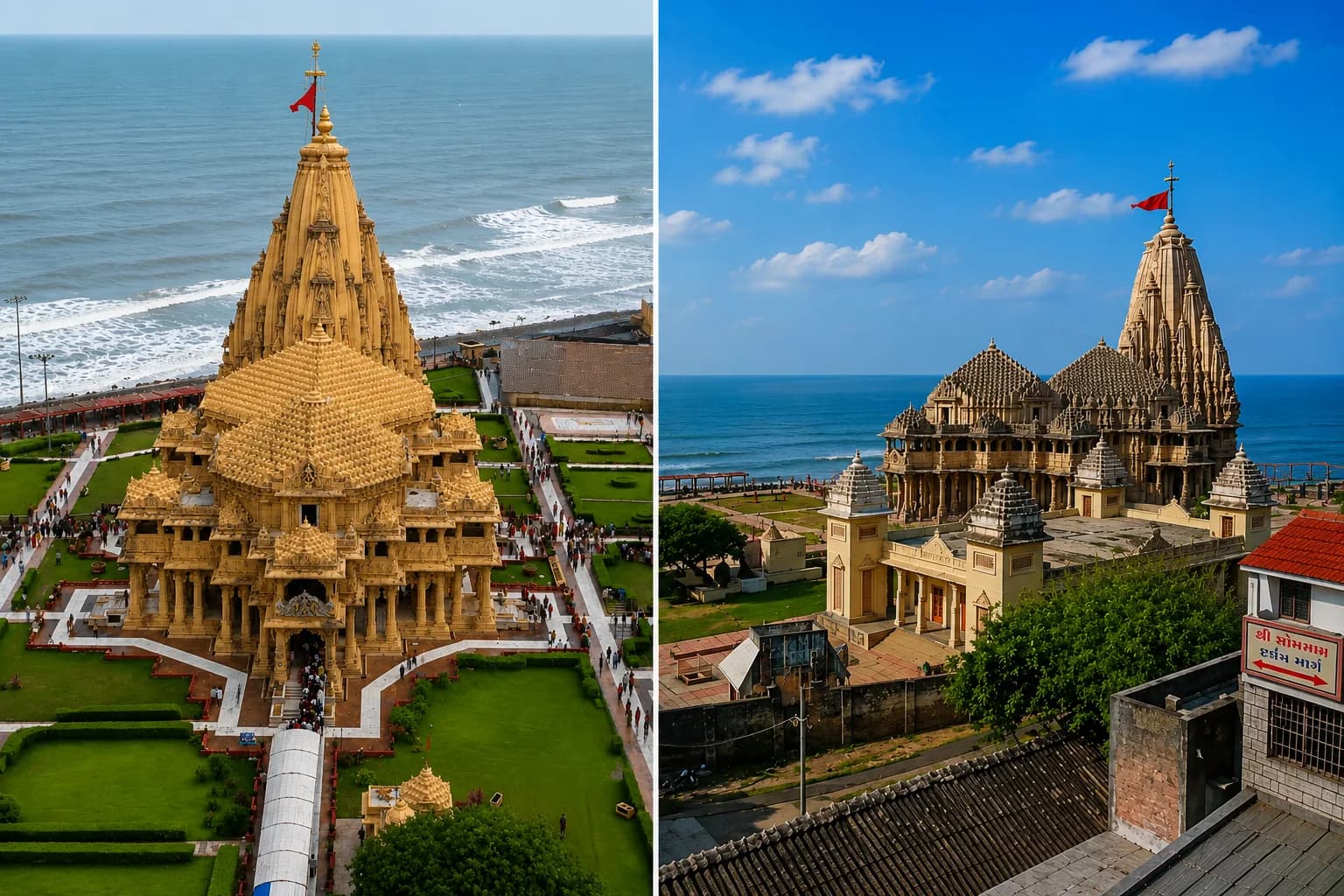
Madhavpur Fair: Krishna's Wedding and India's Festival of Unity
The Madhavpur Fair or Madhavpur Ghed Mela, is a five-day annual festival at Madhavpur Ghed near Porbandar, Gujarat, beginning on Ram Navami to commemorate the wedding of Lord Krishna and Devi Rukmini. Scaled up as a national-unity festival linking Gujarat with Northeast India, it blends temple rituals, a chariot procession, folk performances and beach sports. Entry is free. This guide, from Experience My India, covers it.
The Madhavpur Fair is one of Gujarat's most remarkable festivals, a five-day celebration in the coastal village of Madhavpur Ghed that joins sacred mythology, living folk culture and a powerful message of national unity. Held every year on Ram Navami, it commemorates the legendary wedding of Lord Krishna and Devi Rukmini and in recent years it has grown into a vibrant cultural bridge between Western and Northeastern India. This guide, from the team behind Somnath Dwarka Tour Package, a unit of Experience My India, covers the legend behind the fair, its five days of wedding rituals, the grand chariot procession, the fusion of Gujarati and Northeastern performances, the artisan and food mela and the beach sports, along with the dates, admission and travel details you need to experience this extraordinary festival on the Saurashtra coast.
What is the Madhavpur Fair?
The Madhavpur Fair, also known as the Madhavpur Ghed Mela, is a prominent five-day annual cultural and religious festival held in Madhavpur Ghed, a coastal village in the Porbandar district of Gujarat. The fair begins every year on the auspicious day of Ram Navami to commemorate the mythological wedding of Lord Krishna and Devi Rukmini, which tradition places at this very spot. What was once a local religious fair has, in recent years, been scaled up by the Government of India and Gujarat Tourism into a magnificent symbol of national integration, bridging the cultures of Western and Northeastern India. The result is a festival with two souls, deeply devotional at its heart, with the ancient wedding rituals observed faithfully at the 15th-century Madhavrai temple and joyously multicultural around it, with folk artists from across the country performing side by side. The full story of the temple and the sacred wedding site is told in our guide to the Madhavrai Temple at Madhavpur Ghed.
The Madhavpur Fair at a glance
What it is | A five-day cultural and religious festival |
Also known as | Madhavpur Ghed Mela |
Begins on | Ram Navami, in the Hindu month of Chaitra |
Usual timing | Late March or April, by the lunar calendar |
Location | Madhavpur Ghed, Porbandar district, Gujarat |
Admission | Free, including pavilions and cultural shows |
Known for | Krishna and Rukmini's wedding and national-unity theme |
The legend behind the fair
The fair exists to honour one of the most beloved stories in the Krishna legend. Rukmini was the daughter of King Bhishmaka of Vidarbha, a kingdom historically mapped to the region of present-day Arunachal Pradesh. Deeply in love with Krishna, she wrote to him to rescue her from an arranged marriage to Shishupal. Krishna and his brother Balarama journeyed to Vidarbha, eloped with Rukmini and travelled across the country to solemnise their wedding at the seashore of Madhavpur. It is this divine union that the fair re-enacts and celebrates each year. The sacred site of the wedding is marked by the historical 15th-century Madhavrai Temple and Madhavpur is also home to the 66th of the 84 revered Baithaks of Vallabhacharya, the founder of the Pushtimarg sect of Vaishnavism. After the wedding, Krishna's own holy city lay up the coast at Dwarka and you can read its story in our Dwarka city guide.
A festival of national unity
While the fair has deep roots in local folklore, its modern fame rests on a beautiful idea of unity. Because Rukmini is believed to have belonged to the Mishmi Tribe of Arunachal Pradesh and the Mishmi still trace their lineage back to King Bhishmaka, Lord Krishna is regarded as their traditional son-in-law. This remarkable link makes Madhavpur a natural meeting point of Western and Northeastern India and the Ministry of Culture and the Government of Gujarat have embraced it, scaling up the fair under the Ek Bharat Shreshtha Bharat initiative. The festival now serves as a physical and spiritual bridge connecting Gujarat with the eight Northeastern states, including Arunachal Pradesh, Assam, Manipur, Tripura and their sister states. It is a rare and moving example of a centuries-old legend being used to weave the diverse regions of India closer together and that spirit of confluence is felt everywhere across the five days.
The wedding rituals over five days
At the devotional heart of the fair is a spectacular theatrical reenactment of the divine wedding, with the traditional rituals carefully observed over the five days just as a real wedding would be. The sequence unfolds step by step, each with its own meaning:
Mandap Ropan: the ceremonial setting up of the wedding canopy that opens the celebrations.
Shrini Varnagi: the evening processions through the village as the wedding approaches.
Mameru: the traditional presentation of gifts from the maternal relatives of the bride.
Ratri Lagan: the late-night wedding ceremony itself, the sacred climax of the festival.
Following these rituals across the five days lets visitors experience the full arc of a traditional Hindu wedding raised to a divine and theatrical scale, a deeply atmospheric and moving spectacle that draws thousands of devotees to the village.
The grand chariot procession
One of the most joyous moments of the fair is the chariot procession, a Rath Yatra in which a highly decorated, colourful chariot carrying the idol of Lord Krishna circumnavigates the village. It moves amidst ecstatic singing, bright colours and dancing by thousands of devotees, turning the whole village into a river of celebration. This is the fair at its most exuberant, when the sacred and the festive merge completely and the air fills with devotional song. For visitors it is an unforgettable sight, the gleaming chariot, the swirling crowds and the sheer collective joy of a community honouring its most cherished legend and it is one of the defining experiences of attending the Madhavpur Fair.
Cultural fusion performances
The national-unity spirit of the fair comes most vividly to life on its mega-stages, where over 1,500 folk artists from both Gujarat and the Northeastern states perform. Here visitors can witness authentic Gujarati Raas and Garba side by side with the classical dance-dramas of the Northeast, including graceful Idu Mishmi dances and Assamese Rukmini-Haran theatre that retells the very legend the fair celebrates. The programme also showcases Bihu from Assam, Hojagiri from Tripura and Rikhampada from Arunachal Pradesh, a dazzling parade of the country's living traditions gathered in one coastal village. This side-by-side celebration of Western and Northeastern art forms is the cultural heart of the modern fair and for lovers of folk music and dance it is a once-in-a-lifetime feast.
Artisan stalls and the food mela
Beyond the stages, the festival grounds host hundreds of stalls that turn the fair into a grand showcase of craft and cuisine. Artisans present exquisite handicrafts and handlooms directly from the makers of both the Northeast and Gujarat, offering visitors a rare chance to buy authentic work and meet the people behind it. Alongside them, the food mela serves traditional culinary items from both regions, so you can taste the flavours of Gujarat and the Northeast in a single afternoon. This blend of shopping and eating gives the fair a warm, bustling marketplace atmosphere that complements the spiritual and cultural events and it is one of the great pleasures of wandering the grounds between performances.
The beach sports festival
Alongside the spiritual and cultural events, the beautiful Madhavpur Beach hosts a lively beach sports festival that adds a burst of sporting energy to the celebrations. The golden sands become the stage for sand sculpture exhibitions and a range of highly competitive beach sports, including beach kabaddi, beach football, traditional wrestling and the much-loved coconut throwing. It is a wonderful counterpoint to the devotional rituals, drawing families and young people down to the shore for fun and friendly competition against the backdrop of the Arabian Sea. The beach sports make the fair a genuinely all-day, all-ages affair and they are a reminder that Madhavpur's famous coastline is as much a part of the festival as the temple and the stages.
When to go and admission
The Madhavpur Fair runs for five days, beginning every year on Ram Navami, in the Hindu month of Chaitra, which usually falls in late March or April. Because the dates align with the Hindu lunar calendar, the exact days vary from year to year, so it is worth checking the Ram Navami date for your year of travel. As a recent example, the grand celebrations were held from 27 to 31 March in 2026. Admission is a wonderful bonus, for entry to the fairgrounds, the theme pavilions and the cultural shows is entirely free, so the whole spectacle is open to every visitor at no cost.
Duration | Five days |
Starts on | Ram Navami, usually late March or April |
Dates | Vary yearly with the Hindu lunar calendar |
Recent example | 27 to 31 March in 2026 |
Admission | Free, including pavilions and shows |
How to reach the Madhavpur Fair
Madhavpur Ghed sits directly on the Porbandar to Veraval highway, along the seashore in the Porbandar district, which makes it straightforward to reach during the fair. The nearest regional transport hubs are in Porbandar, roughly 58 km away, which has a domestic airport and a major railway station, so most visitors arrive via Porbandar and drive down the coast. Taxis and private vehicles are the most practical way to make the journey, especially during the festival when you may wish to time your arrival around particular rituals or performances. Our Somnath Dwarka taxi service can arrange comfortable transport to the fair and the Porbandar to Somnath distance guide sets out this stretch of the coastal route.
Combining the fair with the coast
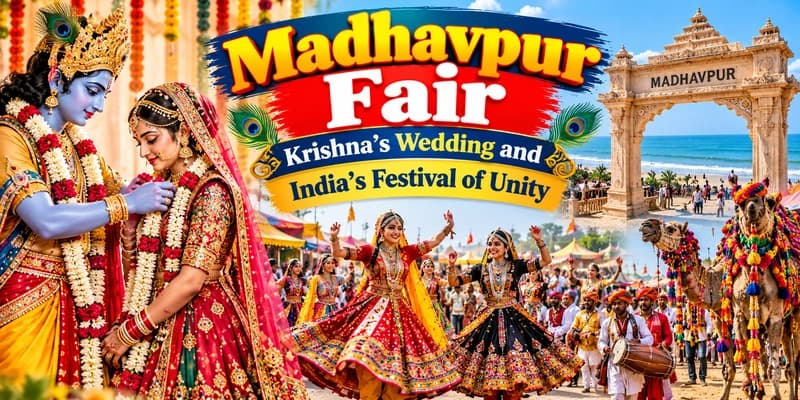
A visit timed for the Madhavpur Fair pairs naturally with the wider Saurashtra coast. Madhavpur lies between Krishna's holy city of Dwarka up the coast and the great temple of Somnath to the southeast, with the port town of Porbandar, birthplace of Mahatma Gandhi, close by. Inland lie the lions of Gir and the heritage of Junagadh and Girnar. Building a few days around the fair lets you combine this once-a-year festival with the region's temples, beaches and wildlife and our best time to visit Gujarat guide helps you plan the surrounding days, since the fair itself falls in the pleasant tail of the winter season.
Tips for visiting the Madhavpur Fair
A few pointers help you make the most of the festival:
Check the Ram Navami date for your year of travel, as the five days shift with the Hindu lunar calendar.
Plan around the rituals you most want to see, such as the Ratri Lagan wedding night or the chariot procession.
Arrive with time to wander the artisan and food stalls and to catch performances from both Gujarat and the Northeast.
Head to Madhavpur Beach for the sand sculptures and beach sports as a lively change from the main stages.
Book transport and any nearby stay well in advance, as the fair draws large crowds.
Entry is free, but carry cash for the handicrafts, handlooms and food at the mela stalls.
Dress modestly and respectfully for the temple rituals at the heart of the festival.
Plan your festival visit
Experience My India can plan a trip built around the Madhavpur Fair, with comfortable transport, a well-timed itinerary that catches the key rituals and performances and a stay arranged within reach of the village. Because Madhavpur sits midway along the coast, our Somnath Dwarka tour packages and wider Gujarat tour packages can weave the festival into a fuller Saurashtra journey taking in Dwarka, Somnath, Porbandar and Gir, with a stay at well-placed Somnath Dwarka hotels. For getting to this part of the coast, see our how to reach Somnath guide.
Related guides
To plan the rest of your visit around the fair, these related guides help:
Related guide | What it covers |
The city beach and promenade at the nearest hub, Porbandar. | |
The sights of the Somnath temple town down the coast. | |
Krishna's holy city up the coast and its key sights. |
Plan your visit
Experience My India can arrange your festival trip and wider Saurashtra journey. Browse more travel guides, message us on WhatsApp or call +91 73006 20809.

Harsh Rawat
Somnath–Dwarka circuit planning
Harsh Rawat runs Somnath Dwarka Tour Package on the ground in Gujarat, part of Experience My India. Since 2018 he has been planning and driving the Somnath–Dwarka circuit — the darshan timings, the road hours between temples and the stops worth adding — and the routes, fares and timings published across this site are the ones he maintains.