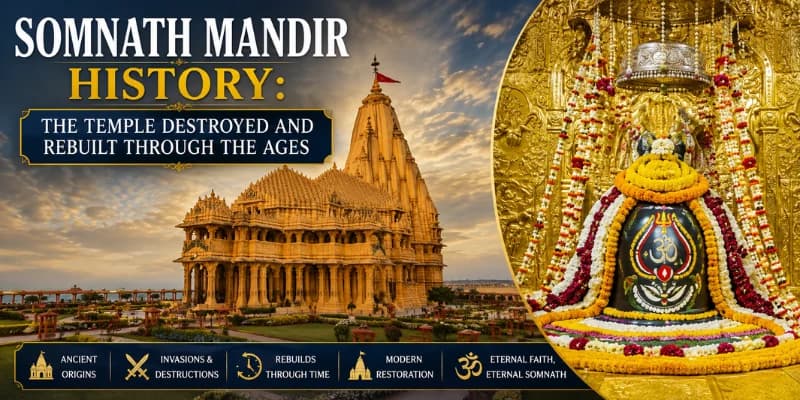
Somnath Mandir History: The Temple Destroyed and Rebuilt Through the Ages
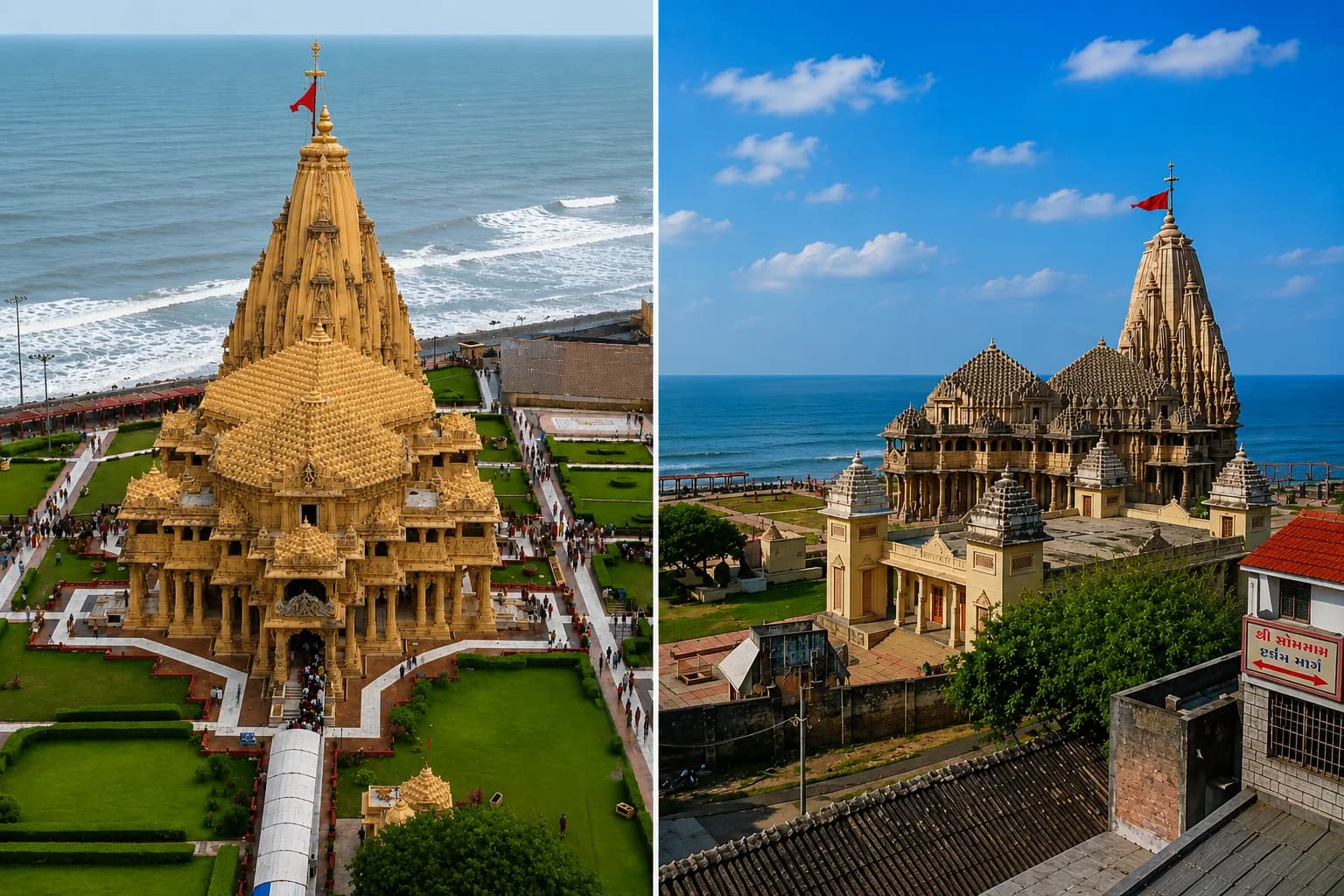
Somnath Temple, the first of the twelve Jyotirlingas of Lord Shiva, is famous for having been destroyed and rebuilt many times across its long history. By tradition the Moon god Soma built the first shrine in gold; historically the temple flourished under the Chaulukya (Solanki) dynasty, was raided by Mahmud of Ghazni in 1024 CE and by later rulers, and the present temple was rebuilt in the Chaulukya style and reconsecrated in 1951 under Sardar Vallabhbhai Patel.
No temple in India carries a story of resilience quite like Somnath's. I was born on this coast and have guided the Somnath circuit for over eight years and the history is what moves visitors most once they know it. Here is that story, keeping faith and documented history clearly apart. To stand where it all happened, our Somnath Dwarka Tour Package from Experience My India takes you to the temple and the sites around it.
The legend of Somnath: the Moon god's golden temple
By tradition, the very first Somnath temple was built by Soma, the Moon god, in gold. The story goes that Soma was cursed to fade away and after worshipping Lord Shiva at this spot on the Prabhas coast he was freed from the curse, his light restored on a waxing and waning cycle. In gratitude he raised a shrine to Shiva as Somnath, the “Lord of the Moon.” Later tellings describe a silver temple by the Sun god and others after him. These origins are matters of faith and Puranic tradition rather than recorded history, but they are why the temple carries its name.
Somnath, the first Jyotirlinga
Somnath is revered as the first of the twelve Jyotirlingas, the self-manifested forms of Lord Shiva, which is why pilgrims from across India come here. It stands at Prabhas Patan on the Arabian Sea, in the Gir Somnath district of Gujarat; for the setting and location see where Somnath sits in Saurashtra. Its wealth and fame in medieval times were immense and that prosperity is central to what happened next.
Who built the Somnath temple? The early temples and dynasties
A shrine at Prabhas is very old; the Gurjara-Pratihara king Nagabhata II recorded visiting the tirtha of Someshvara in Saurashtra in the early ninth century. The temple as a great medieval centre, however, is most associated with the Chaulukya or Solanki, dynasty of Gujarat. Under Chaulukya kings such as Bhima I and later Kumarapala, Somnath received rich royal patronage and grew into one of the wealthiest temples in the land. So when people ask which dynasty built Somnath, the answer for the historic stone temple and for the style of the temple you see today, is the Chaulukya (Solanki) tradition of Gujarat.
The raid of Mahmud of Ghazni, 1024 CE
The most famous episode in Somnath's history came in 1024 CE, during the reign of the Chaulukya king Bhima I, when Mahmud of Ghazni marched into Gujarat and attacked the temple. (Some accounts date the campaign to 1025 to 1026.) Persian chronicles such as the Tarikh-i-Yamini describe the temple's extraordinary wealth and record that Mahmud's forces plundered its treasures and broke the Shivalinga after fierce resistance and heavy loss of life. The raid entered historical memory as a defining moment, but, crucially, the site was not abandoned. It began the long cycle of destruction and renewal that defines Somnath.
Destroyed and rebuilt through the centuries
Somnath's wealth and symbolism made it a repeated target and each time it fell, it was raised again:
After Ghazni's raid, the Chaulukya king Bhima I helped restore the temple and King Bhoja of Malwa is also linked to its rebuilding; later the Chaulukya king Kumarapala rebuilt it grandly in stone in the twelfth century. In 1299 CE the forces of Alauddin Khalji of the Delhi Sultanate attacked it and rulers of the Gujarat Sultanate damaged it again in the centuries that followed. Aurangzeb ordered its destruction in the late seventeenth century. In 1783, Queen Ahilyabai Holkar of Indore built a separate Somnath temple nearby, which still stands, so that worship could continue even as the old site lay in ruins.
By tradition the temple was destroyed and rebuilt seven times; historians document at least six major cycles of destruction and reconstruction. Whatever the exact count, the pattern is clear: Somnath was broken many times and rebuilt every time.
The 1951 reconstruction: a temple reborn
By the nineteenth century, only ruins remained. After India's independence, rebuilding Somnath became a national undertaking. Sardar Vallabhbhai Patel, visiting Junagadh in November 1947, resolved that the temple should rise again and the writer and minister K.M. Munshi drove the project forward. On Mahatma Gandhi's advice, it was funded by public donations rather than state money and the Somnath Trust was formed to collect funds and oversee the work.
The reconstruction carried a political charge of its own: Prime Minister Jawaharlal Nehru had reservations about the state associating itself with a religious project, while others saw the rebuilding as a matter of national self-respect. In the end, on 11 May 1951, Dr. Rajendra Prasad, India's first President, performed the installation ceremony of the Jyotirlinga. The new temple was designed in the traditional Chaulukya (Solanki) style of Gujarat by the master temple architect Prabhashankar Sompura, rising to about 155 feet, its later stages completed over the following years.
Somnath temple today
The Somnath you visit now is that 1951 temple, administered by the Shree Somnath Trust, whose chairman is the Prime Minister of India. Fragments and sculpture from the earlier temples are preserved in the Prabhas Patan Museum nearby, which is one of the sightseeing places in Somnath worth an hour. To plan a visit, see the Somnath temple darshan and aarti timings and how to reach Somnath.
Visit Somnath with Experience My India
If the history moves you, standing before the temple at the evening aarti is unforgettable. Tell us your dates and we will plan the darshan, the tirths and the museum for you. You can start with a Somnath tour, message us on WhatsApp at +91 73006 20809 or call +91 73006 20809. For more, read our full Somnath travel guide.

Harsh Rawat
Somnath–Dwarka circuit planning
Harsh Rawat runs Somnath Dwarka Tour Package on the ground in Gujarat, part of Experience My India. Since 2018 he has been planning and driving the Somnath–Dwarka circuit — the darshan timings, the road hours between temples and the stops worth adding — and the routes, fares and timings published across this site are the ones he maintains.