Underwater Dwarka, Gujarat: The Submerged City, the Science and How to See It
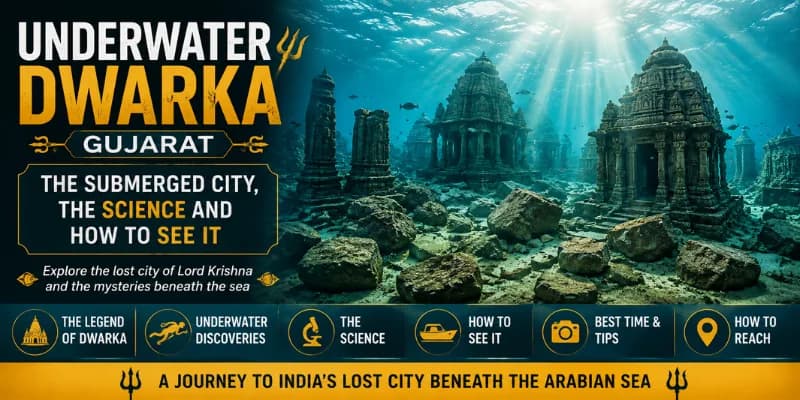
Underwater Dwarka refers to the submerged remains off Gujarat's coast, linked to Lord Krishna's legendary city that sank into the sea. Marine archaeologists have found stone structures and anchors offshore. Today you can view the remains by scuba diving near Bet Dwarka. Experience My India helps plan the trip.
I am Harsh Rawat, born in Dwarka, so the story of the sunken city is one I grew up on. It is part legend, part genuine archaeology and lately part travel experience and travellers ask me about it every single week. I handle these trips for the Somnath Dwarka Tour Package team, the pilgrimage unit of Experience My India. In this guide I have gathered everything worth knowing: the scriptural story, what has actually been found beneath the waves, the honest debate about its age, how you can see it for yourself by scuba diving today and where the much-discussed submarine project really stands. Read on for the honest, complete picture.
Curious about the dive? Message me on WhatsApp for scuba and trip details or call +91 73006 20809.
What Is the Underwater City of Dwarka?
By tradition, Lord Krishna left Mathura and built a magnificent new capital on the far western coast of Gujarat, a city called Dwarka or Dwarkanagari, described in the Mahabharata and the Puranas as a prosperous metropolis of palaces, gardens and gateways, reclaimed from the sea itself. After Krishna departed his earthly form, marking the end of the Dwapara Yuga and the start of the Kali Yuga, the ocean is believed to have slowly taken the city back. That is the legend behind underwater Dwarka and it is why modern Dwarka, one of the four sacred char dham, sits at the edge of a mystery that stretches out beneath the water. For believers it is history; for scientists it is a question; and for a traveller standing on the shore, it is both at once.
What makes Dwarka unusual among India's great legends is that it has not stayed only a legend. Since the twentieth century, serious marine archaeology has gone looking for the city and what it has documented gives the old story a startling physical echo. The rest of this guide separates what is faith, what is evidence and what is still unknown, because the honest version is more interesting than the hype.
What Marine Archaeologists Actually Found
This is where legend meets evidence. From the late 1970s and especially through the 1980s and 1990s, the Marine Archaeology Unit of the National Institute of Oceanography, working with the Archaeological Survey of India, carried out repeated underwater surveys off Dwarka, Bet Dwarka and even Somnath. The celebrated archaeologist Dr S R Rao led much of this work and a major excavation followed in 2007. Using survey boats fitted with underwater cameras, side-scan sonar and airlift equipment and with divers working season after season, they mapped a large area of the sea bed off the Samudranarayan temple. What they recorded at depths of roughly 3 to 12 metres is remarkable.
Dressed stone blocks and what appear to be walls and semicircular fortification structures resting on the sea bed.
More than a hundred stone anchors, including distinctive three-holed and triangular types, the kind used by a large seagoing port, which strongly suggests Dwarka was once a busy harbour.
Pottery, a Late Indus type seal depicting a three-headed animal, an inscribed jar and other antiquities recovered from onshore digs near Bet Dwarka.
Evidence of several distinct settlement phases, hinting at a place that was built, lost and rebuilt many times over a very long span.
Onshore excavations in the Dwarkadhish temple complex itself, back in 1979, revealed the remains of earlier temples beneath the present one and archaeologists have spoken of multiple settlements stacked through the centuries. Taken together, the underwater and onshore finds paint a picture of a genuinely ancient, genuinely maritime Dwarka, whatever its exact age turns out to be.
Is It Really Krishna's Dwarka? The Honest Debate
Here it is worth being honest rather than sensational, because the internet is full of confident claims in both directions. The submerged structures are real and well documented. Their age and identity, however, are genuinely debated among scholars and a good guide should say so.
Several datings place the visible stonework in the historical or medieval period and the discovery of later Gujarati script on one block points to construction well after the Mahabharata era. At the same time, thermoluminescence dating of pottery has yielded ages of roughly 3,000 to 3,500 years, which sits much closer to the traditional timeline and researchers have argued that older foundations could still lie buried beneath accumulated sediment. To complicate matters further, a separate and even more contested set of discoveries in the Gulf of Cambay, further along the Gujarat coast, has been claimed by some to be a submerged settlement over 9,000 years old, though that claim is disputed and is a different site from Dwarka altogether.
So where does that leave us? With something genuinely exciting and genuinely uncertain: there is real ancient settlement beneath these waters, almost certainly an old port, rebuilt across many centuries. Whether every stone belongs to the exact city Krishna is said to have ruled remains an open question. That uncertainty does not diminish the place. If anything, standing above stones that may be thousands of years old, off the coast of the very city the scriptures describe, is more moving for being unresolved.
Can You See Underwater Dwarka? Scuba Diving
Yes and this is the real draw for travellers today. Licensed operators run supervised scuba dives off the Dwarka coast, most commonly near Bet Dwarka island and the Panchkui area, where you can glimpse submerged stonework at shallow depths of around 3 to 6 metres, along with corals and marine life such as turtles, colourful fish and the occasional dolphin. The waters here can be surprisingly clear when conditions are right, especially away from the immediate shore. Interest in the site surged in February 2024, when the Prime Minister scuba dived off the coast and offered prayers at the submerged site, an image that travelled around the country. Dives are seasonal and depend on daily sea conditions, so they are best arranged in advance as part of a one-day Dwarka tour.
You do not need a diving certificate for the introductory, supervised dives most operators offer; a trained instructor accompanies you throughout, gives a short briefing on the surface and manages the descent. Basic swimming comfort helps and anyone with heart, ear or respiratory conditions, as well as pregnant travellers, should check with a doctor first. Scuba diving at Dwarka is relatively affordable compared with famous international sites, though the exact rate varies by operator, season and whether it is a shore or boat dive, so confirm the current price when you book. Bring a change of clothes and a towel and keep valuables ashore.
The Submarine Tourism Project: Where It Really Stands
You may have read that Gujarat plans India's first submarine tourism to view underwater Dwarka, in partnership with Mazagon Dock Shipbuilders, with specially designed submarines meant to carry around thirty passengers down for a window-seat view of the marine world and the submerged site near Bet Dwarka. It is a genuine, officially announced project and it captured headlines when it was first unveiled with a target of Diwali 2024. Set your expectations honestly, though: as of 2026 the project remains in trial, design and regulatory-approval stages and is not yet operational, with public booking not yet open. Until it actually launches, scuba diving is the only real way to see the remains, so treat the submarine as an exciting future addition rather than something you can book today. When it does begin, it will make the underwater world accessible to non-divers, including elders and children, which would be a genuine step forward for the site.
Underwater Dwarka at a Glance
The legend | Krishna's city, said to have submerged after his departure |
Who explored it | NIO Marine Archaeology Unit and ASI; Dr S R Rao; excavation in 2007 |
Key finds | Stone structures, walls and 100-plus anchors at 3 to 12 m depth |
How to see it now | Supervised scuba diving near Bet Dwarka, at 3 to 6 m |
Submarine tourism | Announced with Mazagon Dock, not yet operational as of 2026 |
Best time | October to March for calm, clear water |
How to Plan a Visit
Base yourself in Dwarka and combine the dive with the city's living heritage. The Dwarkadhish temple, Bet Dwarka island and Nageshwar Jyotirlinga all sit close by, so the underwater experience becomes one part of a rich two or three day trip rather than a standalone errand. October to March gives the calmest, clearest water for diving and the most pleasant weather on shore. Book scuba through a licensed operator, ideally in advance, carry a change of clothes and always check conditions on the day, since rough seas can pause diving. Plan it around your Dwarkadhish darshan and see our wider places to visit in Dwarka to fill the rest of the itinerary. A private cab makes moving between the temple, the coast and the island simple, especially with the Sudarshan Setu bridge now connecting Bet Dwarka by road.
Want it all arranged? The Experience My India Dwarka tour packages can add a supervised dive to your Dwarka darshan, with the cab, timing and stay handled.
What I Tell Travellers About the Dive
I am always honest about this one, because managing expectations is what makes people happy. Do not picture a golden palace rising out of glowing blue water; that is a painting, not the sea off Dwarka. What you actually see are stone remains, anchors and marine life at shallow depth and on some days the visibility is modest. But here is the thing: floating above stones that may be thousands of years old, off the coast of Krishna's own city, with the temple flag flying on the shore behind you, is a feeling that stays with people long after the trip. Go in with realistic eyes and an open heart and it becomes unforgettable rather than disappointing. That balance of wonder and honesty is exactly how Experience My India frames the whole underwater Dwarka experience,
Dive into the legend of Dwarka with a local
Chat on WhatsApp Call +91 73006 20809

Harsh Rawat
Somnath–Dwarka circuit planning
Harsh Rawat runs Somnath Dwarka Tour Package on the ground in Gujarat, part of Experience My India. Since 2018 he has been planning and driving the Somnath–Dwarka circuit — the darshan timings, the road hours between temples and the stops worth adding — and the routes, fares and timings published across this site are the ones he maintains.