Blackbuck National Park, Velavadar: Gujarat's Grassland Safari
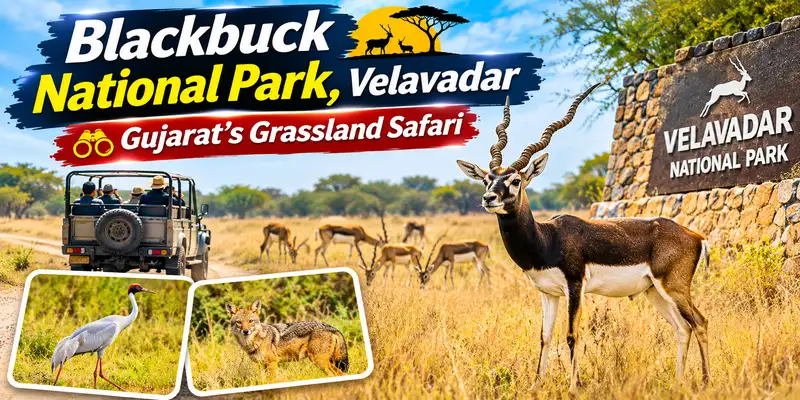
Blackbuck National Park at Velavadar, in the Bhavnagar district of Gujarat, is a roughly 34 sq km grassland sanctuary famous for huge herds of Indian blackbuck, the endangered Indian grey wolf and spectacular winter roosts of migratory harriers. It is open from 16 October to 15 June, with morning and afternoon safari slots and is best visited from November to February. This guide, from Experience My India, covers the safari, timings, wildlife and how to plan your visit.
Away from the forests of Gir, Gujarat holds a very different kind of wild place: the wide golden grasslands of Blackbuck National Park at Velavadar. A protected grassland sanctuary in the Bhal region near the Gulf of Khambhat, it is one of India's finest places to watch blackbuck sprint across open plains, to glimpse the rare Indian grey wolf and to witness thousands of migratory harriers gather at dusk. This guide, from the team behind Somnath Dwarka Tour Package, a unit of Experience My India, covers everything you need to plan a visit: the park's location, its safari timings and season, the wildlife, its history and conservation importance and where to stay, so you can experience one of Gujarat's most special and underrated parks.
Quick facts
Park | Blackbuck National Park, Velavadar |
Location | Velavadar village, Bhavnagar district, Bhal region of Saurashtra, Gujarat |
Area | About 34 sq km of open grassland (vidi) |
Open season | 16 October to 15 June (open daily) |
Monsoon closure | 16 June to 15 October |
Famous for | Indian blackbuck, Indian grey wolf, winter harrier roosts |
Best time | November to February |
Nearest hub | Bhavnagar (nearest airport and railway station) |
Location and how to reach
Blackbuck National Park lies near Velavadar village in the Bhavnagar district, in the Bhal region of Saurashtra, Gujarat. It is a landscape quite unlike the rest of the state's parks: flat, open golden grasslands, known locally as vidi, interspersed with thorn scrub, saline land and coastal wetlands. To the south it adjoins the Gulf of Khambhat, with seasonal tidal mudflats and saline flats, while elsewhere it borders agricultural fields, wastelands and seasonal streams such as the Parvalia and Alang. The park is served by road from Bhavnagar city and from Ahmedabad and Bhavnagar has the nearest airport and railway station, making it the natural gateway. The drive from Bhavnagar is short and from Ahmedabad it is an easy half-day trip, which makes Velavadar a feasible addition to a wider Gujarat itinerary.
Timings and open season
Like most Indian parks, Velavadar follows a fixed annual season and daily safari windows. The park is open from 16 October to 15 June, every day including weekends and closed each year through the monsoon from 16 June to 15 October. Within the open season, the Forest Department runs morning and afternoon or evening slots and the exact hours shift between winter and summer:
Open season | 16 October to 15 June, daily |
Monsoon closure | 16 June to 15 October |
Winter hours (Oct 16 to end Feb) | 6:30 AM to 11:30 AM and 2:00 PM to 7:00 PM |
Summer hours (Mar 1 to Jun 15) | 6:00 AM to 11:00 AM and 2:30 PM to 7:30 PM |
Safari rounds | Typically about 3 hour blocks within these windows |
Individual safari rounds usually run in roughly three-hour blocks within these windows, so it pays to arrive at the forest office or gate early, especially for the sunrise drives when wildlife is most active. The best time to visit overall is November to February, for pleasant weather, active wildlife and the peak winter congregations of migratory birds, above all the harriers. Early morning and late afternoon or evening are the prime hours for spotting wolves, hyenas and blackbuck.
The safari experience
A Velavadar safari is a distinctive experience precisely because the terrain is so open. Safaris operate by open Gypsy or private vehicle and a registered forest guide is mandatory inside the park, both to navigate and to help you spot and understand the wildlife. Unlike a dense forest park, where sightings are fleeting glimpses through trees, Velavadar's flat grasslands give long, unobstructed views of animals running, grazing and hunting across the plains, which is a thrill in itself and a dream for photographers. The rhythm is similar to the safari at Gir National Park, Gujarat's famous lion reserve, but the feel could not be more different: here the drama plays out across a vast open horizon rather than in the shade of the forest. Watching a herd of blackbuck break into their soaring, leaping run across the golden grass is one of Indian wildlife's great sights.
Wildlife at Velavadar
For its size, Velavadar packs in remarkable wildlife, all adapted to the grassland and its edges:
Indian blackbuck: the park protects one of the largest concentrated populations of the Indian blackbuck, Antilope cervicapra, anywhere, with herds moving across the wide-open plains; the males' spiralling horns and leaping gait are unforgettable.
Indian grey wolf: Velavadar is a vital habitat for the endangered Indian grey wolf and it is one of the better places in India to hope for a sighting of this elusive grassland predator.
Striped hyena and jackal: striped hyenas and golden jackals roam the park, most active around dawn and dusk.
Smaller mammals: jungle cats, Indian foxes, wild boar and nilgai, the large blue bull antelope, are also found here.
Grassland character: the mix of a thriving prey base and resident predators makes Velavadar a genuine working grassland ecosystem, not just an antelope park.
A paradise for birdwatchers
Velavadar is renowned among birdwatchers, above all for one of the world's great raptor spectacles. In winter the park supports large roosts of migratory harriers, often numbering in the thousands, which gather in the grasslands at dusk in one of the largest such congregations anywhere, a breathtaking sight as the birds stream in to settle for the night. The park is also important habitat for the Lesser Florican, a rare and threatened grassland bird and it hosts a wide variety of raptors, waders and wetland and grassland birds, drawn by the mix of grassland, saline flats and coastal wetland. For keen birders, a winter evening at Velavadar watching the harriers come in to roost is reason enough to make the journey and it complements the mammal safari beautifully.
Wildlife photography at Velavadar
Few Indian parks are as rewarding for photography as Velavadar and again it comes down to the open terrain. Because the landscape is flat grassland with minimal dense tree cover, photographers get long, unobstructed sightlines of animals running, grazing and hunting, with clean backgrounds and beautiful low light at dawn and dusk. The golden grass, the big skies and the leaping blackbuck make for striking images and the chance to frame a wolf or a harrier roost against an open horizon is rare in India. Morning and evening drives give the warmest light and the most activity, so serious photographers should plan for both and a registered guide can position the vehicle well for the best angles.
History of the park
Velavadar's story reflects a shift from royal hunting ground to conservation success. Historically, the area was a private grassland reserve, a vidi, of the Maharaja of the princely state of Bhavnagar, where blackbuck were hunted using trained hunting cheetahs, a striking image of a vanished era. After independence and the recognition of the blackbuck's decline, the area was established as a national park in July 1976, initially covering about 18 sq km, specifically to protect the species. It was expanded in 1980 by adding roughly 16 sq km, bringing the protected area to about 34 sq km as it stands today. This journey, from a hunting reserve to a dedicated national park, mirrors the wider story of Indian wildlife conservation and has secured one of the country's most important grassland habitats.
Ecological and conservation significance
Velavadar's importance goes well beyond its charismatic animals. Unlike the forest-dominated parks that attract most attention, it preserves a rare, flat semi-arid tropical and saline grassland ecosystem in western India, a habitat often overlooked despite its high biodiversity value. Grasslands are among the most threatened and least protected ecosystems in India, so a park dedicated to one is genuinely significant. Within it, Velavadar safeguards a stronghold population of blackbuck, a vital refuge for the endangered Indian grey wolf and globally important winter roosts for harriers, making it a park of national and international conservation value. Visiting responsibly supports this grassland conservation and it broadens any Gujarat wildlife trip beyond the well-known lions of Gir, where a monsoon visit has its own rules, to a wholly different and equally precious landscape.
Where to stay near Velavadar
Accommodation near Velavadar ranges from simple to luxurious, so you can choose to suit your budget and style. The Forest Department offers rest house and guest house options near the park, serving vegetarian food only and availability should be checked well in advance as rooms are limited. Around Velavadar, a number of lodges and resorts cater to wildlife travellers, ranging from mid-range to luxury, including well-regarded names such as The Blackbuck Lodge, Blackbuck Safari Lodge and Trulyy The Blackbuck Trails. Staying close to the park lets you be at the gate for the prime dawn and dusk drives without a long transfer, which makes a real difference to your sightings. For a wider trip, Bhavnagar city offers a fuller range of hotels a short drive away.
Planning your Velavadar visit
Velavadar fits neatly into a broader Gujarat journey. It pairs naturally with Bhavnagar and can be combined with the Saurashtra temple and wildlife circuit, including Gir and the coast. Entry and safari costs are modest, with vehicle entry fees varying by vehicle type, nationality and weekday versus weekend, a mandatory guide fee and camera charges in some cases, while a full Gypsy safari package generally runs a few thousand rupees per vehicle depending on the operator and season. Because the park is open grassland, a half-day with a morning or evening drive can be very rewarding, though two drives give the best chance of wolves and the harrier roost. To weave Velavadar into a longer tour taking in temples, wildlife and the coast, our 7 days Gujarat tour itinerary guide is a good starting point.
Plan your Gujarat wildlife trip
Experience My India can plan a Gujarat wildlife journey that includes Blackbuck National Park at Velavadar alongside Gir and the temples and coast of Saurashtra, with permits and guides arranged, a comfortable stay and a well-paced itinerary. Our Somnath Dwarka tour packages and wider Gujarat tour packages can build the park into a fuller trip, with a stay at well-placed hotels and comfortable local transport throughout, so you can focus on the wildlife rather than the logistics.
Related guides
To plan your Gujarat wildlife trip further, these related guides help:
Related guide | What it covers |
Gujarat's flagship big cat, found only at Gir. | |
Planning a safari at Gir, easily paired with Velavadar. | |
Sights and day trips around the Gir region. |
Plan your visit
Experience My India can arrange your Gujarat wildlife trip and wider Saurashtra journey. Browse more travel guides, message us on WhatsApp or call +91 73006 20809.

Harsh Rawat
Somnath–Dwarka circuit planning
Harsh Rawat runs Somnath Dwarka Tour Package on the ground in Gujarat, part of Experience My India. Since 2018 he has been planning and driving the Somnath–Dwarka circuit — the darshan timings, the road hours between temples and the stops worth adding — and the routes, fares and timings published across this site are the ones he maintains.