The Asiatic Lion of Gir: Facts, Population and Where to See It
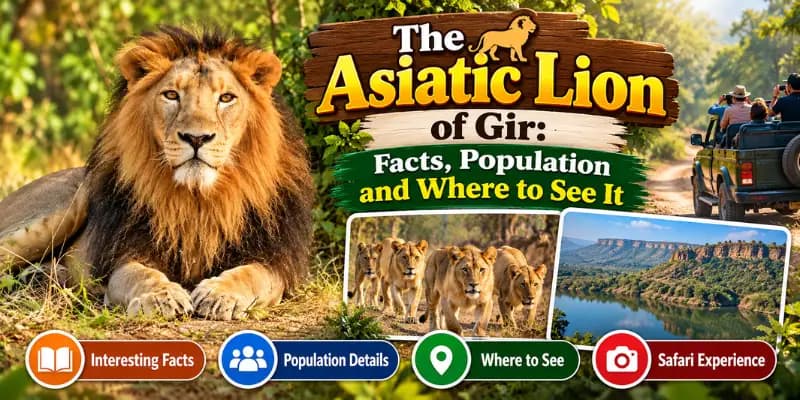
The Asiatic lion, Panthera leo leo, lives in the wild only in the Gir landscape of Gujarat, making Gir the last refuge on Earth for this subspecies. The 2025 census recorded 891 lions, a 32 percent rise in five years. Smaller and with a sparser mane than the African lion, it is best seen on a gypsy safari in Gir.
The Asiatic lion is one of the rarest and most magnificent big cats in the world and seeing it in the wild is the great draw of Gir National Park. This guide, from the team behind Somnath Dwarka Tour Package, a unit of Experience My India, covers the Asiatic lion: what it is, how it differs from the African lion, its remarkable conservation story and the 2025 population and where and when to see it in Gir.
What is the Asiatic lion?
The Asiatic lion, scientifically Panthera leo leo, is a subspecies of lion that today survives in the wild only in the Gir landscape of Saurashtra, in Gujarat, India. This makes Gir National Park the absolute last refuge on Earth for the Asiatic lion, a distinction that gives the region its global significance. Historically, these lions ranged widely across the Middle East, through Persia and Arabia and into eastern India, but hunting and habitat loss drove them to the very edge of extinction, until only a tiny population survived in the Gir forest. From that brink, decades of determined conservation have brought the Asiatic lion back, so that today it is a conservation success story admired the world over. To see the Asiatic lion in Gir is to see a species that was almost lost, surviving in the one place on the planet it still calls home.
The Asiatic lion at a glance
Species | Asiatic lion, Panthera leo leo |
Only wild home | The Gir landscape, Gujarat, India |
2025 population | 891 lions, up 32 percent in five years |
Status | Endangered, a global conservation success story |
Where to see | Gir National Park, on a gypsy safari |
Best months | November to March; April to May for sightings |
How the Asiatic lion differs from the African lion
The Asiatic lion and the African lion are close cousins, but a trained eye or an informed visitor, can tell them apart by several distinctive features. The key differences are:
The belly fold. The most reliable distinguishing feature is a prominent, longitudinal fold of skin running along the belly, which the African lion usually lacks. This is the classic mark of the Asiatic lion.
A smaller body frame. The Asiatic lion is generally a little smaller and more compact than its larger African cousin.
A shorter, sparser mane. Male Asiatic lions have a shorter and sparser mane than African males, so their ears usually remain visible, which is a quick way to tell them apart.
A larger tail tuft. The Asiatic lion tends to have a larger tuft at the end of its tail, another subtle distinguishing feature.
These differences are the result of long separation and adaptation to the dry deciduous forest of Gir, quite different from the open savannah of Africa. For visitors, spotting the belly fold and the ear-revealing mane is a satisfying way to appreciate that this is the rare Asiatic lion, found nowhere else in the wild.
The Asiatic lion population: the 2025 census
The story of the Asiatic lion's numbers is one of the great wildlife recoveries of our time. Having come close to extinction, with only a handful of lions surviving in the early 20th century, the population has climbed steadily under protection. The latest census, carried out in 2025, recorded a record 891 lions in the Gir landscape, an impressive rise of about 32 percent over the previous five years, when the 2020 count stood at 674. This growth reflects decades of conservation, the protection of the Gir forest, the management of prey and water and the involvement of local communities. The lions have also expanded their range well beyond the core Gir National Park, spreading across the wider Saurashtra landscape, including coastal and agricultural areas, a sign of a thriving and growing population. Every census confirms Gir as one of the world's most successful big-cat conservation stories and a source of great pride for Gujarat and for India, which has brought a species back from the very edge of extinction.
Census year | Asiatic lion population |
2015 | About 523 |
2020 | About 674 |
2025 | About 891 |
Why Gir is the last home of the Asiatic lion
Gir is the one place on Earth where the Asiatic lion still roams wild and the reasons lie in both history and geography. The dry deciduous forest of Gir, with its mix of woodland, grassland, rivers and abundant prey such as deer, antelope and nilgai, provides the ideal habitat for the lions. When the subspecies was almost wiped out elsewhere, the last few lions survived here, in part thanks to early protection by the Nawab of Junagadh, who banned their hunting. Since then, the forest has been protected as a sanctuary and national park and the lions have been nurtured back from the brink. The Gir forest is thus not just a wildlife destination but a living ark, the sole guardian of a species that once ranged across three continents. This is what makes a visit to Gir so special and so meaningful, for every lion seen here is a living link to a species that humanity nearly lost forever and chose, instead, to save.
When to see the Asiatic lion in Gir
The best time to see the Asiatic lion depends on what you want from the trip and the Gir safari season runs from mid-October to mid-June, with the park closed in the monsoon. The two main windows are the pleasant peak season and the hot high-sighting season, as covered in our best time to visit Gir guide:
Window | What to expect |
November to March (peak season) | The best weather, crisp and cool; comfortable safaris, light layers for morning drives |
April to May (high sighting window) | Hot, but the best chances of sightings as lions gather near shrinking waterholes |
16 June to 15 October (closed) | The core park is completely closed for the monsoon and breeding season |
So for the most pleasant trip, visit in the cool winter months; for the very best chance of a sighting, the dry heat of April and May concentrates the lions around the remaining water, where they are easier to find. Whenever you go, the early morning is best, as lions are primarily nocturnal hunters and are far more active, vocal and mobile before the daytime heat sets in and they settle into the shade to rest.
How to see the Asiatic lion: the Gir safari
To witness the Asiatic lion in its natural habitat, visitors take an open-top gypsy safari through the dry deciduous forest zones of Gir. The safaris run in the morning and afternoon and the early morning slot, from about 6:30 AM, is the best for an active lion. Permits are limited by government quota to protect the forest, booked in advance through the official Gujarat online permit system, with each gypsy holding a maximum of 6 adults and 1 child and every traveller must carry the original photo ID that matches the permit. The costs and the booking are covered in our Gir safari ticket price guide. For a near-guaranteed sighting, the fenced Devalia Safari Park or Gir Interpretation Zone, is an excellent alternative or addition. Book months in advance, as peak dates can sell out 30 to 60 days ahead.
Tips for seeing the Asiatic lion
A few pointers improve your chances and your experience:
Book your Gir safari permit months in advance, as peak dates sell out 30 to 60 days ahead.
Choose the early morning slot, around 6:30 AM, when lions are most active, vocal and mobile.
Carry the original photo ID that exactly matches the name on your permit, for every traveller.
Visit April to May for the best sighting odds or November to March for the most pleasant weather.
Do two or more safaris if you can, as sightings are never guaranteed on a single drive.
Add the fenced Devalia zone for a near-certain lion sighting, especially with children.
Plan your Gir lion safari
Experience My India can plan a Gir trip built around seeing the Asiatic lion, with the safari permit, transport and the itinerary arranged. Combine your Gir lion safari with the Somnath temple and Dwarka, book Somnath Dwarka hotels and let the Experience My India Somnath Dwarka tour packages or the wider Gujarat tour packages include Gir and the region in your itinerary, with the safari booking handled for you.
Related guides
To plan the rest of your Gir and Saurashtra trip, these related guides help:
Related guide | What it covers |
Air, rail and road access to Sasan Gir. | |
The drive from the Somnath coast to Gir. | |
The fort city and sacred mountain near Gir. | |
The summit temple on the sacred Girnar mountain. | |
The sights of the Somnath temple town nearby. | |
The top sights and spots around Dwarka. |
Plan your visit
Experience My India can arrange your Gir lion safari and Saurashtra trip. Browse more travel guides, message us on WhatsApp or call +91 73006 20809.

Harsh Rawat
Somnath–Dwarka circuit planning
Harsh Rawat runs Somnath Dwarka Tour Package on the ground in Gujarat, part of Experience My India. Since 2018 he has been planning and driving the Somnath–Dwarka circuit — the darshan timings, the road hours between temples and the stops worth adding — and the routes, fares and timings published across this site are the ones he maintains.