Damodar Kund Junagadh: The Sacred Reservoir at the Foot of Girnar
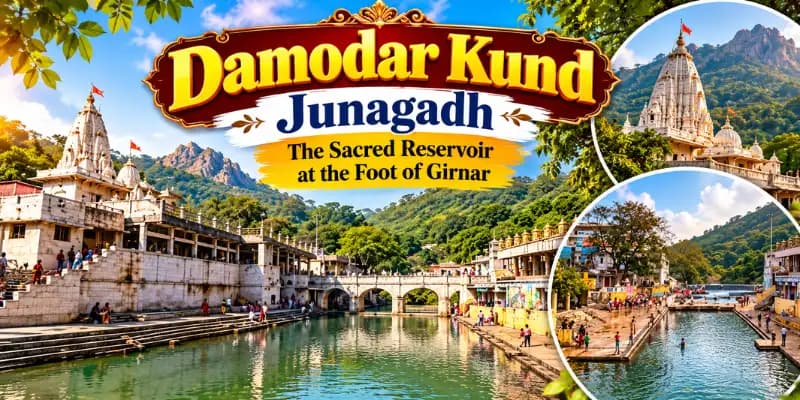
Damodar Kund, on the Junagadh-Girnar Road at the foot of the Girnar hills, is one of India's holiest sacred reservoirs, revered for ancestral rites and for a purifying dip before the Girnar climb. Tied to the saint Narsinh Mehta and to Lord Krishna as Damodar, it is a key spiritual gateway. This guide, from Experience My India, covers its significance and how to visit.
Damodar Kund is one of the most sacred water bodies in all of Gujarat, a holy reservoir set at the foothills of the Junagadh Girnar hills along the Sonrekh or Suvarnarekha, River, revered for centuries as a spiritual gateway for pilgrims before they begin the demanding climb up Mount Girnar. For devout Hindus it ranks among the country's holiest waters. This guide, from the team behind Somnath Dwarka Tour Package, a unit of Experience My India, explains the religious significance of Damodar Kund, its links to the saint Narsinh Mehta and to Lord Krishna, the temples and landmarks around it and how to visit.
What is Damodar Kund?
Damodar Kund is a highly sacred Hindu water reservoir located at the foothills of the Girnar hills, on the Junagadh-Girnar Road in Junagadh, Gujarat, along the course of the Sonrekh or Suvarnarekha, River. A large rectangular tank of about 257 feet in length and 50 feet in width, surrounded by well-built stone ghats, it has been a place of pilgrimage and worship for well over a thousand years. Its position is deeply meaningful, for it sits at the very threshold of the sacred Mount Girnar, so that pilgrims traditionally pause and purify themselves here before setting out on the long climb to the holy peaks above. More than a scenic tank, Damodar Kund is a living centre of faith, where the everyday rhythms of bathing, prayer and ancestral rites continue as they have for generations, in the shadow of one of India's most revered mountains. To understand Damodar Kund is to understand the spiritual gateway to Girnar itself.
Damodar Kund at a glance
What it is | A highly sacred Hindu water reservoir and ghat |
Location | Junagadh-Girnar Road, at the foot of the Girnar hills |
River | The Sonrekh or Suvarnarekha, River |
Size | About 257 feet long and 50 feet wide |
Revered for | Ancestral rites and purifying bathing |
Linked to | Saint Narsinh Mehta and Lord Krishna as Damodar |
Role | The spiritual gateway before the Girnar climb |
A holy water for ancestral rites
Among its most profound roles, Damodar Kund is considered one of India's holiest waters for ancestral rites, spoken of in the same breath as Haridwar and Prayag. The water of the kund is traditionally believed to have the power to dissolve human bones and so Hindus from across the country bring the cremation ashes and remaining bones of departed loved ones here for immersion, the rite known as asthi-visarjan. In doing so they believe they help grant the departed souls moksha, liberation from the cycle of birth and rebirth, the deepest hope of the tradition. For countless families, a journey to Damodar Kund is therefore a solemn and loving duty, a final act of devotion for those they have lost, performed at one of the most sacred spots the faith knows. This gives the kund an atmosphere of deep reverence and visitors should be respectful of the families and priests engaged in these sacred and personal rites by the water.
Holy bathing before the Girnar climb
Damodar Kund is also revered as a place of purifying bathing. Taking a dip in its sacred waters is traditionally believed to wash away one's earthly sins and pilgrims have long bathed here before beginning the ascent of the holy peaks of Girnar. This makes the kund the natural first stop on the Girnar pilgrimage, where the devout cleanse body and spirit before the thousands of steps that lead up to the shrines above, including the Dattatreya temple at the summit. The ritual bath and the climb are two parts of a single act of devotion, the one preparing the pilgrim for the other. Whether or not you take part, understanding this connection explains why Damodar Kund is always busy with pilgrims and why it holds such a cherished place in the spiritual landscape of Girnar.
The connection to saint Narsinh Mehta
Damodar Kund is deeply intertwined with the life of Narsinh Mehta, the beloved fifteenth-century Vaishnava poet-saint of Gujarat, one of the greatest figures of the region's devotional tradition. According to local folklore, Narsinh Mehta would walk down to the kund every morning to bathe in its sacred waters and it is said that he composed his famous prabhatiyas, his morning devotional hymns, right here on these very ghats. To stand by the water is thus to stand where some of Gujarat's most cherished devotional poetry is believed to have been born, sung at dawn by a saint whose songs are still loved across the state today. This association lends Damodar Kund a special warmth and cultural depth beyond its ritual importance, connecting it not only to the great myths and rites of the faith but to a real and tender human story of devotion, poetry and daily prayer by the holy water.
The mythological origins of Damodar Kund
Local mythology links Damodar Kund to Lord Krishna himself, worshipped here in his form as Damodar, which gives the kund its name. One cherished legend holds that when the gods Brahma and Indra performed grand sacrifices at this sacred shrine, all of India's holy rivers, including the Ganga, the Yamuna and the Saraswati, manifested within this single reservoir in response. This belief, that the waters of all the sacred rivers are present together in the kund, is part of why a dip here is held to be so purifying and so spiritually powerful, as if bathing in every holy river of the land at once. Such myths are the living soul of a place like Damodar Kund, carried down the generations and renewed each time a pilgrim descends the ghats to the water. They explain the depth of reverence the kund commands and set it firmly among the great sacred waters of Hindu India, here at the foot of Girnar.
Temples and landmarks around the kund
The reservoir is surrounded by a well-built ghat and several ancient temples and sacred spots that give it a serene, spiritual atmosphere:
Damodar Hari Temple. Built of pink sandstone and dedicated to Lord Vishnu as Damodar, this ancient temple stands right beside the kund. Historical evidence suggests it was renovated as early as 462 AD by Chakrapalita, a governor under the emperor Skandagupta, a mark of its great antiquity.
Revati Kund and Mrigi Kund. These are smaller connected reservoirs nearby where devotees also take ritual dips, adding to the sacred complex around the main kund.
Muchukunda Cave. A nearby sacred cave tied to the myth of King Muchukunda, who is said to have slept there after helping the gods win a celestial war, one of the old legends woven into this holy landscape.
Together these landmarks make Damodar Kund not a single tank but a whole sacred precinct, rich in temples, legend and centuries of devotion, well worth exploring slowly as part of a Girnar pilgrimage.
Festivals at Damodar Kund
Damodar Kund and its surroundings become especially vibrant at certain times of the year. The site draws great crowds during the annual Mahashivratri Mela, the vast fair held in the nearby Bhavnath temple precinct at the foot of Girnar, which fills the whole area with pilgrims, sadhus and naga ascetics, as covered in our Bhavnath Mahadev Temple guide. The kund is also thronged on the Amavasya, the new moon day, of the Bhadarva month, a particularly auspicious time for ancestral rites and bathing, when millions of devotees and holy men gather. At these peak times the atmosphere is extraordinary, a sea of faith around the ancient water, though the crowds are immense, so pilgrims and visitors should plan carefully. At quieter times the kund offers a more peaceful, contemplative experience of the same sacred place.
How to reach Damodar Kund
Damodar Kund lies on the Junagadh-Girnar Road, at the foot of the Girnar hills, a short drive from the centre of Junagadh and on the way to the base of the Girnar climb. It is easily reached by auto-rickshaw or taxi from anywhere in the city and it naturally forms part of the route towards the Girnar Ropeway and the mountain shrines. For a comfortable way to combine the kund with the rest of the Girnar and Junagadh sights, our Somnath Dwarka taxi service can include it and the approach to the mountain is covered in our Junagadh to Girnar guide. Because the kund is right on the Girnar road, it is simplest to visit it first, on the way to the mountain, exactly as the pilgrims traditionally do.
Combining Damodar Kund with the Girnar pilgrimage
Damodar Kund is best understood and enjoyed as the opening chapter of a Girnar pilgrimage, the sacred threshold before the mountain. From the kund, pilgrims go on to the base of Girnar and climb or ride the ropeway, to the Jain and Hindu shrines on the peaks, with the Dattatreya Temple at the summit. The wider circuit of the mountain is the Girnar Parikrama and the great fair at its foot is the Mahashivratri Mela. Beyond the sacred sites, Junagadh offers the mighty Uparkot Fort, the Darbar Hall Museum, the Sakkarbaug Zoo and the scenic Willingdon Dam, so that a visit to Damodar Kund sits within one of the richest sightseeing and pilgrimage destinations in all of Gujarat.
Tips for visiting Damodar Kund
A few pointers help you visit respectfully and well:
Visit in the early morning for a peaceful, contemplative experience and to follow the pilgrims' tradition of a dawn visit.
Be respectful of families and priests performing ancestral rites by the water, as these are solemn and deeply personal.
Dress modestly, as this is an active and revered place of worship, not merely a sightseeing spot.
Visit the kund first, on the way to the mountain, as pilgrims traditionally bathe here before the Girnar climb.
Expect vast crowds during the Mahashivratri Mela and on the Bhadarva Amavasya and plan carefully for those peak days.
Take time to see the ancient Damodar Hari temple and the smaller Revati and Mrigi kunds around the main reservoir.
Combine the visit with the Girnar shrines and Junagadh's other sights for a full spiritual and sightseeing day.
Plan your Girnar pilgrimage
Experience My India can plan your Girnar pilgrimage around Damodar Kund, the mountain shrines and the great fair, with comfortable transport and well-timed visits that respect the rituals and the crowds. You can combine the Girnar pilgrimage with the Somnath temple and Dwarka, stay at well-placed Somnath Dwarka hotels and let the Experience My India Somnath Dwarka tour packages or the wider Gujarat tour packages bring the sacred waters of Damodar, the peaks of Girnar and the holy coast of Saurashtra together in one deeply meaningful journey.
Related guides
To plan the rest of your Junagadh and Saurashtra trip, these related guides help:
Related guide | What it covers |
The best season for Junagadh, Girnar and the state. | |
The sights of the Somnath temple town nearby. | |
The ornate Nawabi mausoleum in Junagadh city. |
Plan your visit
Experience My India can arrange your Girnar pilgrimage and wider Saurashtra journey. Browse more travel guides, message us on WhatsApp or call +91 73006 20809.

Harsh Rawat
Somnath–Dwarka circuit planning
Harsh Rawat runs Somnath Dwarka Tour Package on the ground in Gujarat, part of Experience My India. Since 2018 he has been planning and driving the Somnath–Dwarka circuit — the darshan timings, the road hours between temples and the stops worth adding — and the routes, fares and timings published across this site are the ones he maintains.