Darbar Hall Museum Junagadh: The Royal Treasure of the Nawabs
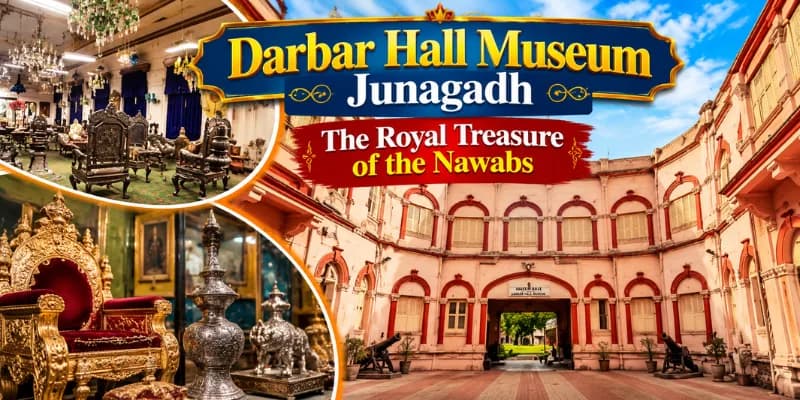
The Darbar Hall Museum, officially the Junagadh Museum, holds over 2,900 royal artifacts of the Babi dynasty inside the historic Taj Manzil near Sardar Baug. Reopened in 2026 with 11 new galleries, it showcases the Nawabs' opulent Darbar Hall, weapons, and famous dog collection. This guide, from Experience My India, covers the highlights and how to visit.
The Darbar Hall Museum is one of the great heritage treasures of Junagadh Girnar, a glittering window into the lost world of the Nawabs who once ruled this princely state. Officially the Junagadh Museum, it houses an opulent collection of royal splendour, from a silver-plated throne to the beloved dogs of the last Nawab. This guide, from the team behind Somnath Dwarka Tour Package, a unit of Experience My India, covers what the Darbar Hall Museum is, its magnificent galleries and highlights, the recent renovation and all the visitor information you need to plan your trip.
What is the Darbar Hall Museum?
The Darbar Hall Museum, officially known as the Junagadh Museum, is one of Gujarat's premier heritage destinations, housing an opulent repository of over 2,900 royal artifacts from the Babi dynasty, the family of Nawabs who ruled Junagadh. It is located inside the historic Taj Manzil building near Sardar Baug, a structure that originally served as a grand courthouse and palace where the Nawabs of Junagadh held their state assemblies or darbars, which is how the museum takes its name. To walk through it is to step into the daily grandeur of a princely court, surrounded by the throne, the weapons, the furniture and the personal treasures of the rulers who governed this corner of Saurashtra until it joined India. For anyone interested in the royal history of Gujarat, the Darbar Hall Museum is an essential and richly rewarding stop, a place where the opulence of the Nawab era survives intact behind the walls of their own palace of justice.
The Darbar Hall Museum at a glance
Official name | Junagadh Museum (Darbar Hall Museum) |
What it holds | Over 2,900 royal artifacts of the Babi dynasty |
Building | The historic Taj Manzil, a former courthouse and palace |
Location | Near Sardar Baug, Junagadh, Gujarat |
Galleries | 11 newly curated thematic galleries since 2026 |
Famous for | The Darbar Hall, weapons and the Nawab's dog collection |
Access | Fully wheelchair accessible after renovation |
The 2026 renovation and 11 new galleries
The Darbar Hall Museum recently underwent a major transformation. A comprehensive renovation costing about 2.14 crore rupees, handled by Savani Heritage Conservation, saw the museum officially reopen to the public on 22 August 2026. The upgrades reorganised the layout into 11 newly curated thematic galleries, fitted with interactive digital displays and addressed long-standing maintenance issues to fully modernise the visitor experience. The result is a heritage museum that now matches its priceless collection with a presentation worthy of it, where each gallery tells a clear chapter of the Nawabi story and digital displays bring the artifacts to life. Importantly for visitors, the renovation also made the building fully accessible, with smooth custom ramp systems throughout, so the royal treasures can now be enjoyed by everyone. If you visited the museum years ago, it is well worth returning, as the experience today is thoroughly renewed while the authentic grandeur of the original palace remains at its heart.
The Darbar Hall: the crown jewel
The Darbar Hall itself is the crown jewel of the palace and the heart of the museum. This is the grand assembly chamber where the Nawabs once held court and it has been preserved in all its glittering splendour. Beneath magnificent crystal chandeliers that once lit the court on ceremonial nights hang grand oil paintings and gilded mirrors, while the centrepiece is a silver-plated throne from which the Nawab presided over his darbar. Around it stand items of royal furniture, the chairs, tables and furnishings of a princely court, all speaking of the luxury and ceremony of the Nawab era. Standing in this hall, it is easy to imagine the assemblies that once filled it, the nobles and petitioners, the ceremony and the power. It is the single most atmospheric space in the museum and the reason the whole institution carries the name Darbar Hall, a room that has held onto the grandeur of a vanished age.
The Weapons Gallery
The Weapons Gallery is one of the museum's most popular sections, housing a formidable royal armoury that reflects the martial heritage of the Nawabs and their court. On display is an impressive array of antique armour, pistols, revolvers and beautifully ornate swords and daggers, the fine weapons of princes and warriors. Alongside the conventional arms are rare and curious specialty items that always draw interest, including cleverly disguised stick guns and the weapons known as tiger nails, the small, claw-like blades of legend. Together the collection gives a vivid sense of both the warfare and the craftsmanship of the era, for these are not merely weapons but works of art, inlaid, engraved and finely wrought for royal hands. The Weapons Gallery is a highlight for visitors of all ages and a window onto the harder, more martial side of the princely world that the glittering Darbar Hall only hints at.
The famous Canine Collection
Perhaps the most uniquely famous gallery in the whole museum is its Canine Collection, a charming and unusual tribute that surprises and delights every visitor. This gallery documents, through photographs and paintings, the last ruling Nawab of Junagadh, Mohammad Mahabat Khanji III, together with his numerous prized and beloved dogs. The last Nawab was famously devoted to his dogs, keeping a great many of them in considerable style and the collection captures this remarkable passion in affectionate detail. It is a quirky, human and endearing counterpoint to the grandeur elsewhere in the museum, a reminder that behind the throne and the ceremony was a ruler with a very particular love. The Canine Collection has become one of the museum's signature attractions and a favourite talking point and it pairs naturally with a visit to the Nawab's own resting place, the extraordinary Mahabat Maqbara, one of the finest mausoleums in Gujarat.
The diamond-woven carpet
Among the museum's most extraordinary single exhibits is its massive, intricate carpet, a true masterpiece of craftsmanship. This enormous hand-woven carpet, richly patterned and remarkable in both scale and detail, carries a fascinating story, for it was entirely hand-woven by the inmates of the local Junagadh Jail. That such a work of patience and artistry came from the prison gives it a special poignancy and makes it one of the most talked-about pieces in the collection. Visitors often stand before it taking in the sheer labour and skill the weaving represents, the months of work by many hands to produce a single magnificent object. It is a reminder that the treasures of a princely state were made not only by court artisans but by ordinary people of great skill and it stands today as both a decorative marvel and a human story woven into the fabric of the museum.
Royal transit rooms and textiles
Beyond the throne room and the galleries, the museum's royal transit rooms display the means and the finery by which the Nawabs moved and dressed. Here you will find silver-plated ceremonial palanquins, in which royalty was once carried in state and howdahs, the ornate seats mounted on elephants for grand processions, both evoking the pageantry of princely travel. Alongside them are collections of intricately tailored royal textiles and robes, the garments of the court, finely worked and richly coloured, that clothed the Nawabs and their household. These rooms complete the picture of royal life, showing not just how the Nawabs ruled and fought, but how they travelled, processed and presented themselves to their people. The palanquins and howdahs in particular are striking, tangible links to an age of elephants and ceremony and they make the royal world of old Junagadh feel vividly real.
Visitor information: timings, fees and closure
Here is the practical information you need to plan your visit to the Darbar Hall Museum:
Location | Taj Manzil, Nagar Road, Shashikunj, Junagadh 362001 |
Operating hours | Thursday to Tuesday, 9:00 AM to 12:00 PM and 3:00 PM to 6:00 PM |
Midday break | The museum closes between 12:00 PM and 3:00 PM |
Weekly closure | Closed every Wednesday, some public holidays and alternate Saturdays |
Entry fee | A nominal 5 rupees for Indians, 50 rupees for foreign visitors |
Photography fee | An extra 100 rupees permit to use cameras inside |
Accessibility | Fully wheelchair accessible with custom ramps |
Note the midday closure and the Wednesday closure in particular, as both catch visitors out. Because the museum shuts between noon and 3:00 PM, plan to arrive either in the morning session or the later afternoon and never on a Wednesday. The entry fees are nominal, so the museum is excellent value, with only the optional camera permit adding a little more for photographers.
How to reach the Darbar Hall Museum
The Darbar Hall Museum sits in the Taj Manzil building near Sardar Baug, in the heart of Junagadh city, easily reached from anywhere in town. Junagadh is well connected by road and rail to the rest of Saurashtra and the museum is a short drive from the railway station and the central areas, so a local auto-rickshaw or taxi reaches it with ease. For visitors touring the region, it combines naturally with the city's other sights in a single day. A convenient option for getting around comfortably is our Somnath Dwarka taxi service, which can include Junagadh and for the drive up to the sacred mountain afterwards, see our Junagadh to Girnar guide. The best season for sightseeing in Junagadh, as across the state, is the cooler winter, covered in our best time to visit Gujarat guide.
Combining the museum with Junagadh's sights
The Darbar Hall Museum is best enjoyed as part of a fuller day exploring Junagadh's remarkable heritage, which is unusually rich even by Gujarat's standards. A natural pairing is the mighty Uparkot Fort, the ancient citadel at the city's heart and the Ashokan Rock Edicts, where the emperor Ashoka's words are carved in stone on the road to Girnar. Towering over it all is sacred Mount Girnar, reached in minutes by the Girnar Ropeway or on foot by the great Girnar Parikrama, with the revered Dattatreya Temple at its summit. Together with the Darbar Hall Museum, these sights make Junagadh a destination in its own right, where the royal, the ancient and the sacred stand within a few kilometres of one another.
Tips for visiting the Darbar Hall Museum
A few pointers make your visit smoother:
Never visit on a Wednesday, when the museum is closed and check for public holidays and the alternate-Saturday closure before you go.
Arrive in the morning session or after 3:00 PM, as the museum closes for a midday break between noon and 3:00 PM.
Buy the 100-rupee camera permit at entry if you wish to photograph the galleries, as photography needs the permit.
Give yourself time for the Darbar Hall, the Weapons Gallery and the famous dog collection, the three signature highlights.
Look out for the diamond-woven carpet and the silver palanquins and howdahs, among the most remarkable single exhibits.
Combine the museum with Uparkot Fort and the Girnar sights for a full and rewarding day in Junagadh.
The museum is fully wheelchair accessible, so visitors with mobility needs can enjoy it comfortably.
Plan your Junagadh visit
Experience My India can plan your Junagadh heritage visit, with the Darbar Hall Museum, Uparkot Fort and the Girnar sights arranged around the right timings and closures and comfortable transport sorted. You can combine Junagadh with the Somnath temple, Dwarka and the lions of Gir, stay at well-placed Somnath Dwarka hotels and let the Experience My India Somnath Dwarka tour packages or the wider Gujarat tour packages bring the royal, sacred and wild sides of Saurashtra together in one journey.
Related guides
To plan the rest of your Junagadh and Saurashtra trip, these related guides help:
Related guide | What it covers |
Air, rail and road access to the Somnath region. | |
The drive from Somnath across to Junagadh and Girnar. | |
The sights of the Somnath temple town nearby. |
Plan your visit
Experience My India can arrange your Junagadh heritage trip and wider Saurashtra journey. Browse more travel guides, message us on WhatsApp or call +91 73006 20809.

Harsh Rawat
Somnath–Dwarka circuit planning
Harsh Rawat runs Somnath Dwarka Tour Package on the ground in Gujarat, part of Experience My India. Since 2018 he has been planning and driving the Somnath–Dwarka circuit — the darshan timings, the road hours between temples and the stops worth adding — and the routes, fares and timings published across this site are the ones he maintains.