Nishkalank Mahadev Temple: Timings, Tides, History and Darshan
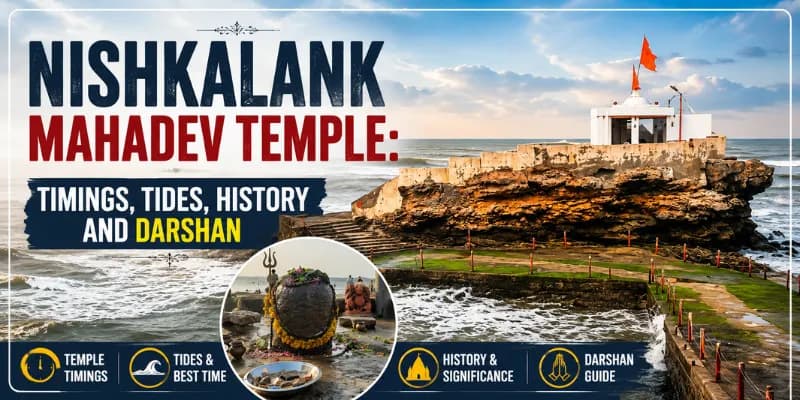
Nishkalank Mahadev is a Shiva temple set about 1.5 km inside the sea at Koliyak beach near Bhavnagar, Gujarat, accessible only at low tide when the water recedes. Its five Shivlings are linked to the Pandavas. The timings shift daily with the tides, following the lunar tithi.
Among the most extraordinary temples in India, Nishkalank Mahadev appears to float in the Arabian Sea, revealed only when the tide draws back. This guide, from the team behind Somnath Dwarka Tour Package, a unit of Experience My India, covers the Nishkalank Mahadev temple timings by tithi, how the tides control access, the moving legend of the Pandavas behind it and how to reach this rare sea temple on the Gujarat coast.
About Nishkalank Mahadev Temple
Nishkalank Mahadev, also called Nishkalangeshwar, is a Hindu temple dedicated to Lord Shiva, located on Koliyak beach near Bhavnagar in Gujarat. What makes it truly unique is its setting: the temple stands about 1.5 km out inside the Arabian Sea, on a small platform that is completely submerged at high tide and emerges at low tide, when devotees walk out barefoot across the wet sands and shallow water to reach it. On the platform stand five self-manifested or swayambhu, Shivlings, each with a Nandi facing it, believed to represent the five Pandava brothers. It is counted among the rarest sea temples in India and the sight of it standing alone amid the sea, appearing and vanishing with the tide, has drawn devotees and curious travellers for generations.
Nishkalank Mahadev Temple at a glance
Temple | Nishkalank Mahadev (Nishkalangeshwar) |
Deity | Lord Shiva, five swayambhu lingams |
Location | Koliyak beach, near Bhavnagar, Gujarat |
Setting | About 1.5 km inside the Arabian Sea |
Access | Low tide only; submerged at high tide |
Main fair | Bhadarvi Amavasya, in the month of Bhadarva |
Nishkalank Mahadev temple timings by tithi
The visiting hours depend entirely on the daily sea tides, so they shift a little each day following the lunar calendar or tithi. The temple opens when the low tide clears the walking path in the morning and closes when the water rises again later in the day. The approximate timings by tithi are:
Tithi (lunar day) | Path clears (low tide) | Water rises (closing) |
1st, Pratipada | 08:18 AM | 01:18 PM |
2nd, Dwitiya | 09:06 AM | 02:06 PM |
3rd, Tritiya | 09:54 AM | 02:54 PM |
4th, Chaturthi | 10:42 AM | 03:42 PM |
5th, Panchami | 11:30 AM | 04:30 PM |
6th, Shashthi | 12:18 PM | 05:18 PM |
7th, Saptami | 01:06 PM | 06:06 PM |
8th, Ashtami | 02:18 PM | 07:18 PM |
9th, Navami | 03:06 PM | 08:06 PM |
10th, Dashami | 03:54 PM | 08:54 PM |
11th, Ekadashi | 04:42 PM | 09:42 PM |
12th, Dwadashi | 05:30 PM | 10:30 PM |
13th, Trayodashi | 06:18 PM | 11:18 PM |
14th, Chaturdashi | 07:06 PM | 12:06 AM |
These times are a helpful guide, but actual high and low tide times vary with the exact date, the location and the spring and neap tide cycle, so always check the specific tide schedule for your planned day of visit before setting out. Aim to reach during the daytime low tide for a safe and unhurried darshan.
How the tides control access
The entire experience of visiting Nishkalank Mahadev revolves around the sea. At low tide, the water recedes far out, clearing a walking path of wet sand and ankle-deep water that devotees follow on foot from the shore to the temple platform. At high tide, the sea rushes back in and completely submerges the pathway and the lower parts of the temple, leaving only the tall flag and the top of a pillar visible above the waves. This means the temple is genuinely accessible for only a few hours around each low tide, which is why planning around the tide timings is essential. There are usually two low tides in a day, so on some dates there can be a second, later window, though the daytime one is by far the safest and most popular for darshan.
The legend of Nishkalank Mahadev
The temple's story reaches back to the Mahabharata. After the great war, the Pandavas were burdened with the sin of having killed their own kin and they sought a way to cleanse themselves. Lord Krishna gave them a black flag and a black cow and told them to wander until both turned white, at which point their sins would be forgiven, after which they should worship Lord Shiva. The Pandavas roamed for a long time, but the black did not fade, until at last they reached Koliyak beach, where both the flag and the cow turned white. There the Pandavas meditated on Lord Shiva, who, pleased with their devotion, appeared before each brother in the form of a Shivling.
Why is it called Nishkalank?
The name Nishkalank means spotless, stainless or without blemish. It refers to the moment the Pandavas were cleansed of their sins here, becoming nishkalank or pure once more. This is the very heart of the temple's spiritual appeal: it is revered as a place where devotees, like the Pandavas before them, can seek absolution and wash away their sins through the darshan of Lord Shiva. For many pilgrims, the act of walking out across the sea at low tide to reach the five lingams carries this powerful sense of purification and renewal, as if the receding water itself is washing the soul clean.
The five Shivlings of the Pandavas
On the temple's square platform stand five separate Shivlings, each accompanied by a Nandi bull facing it and each said to have been established by one of the five Pandava brothers, Yudhishthira, Bhima, Arjuna, Nakula and Sahadeva. The lingams are believed to be swayambhu or self-manifested, which adds to their sanctity. Together with the small water tanks around them, said to remain filled even as the sea rises and falls, the five lingams make the platform a deeply sacred spot and the focus of every pilgrim's darshan at Nishkalank Mahadev.
The Bhadarvi Amavasya fair
The temple's biggest festival is the Bhadarvi Amavasya fair, held on the new moon day of the Hindu month of Bhadarva, when thousands of devotees gather at Koliyak for darshan and celebration. During the festival, a new flag is hoisted on the temple, traditionally associated with the royal family of Bhavnagar and the flag then flies for the rest of the year. Maha Shivratri and Navaratri are also observed with devotion. Visiting during the Bhadarvi fair is a powerful experience, though it means large crowds, so plan and time your visit carefully around the tides.
How to reach Nishkalank Mahadev Temple
Nishkalank Mahadev is at Koliyak beach, about 25 km from Bhavnagar city, which is the nearest major town, railway station and airport. From Bhavnagar it is a short drive to the Koliyak shore, from where you walk out to the temple at low tide. Ahmedabad, the state's main hub, is roughly 190 to 200 km away, about a four to five hour drive. The temple lies on the Gulf of Khambhat side of Saurashtra, some distance from the Somnath and Dwarka coast, so it is best planned as part of a wider Gujarat journey rather than a quick add-on to the western pilgrimage circuit.
Best time to visit
The best time to visit Nishkalank Mahadev is the cooler season, October to March, when the coastal weather is pleasant for the walk out to the temple, in line with the best time to visit Gujarat. Within the day, aim for a daytime low tide so you can reach the temple and return in daylight. Avoid the monsoon, when the sea is rough and the walk can be unsafe and note that the Bhadarvi fair, though special, brings very large crowds. Above all, plan your visit around the tide timings for that exact date.
Tips for visiting Nishkalank Mahadev
A few pointers keep your visit safe and rewarding:
Check the tide first: confirm the exact low and high tide times for your date before you set out, as the schedule shifts daily.
Keep a safety margin: start your walk back to the mainland at least 30 to 45 minutes before the high-tide closing time, as the water rises steadily.
Wear the right footwear: go barefoot or in water-friendly, quick-dry shoes, as you walk through shallow, slushy sea water.
Dress comfortably: wear quick-dry clothing and avoid loose garments, as there can be strong sea winds.
Go in daylight: aim for a daytime low tide for a safe, unhurried darshan and the return walk.
Carry essentials: water, sun protection and a small bag to keep your phone and valuables dry are all useful.
Combine it with a wider Gujarat trip
Because Nishkalank Mahadev sits near Bhavnagar, on the eastern side of Saurashtra, it is best woven into a broader Gujarat itinerary rather than a Somnath and Dwarka trip alone. It pairs well with Bhavnagar's own sights and the wider region and makes a fascinating contrast with the other famous sea temple of Gujarat, Bhadkeshwar Mahadev, on the Dwarka coast. For a full state tour, explore our Gujarat tour packages, which can bring together temples, coast and culture across Gujarat. Experience My India can build such rare and offbeat sites into a wider, well-paced itinerary so you do not have to work out the logistics yourself.
Plan your trip
Experience My India can help plan a Gujarat trip that includes rare gems like Nishkalank Mahadev alongside the great temples of the coast. Browse the Somnath Dwarka tour packages, book Somnath Dwarka hotels and let a Somnath Dwarka taxi service handle the travel across the state.
Related guides
To plan the rest of your Gujarat trip, these related guides help:
Related guide | What it covers |
Air, rail and road access to the Somnath coast. | |
Air, rail and road access to the Dwarka coast. | |
The Jyotirlinga of Lord Shiva near Dwarka. | |
Darshan and aarti hours at the first Jyotirlinga. | |
When to plan a lion safari on your trip. | |
The sights within the Somnath temple town. |
Plan your visit
Experience My India can arrange your Gujarat trip, including rare temples like Nishkalank Mahadev. Browse more travel guides, message us on WhatsApp or call +91 73006 20809.

Harsh Rawat
Somnath–Dwarka circuit planning
Harsh Rawat runs Somnath Dwarka Tour Package on the ground in Gujarat, part of Experience My India. Since 2018 he has been planning and driving the Somnath–Dwarka circuit — the darshan timings, the road hours between temples and the stops worth adding — and the routes, fares and timings published across this site are the ones he maintains.