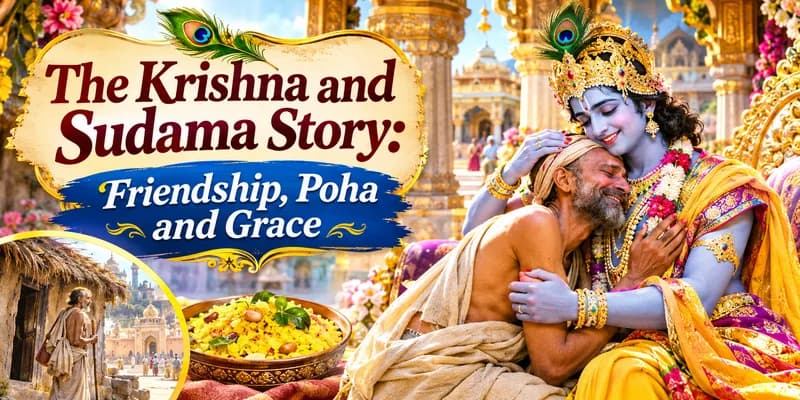
The Krishna and Sudama Story: Friendship, Poha and Grace
The story of Krishna and Sudama is Hinduism's great parable of selfless friendship and pure devotion. Sudama, a poor Brahmin and Krishna's gurukul friend, travels to Dwarka with nothing but a bundle of poha, is received by the king with overwhelming love and returns home to find his hut turned into a golden palace, all without ever asking for a thing. This guide, from Experience My India, tells the full story and shows where it is honoured.
Among all the legends of Lord Krishna, the tale of his friendship with Sudama is perhaps the most tender. It is not a story of battles or miracles of power, but of two childhood friends, a handful of beaten rice and a love that measured the heart rather than the gift. The story is immortalised at Porbandar in Gujarat, revered as Sudama's own birthplace, a short journey down the coast from Dwarka, where Krishna reigned as king. This guide, from the team behind Somnath Dwarka Tour Package, a unit of Experience My India, tells the full story of Krishna and Sudama: their gurukul days, the humble gift of poha, the royal reunion and the silent grace that followed, along with where you can honour the bond today.
Who was Sudama?
Sudama was a deeply spiritual but impoverished Brahmin who shared one of the closest friendships in Hindu tradition with Lord Krishna. Though the two could not have come from more different worlds, Sudama born to hardship and Krishna to divinity and later to kingship, they forged an inseparable, brotherly bond in their student days. In the years that followed, Krishna rose to become the affluent King of Dwarka while Sudama lived in abject penury with his wife, Sushila and their children, often unable to feed them. It is precisely this gulf between them, wealth on one side and want on the other, that makes the story so moving, for it is bridged entirely by love and asks for nothing in return.
The gurukul days at Sandipani's ashram
The friendship began at the gurukul of Sage Sandipani, where both boys studied together as equals, sharing lessons, chores and the simple life of students. It was here that their lifelong bond was formed, untouched by the differences of birth and fortune that would later divide their circumstances. The tradition of this sacred schooling is honoured at the Sandipani Ashram in Porbandar and it is the foundation on which the whole story rests: Krishna and Sudama were, before anything else, classmates and friends who had shared the same roof and the same teacher.
The handful of roasted grams
One episode from their student days is said to explain Sudama's later poverty. While the two boys were out collecting firewood in a forest, a severe storm struck and stranded them. The Guru's wife had given them a small quantity of roasted grams, chana, to share between them. In the dark and the hunger of the storm, Sudama quietly ate the entire portion himself, without telling his hungry friend. Krishna, being divine, knew what had happened but said nothing. According to the lore, this single hidden act of keeping food from a friend manifested later in Sudama's life as extreme and lasting penury. It is a gentle, cautionary thread in the story, a reminder that even small acts leave their mark and it deepens the poignancy of all that follows.
Years of poverty and the journey to Dwarka
Years passed. Krishna became the opulent ruler of the golden city of Dwarka, while Sudama sank ever deeper into poverty, unable to provide even basic food for his children. Seeing her family's suffering, Sudama's wife, Sushila, gently urged him to go and visit his old friend, now a king and ask for help. Sudama was deeply reluctant and ashamed, for he could not bear to approach his friend as a beggar and he refused to go empty-handed. Having nothing of his own to offer, he borrowed a modest bundle of poha, flattened or beaten rice, a favourite snack from their school days, tied it in a torn piece of cloth and set out on the long journey to Dwarka. That humble bundle, carried out of love rather than obligation, is the heart of the whole story.
The royal reunion at Dwarka
What happened when Sudama reached the palace is the most beloved scene of the legend. When Krishna heard that his old friend had come, he broke every rule of royal protocol. He leapt from his throne and ran barefoot to the palace gates to meet him, astonishing his entire court. He embraced the ragged, hermit-like Sudama tightly, led him inside and seated his poor friend on the royal throne itself. Then, in an act of pure humility, the King of Dwarka washed Sudama's weary, thorn-ridden feet with his own hands, his tears falling as water for the washing. For the king to honour a penniless Brahmin in this way, before his whole court, overturned every expectation of rank and status and it is this image of love transcending power that the story holds up as its ideal.
Silent benevolence and the golden palace
Overwhelmed by the splendour around him and embarrassed by his meagre gift, Sudama tried to hide the little bundle of poha. But Krishna, who sees the love behind every offering, playfully snatched it away and ate a handful with evident delight, relishing it as the most precious of gifts. It is said that for each handful of beaten rice Krishna ate, he silently granted Sudama the wealth of an entire kingdom. Sudama spent two blissful days in his friend's company, but was too deeply absorbed in the joy of their reunion and too ashamed, to ever actually ask for financial help. He left for home empty-handed, assuming nothing had changed. Yet when he reached his village, he found his ramshackle hut miraculously transformed into an opulent golden palace, his family adorned in riches, all granted by Krishna's omniscient grace without a single word of request. The friend had given everything and the devotee had asked for nothing.
The meaning of the Krishna and Sudama story
The enduring power of this story lies in its simple, radical message: the Divine measures the purity of a devotee's heart, the depth of their bhakti, rather than the material value of what they offer. A handful of borrowed poha, given in love, drew down the wealth of empires, because it was given without calculation or demand. The tale teaches that true friendship transcends status and wealth, that humility and devotion are themselves the richest offerings and that grace, when it comes, often comes unasked. It sits alongside the wider story of Krishna's life as king, which you can read in our guide to Krishna's three cities, tracing his journey from Mathura through Vrindavan to Dwarka, where this reunion took place.
Where the story is honoured: Sudama Mandir, Porbandar
The coastal city of Porbandar in Gujarat was historically known as Sudamapuri, revered as the birthplace and home of Sudama and it is here that the bond is honoured at the Sudama Mandir. The temple is widely considered the only major shrine in the world dedicated to a mortal devotee like Sudama rather than to a deity, which makes it unique among Hindu temples. Inside the sanctum stands a poignant statue of Krishna and Sudama embracing, alongside depictions of Krishna washing his friend's feet and the complex preserves the original stepwell from which Sudama's family drew water. Experience My India can include the shrine in a Porbandar visit and for full timings, architecture, the famous purification maze and all visitor details, see our dedicated guide to the Sudama Temple in Porbandar.
The temple sits at the heart of Porbandar, within walking distance of the Kirti Mandir, the birthplace of Mahatma Gandhi and it pairs naturally with the city's other sights covered in our Porbandar tourism guide. Entry to the Sudama Mandir is free for everyone.
Sudama in the Dwarka pilgrimage circuit
Sudama's presence runs through the whole Dwarka region, not only Porbandar. In Dwarka itself, the footbridge that carries pilgrims across the Gomti creek to the Panchkui temples is named the Sudama Setu in his honour, a daily reminder of the friend who came with empty hands. Porbandar lies roughly 105 km south of Dwarka along the coast, which makes the Sudama Mandir a natural and much-loved stopover for pilgrims completing the sacred Dwarka to Somnath circuit and you can plan that leg with our Dwarka to Somnath distance guide. Weaving the story of Sudama into a Dwarka pilgrimage turns a temple visit into a journey through one of the most beloved friendships in all of Hindu tradition.
Tips for honouring the Sudama story on a visit
A few pointers help you connect with the legend when you travel:
Visit the Sudama Mandir in Porbandar, revered as Sudamapuri, the devotee's own birthplace.
Look for the sanctum statue of Krishna and Sudama embracing, the emotional heart of the shrine.
See the ancient stepwell in the complex, from which Sudama's family is said to have drawn water.
Pair the visit with the nearby Kirti Mandir, Gandhi's birthplace, a short walk away.
Carry the story's lesson of devotion over wealth and offer your prayers with a humble heart.
Cross the Sudama Setu at Dwarka to feel the friend's presence in the pilgrimage city too.
Time Porbandar as a stopover on the Dwarka to Somnath coastal circuit for a full pilgrimage.
Plan your Sudama and Dwarka pilgrimage
Experience My India can plan a pilgrimage that follows the story of Krishna and Sudama, taking in the Sudama Mandir and the sights of Porbandar alongside the great temple city of Dwarka and the coast beyond. Our Somnath Dwarka tour packages and wider Gujarat tour packages weave Porbandar, Dwarka and Somnath into one well-paced journey, with a stay at well-placed hotels and comfortable local transport throughout.
Related guides
To explore the story and its setting further, these related guides help:
Related guide | What it covers |
The 8th-century monastery that made Dwarka a seat of learning. | |
The nine sacred Dwarka temples of the Krishna tradition. | |
A compact plan of the holy city's key sights. |
Plan your visit
Experience My India can arrange your Sudama and Dwarka pilgrimage and wider Saurashtra journey. Browse more travel guides, message us on WhatsApp or call +91 73006 20809.

Harsh Rawat
Somnath–Dwarka circuit planning
Harsh Rawat runs Somnath Dwarka Tour Package on the ground in Gujarat, part of Experience My India. Since 2018 he has been planning and driving the Somnath–Dwarka circuit — the darshan timings, the road hours between temples and the stops worth adding — and the routes, fares and timings published across this site are the ones he maintains.