What to Eat in Diu: Seafood, Portuguese Flavours and Thalis
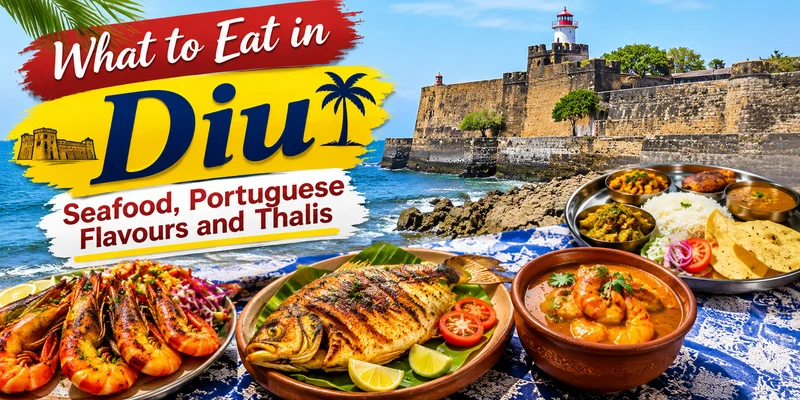
Diu's food is a delicious meeting of three worlds: fresh Arabian Sea seafood, a 400-year Portuguese legacy and Gujarati-Kathiawadi vegetarian fare. Must-try dishes include pomfret, kingfish and prawns cooked in coconut-tamarind or Goan-Portuguese style, fish Koliwada and fried calamari at beach shacks, Portuguese-style curries and Bebinca, hearty veg thalis and the famous Sri Ram Vijay cream sodas. This guide, from Experience My India, covers what to eat and where.
Unlike the strictly vegetarian temple towns of Somnath and Dwarka, the island of Diu is a different kind of coastal destination, where Gujarati-Kathiawadi traditions meet fresh seafood and a 400-year-old Portuguese colonial legacy. That rare mix makes eating in Diu one of its great pleasures. This guide, from the team behind Somnath Dwarka Tour Package, a unit of Experience My India, walks you through what to eat in Diu: its seafood specialities, its Portuguese-influenced dishes, its Gujarati and Kathiawadi staples, its iconic old refreshments and where to find them, so you can eat your way around the island, which you can also explore through our places to visit in Diu guide.
Diu's unique food culture
Diu's cuisine is special because of where it sits, both geographically and historically. As an island union territory on the Arabian Sea, it has always had access to fresh seafood, which sets it apart from the vegetarian mainland pilgrimage towns nearby. Four centuries of Portuguese rule layered European techniques and flavours over the local cooking, bringing vinegar, garlic, chillies and coconut milk into the kitchen. And because Diu is part of the Saurashtra cultural sphere, Gujarati and Kathiawadi vegetarian food is everywhere too. The result is a cuisine that balances sweet-spicy vegetarian Gujarati plates with bold, spice-rich coastal and Portuguese-influenced dishes, so whether you eat vegetarian or seafood, the island has something memorable to offer. Few places in India let you move so easily between a traditional thali, a plate of grilled fish and a Portuguese-style curry in a single day.
Seafood specialities in Diu
Seafood is the star of Diu's table, landed fresh from the Arabian Sea and cooked with real skill. These are the dishes to seek out:
Pomfret and kingfish: prized local fish, the kingfish known here as dara, grilled, fried or simmered in a spicy coconut-tamarind curry.
Prawns, crab and squid: fresh shellfish prepared in Goan-Portuguese style or in rich, tangy coastal gravies.
Fish Koliwada: spiced, batter-fried fish in the beloved Koliwada style, crisp outside and tender within, a classic beach-shack order.
Fried calamari: crisp fried squid rings, a popular starter at the coastal spots.
Roasted and grilled fish: whole fish marinated and grilled over coals, served simply with lime and salad at the beach shacks.
The best seafood is often found at the casual beach shacks and coastal eateries rather than formal restaurants, where the catch is freshest and the cooking is unfussy and authentic.
Portuguese-influenced dishes
Diu's 400-year Portuguese heritage lives on most deliciously in its food. The colonial kitchen introduced a love of vinegar, garlic, chillies and coconut milk, which you taste in the island's spicy seafood and meat preparations, including local variations of vindaloo and Portuguese-style fish and prawn curries, tangy and fiery in equal measure. The influence extends to the sweet side too: traditional baked goods and layered sweets such as Bebinca, a rich, multi-layered coconut-and-egg dessert of Portuguese origin, are a genuine taste of Diu's history. Trying these dishes is a way of tasting the island's past, a reminder that Diu was once one of the Portuguese Empire's strongholds in Asia, as our
Diu Fort guide explores. For food lovers, this European layer is what makes Diu's cuisine stand apart from anywhere else in Gujarat.
Gujarati and Kathiawadi vegetarian food
Vegetarian travellers are far from left out in Diu, as Gujarati and Kathiawadi food is everywhere. Full vegetarian thalis are the staple, typically comprising kadhi, rotli or rotlo, dal dhokli, lasaniya batata (garlic potatoes) and an array of local farsan such as khaman dhokla or patra. In the mornings, the town markets serve classic street breakfasts of fafda and jalebi, the crisp gram-flour strips with sweet syrup spirals. This is the same hearty, rustic Saurashtra cooking you find across the region and if you want to understand it in depth, our Kathiyawadi food and Gujarati thali guide covers the full cuisine. In Diu, a vegetarian thali at lunch and fresh seafood at dinner is a perfectly natural way to eat.
Iconic local refreshments
Diu has a sweet, nostalgic drinks culture all its own, best embodied by its historic refreshment houses. The most famous is Sri Ram Vijay Refreshments, serving since 1933, a beloved institution known for its homemade ice creams, old-style milk colas and signature flavoured cream sodas. Sipping a brightly coloured cream soda or spooning a homemade ice cream here is a little journey into Diu's past, a ritual that generations of visitors have enjoyed. These old-fashioned refreshments, served in a setting that has barely changed in decades, are as much a part of what to eat in Diu as any plate of seafood and they offer a cooling, charming break from the island heat.
Where to eat in Diu
Diu's dining spreads across a few distinct settings, each with its own character. The Nagoa Beach area has casual shacks and cafes serving seafood and snacks with a sea view, while the quieter Ghoghla Beach and other coastal spots offer fresh grilled fish away from the crowds. In Diu town, around the markets and near the fort, you will find vegetarian Gujarati eateries, Portuguese-influenced restaurants and the historic refreshment houses. For the best seafood, head to where the fishing boats come in and the shacks cook the day's catch; for thalis and farsan, the town eateries are the place. Many visitors graze across all of these over a two or three day stay.
Drinks and the evening scene
One thing sets Diu apart from the rest of the region: as a union territory, it is not a dry zone like mainland Gujarat, so alcohol is legally available and the island has a relaxed evening scene of beachside cafes and bars. This, combined with the Portuguese atmosphere, gives Diu a laid-back, holiday feel quite different from the pilgrimage towns. The beach cafes are pleasant places to watch the sunset over a drink and a plate of seafood and the island's gentle nightlife is covered in our Diu nightlife guide. Enjoyed responsibly, an evening by the water is one of Diu's simple pleasures and a reason many travellers pair the island with a Somnath or Dwarka pilgrimage for a change of pace.
Vegetarian, seafood and dietary notes
Diu genuinely caters to every kind of eater, which is part of its charm. Committed vegetarians will find plenty, from full Gujarati thalis to farsan and the famous refreshments and many eateries are purely vegetarian. Seafood lovers get some of the freshest fish, prawns and squid on the western coast. Those curious about history can seek out the Portuguese-influenced curries and Bebinca. If you follow a strict vegetarian or Jain diet, it is easy to eat well by choosing the Gujarati eateries, while seafood is best enjoyed at the dedicated coastal shacks. As always, it is worth confirming ingredients with the staff if you have specific requirements, as kitchens here handle both vegetarian and non-vegetarian cooking.
Best time and dining tips for Diu
A few pointers help you eat well on the island:
Best season: October to March offers the most pleasant weather for beach dining and sightseeing, with the sea calm and the shacks in full swing.
Eat seafood where it lands: the freshest fish is at the beach shacks and coastal spots near the fishing harbour, not the formal restaurants inland.
Ask what is fresh: order the catch of the day rather than a fixed menu, as availability depends on the morning's haul.
Try the refreshments: a visit to a historic spot like Sri Ram Vijay for a cream soda or homemade ice cream is a must.
Mix it up: a vegetarian thali for lunch and grilled fish or a Portuguese curry for dinner is the ideal Diu food day.
Carry cash: smaller shacks and refreshment houses often prefer cash, so keep some handy.
A little about Diu
Diu's food makes more sense against its history. The island passed through the Chavda Rajputs, the Vaghela dynasty and the Gujarat Sultanate before the Portuguese built the massive Diu Fort from 1535, under Governor Nuno da Cunha, after an alliance with Sultan Bahadur Shah of Gujarat. The fort withstood fierce sieges, including a joint Ottoman-Gujarati attack in 1546, becoming one of the Portuguese Empire's strongest naval strongholds in Asia. Portuguese rule lasted over 420 years until Diu was liberated and integrated into India on 19 December 1961 during Operation Vijay. That long European chapter is why the island's food, architecture and atmosphere feel so distinct today and you can plan the whole island in our how to plan a Diu tour guide.
Plan your Diu trip
Experience My India can plan a Diu holiday that makes the most of its food, beaches and history, pairing the island with the temples and coast of Saurashtra for a complete journey. Our Somnath Dwarka tour packages and wider Gujarat tour packages can include Diu with comfortable hotels and reliable local transport, so you can relax and enjoy the island's seafood and charm, arriving easily via Diu Airport or by road.
Related guides
To plan Diu and its region further, these related guides help:
Related guide | What it covers |
Day trips and sights around the island. | |
The striking rock caves near Diu Fort. | |
Sequencing Diu with the Somnath and Dwarka circuit. |
Plan your visit
Experience My India can arrange your Diu holiday and wider Gujarat journey. Browse more travel guides, message us on WhatsApp or call +91 73006 20809.

Harsh Rawat
Somnath–Dwarka circuit planning
Harsh Rawat runs Somnath Dwarka Tour Package on the ground in Gujarat, part of Experience My India. Since 2018 he has been planning and driving the Somnath–Dwarka circuit — the darshan timings, the road hours between temples and the stops worth adding — and the routes, fares and timings published across this site are the ones he maintains.