Gir Safari Gypsy Cost: Permit, Vehicle and Guide Fees
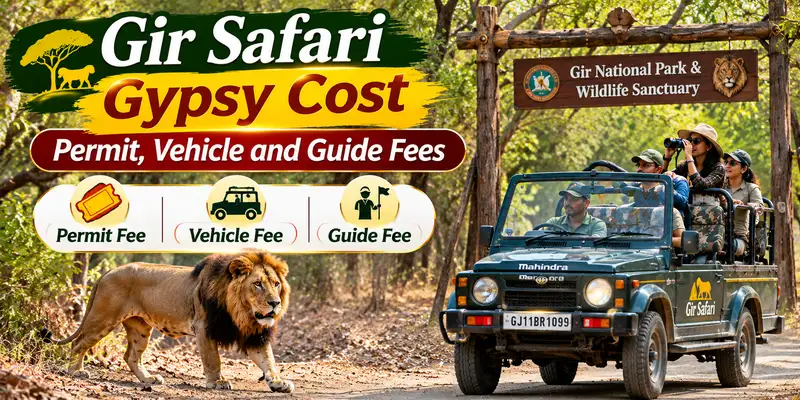
A Gir jungle Gypsy safari for Indian nationals costs around Rs 3,500 to 5,500 or more in total per Gypsy, combining the online permit of about Rs 800 on weekdays or Rs 1,000 on weekends and festivals, the Gypsy vehicle charge of roughly Rs 2,000 to 4,500 depending on size and the guide fee of about Rs 400 to 800. Foreign nationals pay far higher permit fees. One Gypsy seats up to 6 adults and 1 child. This guide, from Experience My India, breaks down every charge.
Planning a safari at Gir, the last home of the wild Asiatic lion, raises an immediate practical question: how much does the Gypsy safari actually cost? The answer has a few parts, because the total is made up of a permit fee paid online plus vehicle and guide charges paid separately and the figures differ for Indian and foreign visitors and between weekdays and weekends. This guide, from the team behind Somnath Dwarka Tour Package, a unit of Experience My India, breaks down every element of the Gir safari Gypsy cost so you know exactly what to expect and for the step-by-step booking process itself, see our Gir safari booking online guide.
How the Gir safari cost is structured
The first thing to understand is that the Gir safari cost is not a single ticket but a combination of charges, which is why quoted prices vary. There are three main components: the permit fee, which is booked and paid online in advance and covers the whole vehicle of up to six adults and one child; the Gypsy vehicle charge, paid separately, which depends on the size and category of the open 4x4 Gypsy; and the mandatory eco-guide fee, also paid at the reception. On top of these, camera charges may apply. Because the permit covers the vehicle rather than the person, the cost per head falls the more people share a Gypsy, so a full group of six is far more economical per person than a couple travelling alone.
Permit fees
The permit is booked online through the official Gir permit system and covers one Gypsy of up to 6 adults plus 1 child aged 3 to 12. For Indian nationals, the permit costs around Rs 800 on weekdays and Rs 1,000 on weekends and festival days, with an extra child fee of about Rs 100 on weekdays or Rs 125 on weekends. Foreign nationals pay substantially more, around Rs 7,600 on weekdays and Rs 9,500 on weekends and festivals, with extra child fees of about Rs 1,900 or Rs 2,375. These permit fees are the fixed, official online portion of the cost and they are the same whatever Gypsy you then hire. Here is the permit breakdown:
Charge | Indian nationals | Foreign nationals |
Permit, weekday | about Rs 800 | about Rs 7,600 |
Permit, weekend or festival | about Rs 1,000 | about Rs 9,500 |
Extra child, weekday | about Rs 100 | about Rs 1,900 |
Extra child, weekend | about Rs 125 | about Rs 2,375 |
Gypsy vehicle and guide charges
Beyond the permit, you pay separately at the reception for the open Gypsy vehicle and the mandatory forest guide. The Gypsy charge depends on the seating capacity and category of the vehicle, commonly ranging from about Rs 2,000 to 4,500 or more, with larger or newer vehicles at the higher end. The eco-guide or naturalist fee typically runs from about Rs 400 to 800 per shift. A registered forest guide is compulsory on every safari, both to navigate the randomly assigned routes and to help you spot and understand the wildlife, so this is not an optional extra. These vehicle and guide charges, paid on site, are the variable part of the cost, which is why it helps to confirm the exact figures at the reception when you arrive, as covered in our Gir National Park timings guide for planning your slot.
Open Gypsy vehicle | About Rs 2,000 to 4,500 or more, by size and category |
Eco-guide or naturalist | About Rs 400 to 800 per shift |
Camera fee | Around Rs 200 for an amateur camera (Indian nationals) |
Payment | Vehicle, guide and camera fees paid at the reception |
The total cost you can expect
Putting the parts together gives a realistic total. For Indian nationals, the combined permit, Gypsy and guide costs for a single Gypsy generally total around Rs 3,500 to 5,500 or more, depending on the day of the week, the vehicle category and any camera fees. Shared among a full group of up to six adults, this works out to a very reasonable per-person cost, which is why joining or forming a full Gypsy group is the economical way to do the safari. For foreign nationals, the total is substantially higher, driven mainly by the much larger permit fee and private tour packages that bundle everything will also cost more than the bare official charges. As a rule of thumb, an Indian family or group should budget in the region of Rs 4,000 to 6,000 per Gypsy per safari to be comfortable, including a camera and any extras.
Indian nationals, total per Gypsy | About Rs 3,500 to 5,500 or more |
Per person (full group of 6) | A modest share of the Gypsy total |
Foreign nationals | Substantially higher, driven by the permit fee |
Private tour packages | Higher than bare official charges, with extras bundled |
What the cost includes
For the price, a Gir Gypsy safari gives you a three-hour open-vehicle drive through the forest on one of thirteen designated routes, assigned randomly at entry, accompanied by a certified driver and a registered eco-guide. The safari departs from the Sinh Sadan reception at Sasan Gir, the park's main hub. The chance to see the wild Asiatic lion, whose population has recovered strongly, along with leopards, deer, nilgai and over 300 bird species, is what the cost buys and most visitors find it excellent value for a genuine wilderness experience. The permit covers the vehicle, so the more you share it, the better the value. For those who cannot secure a jungle permit, the Devaliya Safari Park offers a shorter, separately priced alternative with a very high chance of a sighting.
Why the cost varies
It helps to understand why quotes for a Gir safari differ so much. Several factors move the price:
Weekday versus weekend: permit fees are higher on weekends and festival days than on weekdays.
Nationality: foreign nationals pay a much higher permit tariff than Indian nationals.
Vehicle category: Gypsy charges vary by seating capacity and the type of vehicle hired.
Group size: because the permit covers the vehicle, the cost per person falls sharply with a larger group.
Camera and extras: camera fees and any private tour package elements add to the base cost.
Season and demand: peak-season demand can affect vehicle availability and bundled package prices.
Tips to plan your safari budget
A few pointers help you budget and save:
Travel on a weekday: the lower weekday permit fee makes a noticeable difference to the total.
Fill the Gypsy: a full group of up to six adults spreads the vehicle and permit cost for the best per-person value.
Book the permit early: permits sell out, so booking ahead secures your slot and avoids disappointment.
Carry cash for on-site fees: the vehicle, guide and camera charges are paid at the reception, so keep cash ready.
Confirm the latest rates: official fees are revised periodically, so check the current figures when you book.
Consider a package: a tour operator can bundle permit, Gypsy, guide and transfers, which is convenient though it costs more than the bare charges.
When you can do the safari
The cost only applies when the park is open. The core Gir jungle trail runs from 16 October to 15 June each year, closing in the monsoon from 16 June to 15 October for the breeding season. Within the open season, safaris run in three-hour slots in the morning and afternoon, shifting between winter and summer timings. The best time to visit is November to March, for pleasant weather and good visibility. During the monsoon closure, the fenced Devaliya Safari Park remains open, except on Wednesdays, offering an alternative, separately priced experience. Planning your safari within the open season and booking the permit for your chosen slot well ahead is essential, as covered in our how to plan a Gir tour guide.
Is the Gir safari worth the cost?
For most visitors, the Gir safari is excellent value. For a few thousand rupees per Gypsy, you get a three-hour drive through the only wild habitat of the Asiatic lion on earth, with a real chance of seeing these magnificent animals in their natural setting, alongside leopards, deer and rich birdlife. Shared among a group, the per-person cost is modest for such a rare wildlife experience and the mandatory guide adds genuine value in spotting and interpreting the wildlife. Compared with wildlife experiences elsewhere in the world, a Gir safari is remarkably affordable, which, combined with the uniqueness of seeing wild Asiatic lions, makes it one of the best-value safaris in India and a highlight of any Saurashtra journey.
Plan your Gir safari
Experience My India can arrange your Gir safari with the permit, Gypsy, guide and transfers handled, a comfortable stay near Sasan and a well-paced itinerary that can also take in Somnath and the coast. Our Somnath Dwarka tour packages and wider Gujarat tour packages weave Gir into a fuller Saurashtra journey, with a stay at well-placed hotels and comfortable local transport throughout, so the costs and bookings are taken care of for you.
Related guides
To plan your Gir safari further, these related guides help:
Related guide | What it covers |
Choosing the zone with the best sighting odds. | |
Safari etiquette and park regulations to follow. | |
Accommodation options near the Gir gate. |
Plan your visit
Experience My India can arrange your Gir safari and wider Gujarat journey. Browse more travel guides, message us on WhatsApp or call +91 73006 20809.

Harsh Rawat
Somnath–Dwarka circuit planning
Harsh Rawat runs Somnath Dwarka Tour Package on the ground in Gujarat, part of Experience My India. Since 2018 he has been planning and driving the Somnath–Dwarka circuit — the darshan timings, the road hours between temples and the stops worth adding — and the routes, fares and timings published across this site are the ones he maintains.