Navratri in Gujarat 2026: Dates, Colours, Garba and Where to Celebrate
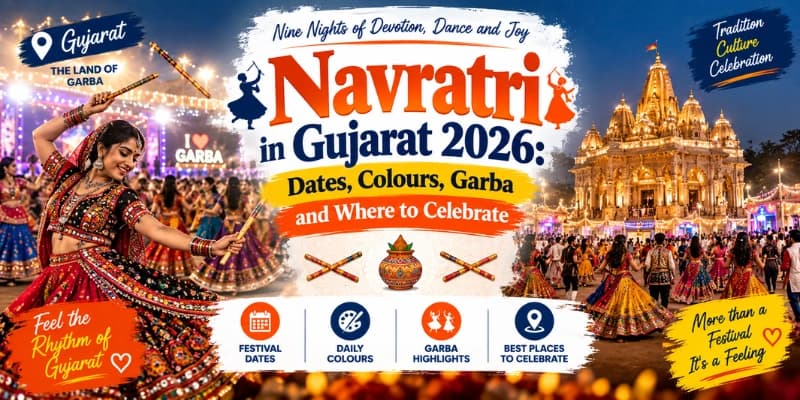
Navratri in Gujarat 2026 runs from Sunday, October 11 to Monday, October 19, 2026, with Dussehra on Tuesday, October 20. For nine nights, the state comes alive with Garba and Dandiya Raas, a distinct colour and form of the goddess for each day, in the world's longest dance festival.
Navratri is the heartbeat of Gujarat, when the whole state dances through nine spectacular nights in honour of the goddess Durga. This guide, from the team behind Somnath Dwarka Tour Package, a unit of Experience My India, covers the Navratri Gujarat 2026 dates and day-wise colours, the traditions of Garba and Dandiya, what to wear and eat and where to experience the festival. For more of the state's celebrations, see our festivals section.
When is Navratri 2026 in Gujarat?
Sharad Navratri 2026 in Gujarat runs from Sunday, October 11 to Monday, October 19, 2026, with the grand festival of Vijayadashami or Dussehra, following on Tuesday, October 20, 2026. The festival begins with the Ghatasthapana ceremony on the morning of October 11 and continues for nine nights of worship and dance. As the dates are set by the Hindu lunar calendar and this year the tithis span ten calendar days, they can shift by a day in some panchangs and regions, so check your local calendar for the exact dates and muhurats at your location. Navratri falls just after the Pitru Paksha period, marking a joyful turn from remembrance to celebration and it opens the vibrant autumn festival season across Gujarat.
Navratri Gujarat 2026 at a glance
Festival | Sharad Navratri, the nine nights of the goddess |
Dates in 2026 | October 11 to 19, 2026 |
Dussehra (Vijayadashami) | Tuesday, October 20, 2026 |
In Gujarat | Garba and Dandiya, the world's longest dance festival |
Key rituals | Ghatasthapana, the Garbo, nightly dance, fasting |
Top hubs | Ahmedabad, Vadodara, Surat and Rajkot |
Navratri 2026 day-wise calendar and colours
Each of the nine days honours a different form of the goddess Durga, the Navadurga and has an associated colour that devotees often wear:
Day and date | Goddess (Navadurga) | Colour |
Day 1, October 11 | Maa Shailaputri | Orange |
Day 2, October 12 | Maa Brahmacharini | White |
Day 3, October 13 | Maa Chandraghanta | Red |
Day 4, October 14 | Maa Kushmanda | Royal Blue |
Day 5, October 15 | Maa Skandamata | Yellow |
Day 6, October 16 | Maa Katyayani | Green |
Day 7, October 17 | Maa Kalaratri | Grey |
Day 8, October 18 | Maa Mahagauri (Ashtami) | Purple |
Day 9, October 19 | Maa Siddhidatri (Navami) | Peacock Green |
Wearing the colour of the day is a joyful part of Navratri and you will see the crowds at the Garba grounds glowing in a different hue each night. Colour associations can vary a little by tradition, so treat the list as a popular guide rather than a strict rule.
The nine forms of the goddess
The nine nights are traditionally divided into three sets of three, marking a spiritual journey. The first three nights invoke Durga to destroy negativity and impurities, the middle three invoke Lakshmi for prosperity and abundance and the final three invoke Saraswati for wisdom and knowledge. From Shailaputri on the first night to Siddhidatri on the ninth, each form of the Navadurga represents a stage in the awakening of divine energy, so that Navratri is not only a festival of dance but a nine-night path of devotion, ending in the triumph of good over evil on Dussehra. This deeper meaning, the journey from strength through prosperity to wisdom, gives the joyous celebrations their spiritual heart and is why devotees keep the fast and the daily worship alongside the nightly dancing.
What makes Gujarati Navratri special
While Navratri is celebrated across India, nowhere is it quite like Gujarat. Here the festival turns the entire state into the world's longest-running dance festival, blending deep religious devotion with high-energy cultural dance. For nine nights, towns and cities fill with the sound of drums, dhol and folk songs, as people of all ages gather to dance in vast circles around the sacred lamp of the goddess. The scale, the colour, the music and the sheer joy of Gujarati Navratri make it one of India's most exhilarating festivals to witness or take part in. From tiny neighbourhood gatherings in village squares to enormous organised events drawing tens of thousands of dancers, the whole of Gujarat becomes one great celebration of the divine feminine for nine unforgettable nights.
Garba and Dandiya Raas
At the heart of Gujarati Navratri are two beloved folk dances. Garba sees dancers move in synchronised concentric circles around the Garbo or an image of the goddess, using graceful, rhythmic handclaps and footwork that build in speed through the night. Dandiya Raas, often flowing on from the Garba, uses pairs of polished wooden sticks struck to the beat of the music, in a lively, playful dance performed with partners. Together they are the pulse of Navratri, danced every single evening from soon after dusk until well past midnight, in a whirl of colour and energy. The dances are open to everyone, from tiny children to grandparents and the sight of a great circle of dancers moving as one around the glowing lamp of the goddess is one of the most joyful spectacles in all of India.
Ghatasthapana and the Garbo
The festival opens on the morning of the first day with Ghatasthapana, the ritual installation of a sacred clay pot that invokes the goddess. In Gujarat this pot is the Garbo, a perforated earthen pot that houses a continuously burning lamp, representing the divine feminine cosmic energy at the centre of creation. The Garbo, glowing from within through its many holes, is the very symbol of the festival and the word Garba itself comes from it. Around this sacred lamp the community gathers each night to dance, so that the whole celebration revolves, quite literally, around the light of the goddess. In many homes, a smaller Garbo is kept and worshipped through the nine days, a beautiful reminder that the grand public dance and the quiet household devotion are two sides of the same festival.
Traditional attire for Navratri
Dressing up is central to the Navratri experience and the traditional attire is as dazzling as the dancing. Women wear the Chaniya Choli, a heavily embroidered, multi-coloured skirt and blouse, embellished with mirror-work, shells and beads and set off with heavy oxidised silver jewellery, bangles and vibrant dupattas. Men dress in the Kediya, a traditional pleated tunic, paired with dhotis or kafnis, often in bright colours. Wearing full traditional dress and the colour of the day, is part of the fun and the Garba grounds become a spectacular sea of colour and sparkle each night. Many families take great care over their outfits and shopping for Navratri attire, much of it showcasing Gujarat's famous mirror-work and embroidery crafts, is a beloved part of the build-up to the festival.
Fasting and feasting
Navratri is a time of both discipline and celebration. Many devotees observe a strict fast or vrat, through the day, eating only sattvic, fasting-friendly foods such as fruits, milk and dishes made from special fasting flours, avoiding regular grains. The nights, however, are for feasting and fun and after dancing late into the night, revellers gather at street stalls for local delicacies. The classic Navratri and Dussehra treat of Fafda and Jalebi, along with hot tea, is a much-loved way to end the night, connecting the festival to the flavours in our famous food of Gujarat guide.
Where to experience Navratri in Gujarat
Different cities offer different flavours of the festival:
Ahmedabad: known for its massive commercial venues, farmhouse grounds and the state-sponsored celebrations at the GMDC Ground, mixing modern sound systems with energetic pop-folk music.
Vadodara: widely considered the cultural capital of Navratri, focused on traditional, acoustic folk music with huge non-commercial venues holding tens of thousands of dancers in a single circle.
Surat and Rajkot: famous for innovative theme-based Garba events, elaborate costume competitions and energetic, youth-centric crowds.
Navratri near Somnath and Dwarka
The festive spirit reaches the coast too. In the temple towns of Somnath and Dwarka, Navratri is marked with devotion at the temples and local Garba celebrations, adding a festive glow to a pilgrimage. Visiting Gujarat during Navratri lets you combine the darshan of the great temples with the joy of the dance nights and it falls in the pleasant autumn season, a lovely time to travel. If you plan a Somnath and Dwarka trip around this time, you can experience both the sacred and the celebratory sides of Gujarat in one memorable journey. Experience My India can time your pilgrimage to coincide with the festival, so you enjoy the temple aartis by day and the Garba nights by evening.
Tips for experiencing Navratri in Gujarat
A few pointers to make the most of the festival:
Wear traditional attire, a Chaniya Choli or Kediya and the colour of the day to join in the spirit fully.
Learn the basic Garba and Dandiya steps beforehand or simply follow the crowd, as all are welcome.
Reach the venues early, as the popular grounds fill up and some require passes.
Pace yourself, as the dancing goes on late into the night and stay hydrated through the evening.
Try the Fafda, Jalebi and street food after the dance, a Navratri tradition.
Book travel and stays well in advance, as Navratri is a peak festival season right across Gujarat.
Plan a Navratri trip to Gujarat
Experience My India can plan a Gujarat trip around Navratri, combining the festival with the temples, coast and culture of the state. Plan the season with the best time to visit Gujarat, explore the Gujarat tour packages and the Somnath Dwarka tour packages, book Somnath Dwarka hotels and let a Somnath Dwarka taxi service handle the travel so you can focus on the darshan and the dance.
Related guides
To plan your Gujarat trip, these related guides help:
Related guide | What it covers |
Air, rail and road access to the Dwarka coast. | |
Access for the Somnath end of the coast. | |
The best months for the Dwarka coast. | |
What to see and do in Krishna's city. | |
The sights within the Somnath temple town. | |
What to eat around the temple town. |
Plan your festival trip
Experience My India can arrange a Gujarat trip around Navratri and the temples. Browse more travel guides, message us on WhatsApp or call +91 73006 20809.

Harsh Rawat
Somnath–Dwarka circuit planning
Harsh Rawat runs Somnath Dwarka Tour Package on the ground in Gujarat, part of Experience My India. Since 2018 he has been planning and driving the Somnath–Dwarka circuit — the darshan timings, the road hours between temples and the stops worth adding — and the routes, fares and timings published across this site are the ones he maintains.