Somnath to Kutch Distance: Route, Time and How to Travel

Somnath to Bhuj, the gateway to Kutch, is about 427 km, roughly 8 to 8.5 hours by road via NH 27, usually through Junagadh, Rajkot and Morbi. Reaching the White Rann at Dhordo adds another 80 km or so, for around 500 to 530 km in total. Driving or a private taxi is the most direct option, with buses and connecting trains also available. This guide, from Experience My India, covers the route, times and travel options.
Travelling from the sacred coast of Somnath to the white salt desert of Kutch links two of Gujarat's most iconic experiences, the first Jyotirlinga and the vast Rann, in one memorable journey across the breadth of Saurashtra and beyond. It is a long drive, so planning the route and the stops matters. This guide, from the team behind Somnath Dwarka Tour Package, a unit of Experience My India, sets out the distance and driving time from Somnath to Kutch, the best road routes, the train and bus options, the extra leg to the White Rann at Dhordo and what to see at each end, so you can plan this cross-Gujarat journey with confidence.
Somnath to Kutch distance at a glance
The headline figures depend on exactly where in Kutch you are headed, since Kutch is India's largest district and Bhuj is its main gateway. Here are the key distances and times:
Route | Distance | Driving time |
Somnath to Bhuj via NH 27 | about 427 km | about 8 hr 15 min |
Somnath to Kutch (fastest current) | about 488 to 499 km | about 9 hr 40 min to 10 hr |
Bhuj to Dhordo (White Rann) | about 80 to 85 km | about 2 to 3 hr with permit checks |
Somnath to Dhordo (total) | about 500 to 530 km | about 11 to 12 hr |
In short, reaching Bhuj, the gateway to Kutch, is roughly 427 km and a little over 8 hours by the most direct run, while the full journey all the way to the White Rann tent city at Dhordo is around 500 to 530 km and best treated as a long day or, better, split with an overnight stop. Live navigation apps sometimes route slightly longer at around 488 to 500 km and 9 to 10 hours depending on road conditions and closures, so allow a generous margin.
The road route via NH 27
The main road route from Somnath to Kutch runs north and west along NH 27, the great highway across Saurashtra, typically passing through Junagadh, Rajkot and Morbi before curving toward Bhuj. It is a well-paved, largely four-lane highway for much of the way, making for comfortable driving. The route passes close to several worthwhile stops, including the historic city of Junagadh with its fort and Girnar hill and the commercial hub of Rajkot, so you can break the long drive with a meal or a sight. An alternative routing via NH 151 and NH 27 runs a similar distance and is sometimes faster when there are closures on the main highway. Whichever way you go, the drive is long but straightforward, crossing the heart of Saurashtra from its southern coast to its northern desert edge.
Travelling by road: car, taxi and bus
For most travellers, driving or hiring a private taxi is the most direct and comfortable way to cover the Somnath to Kutch distance, as it lets you set your own pace, break the journey where you like and carry luggage easily. Given the 8 to 10 hour duration, a private cab with a driver is popular and many visitors split the journey with a stop or an overnight at Rajkot. State transport buses, run by GSRTC and private operators also connect Somnath and the Saurashtra towns with Bhuj, though bus journeys are longer and less flexible, often involving a change. For a sightseeing trip taking in both Somnath and Kutch, a private vehicle for the whole circuit is usually the best choice and it makes the extra leg to the Rann far easier.
Travelling by train
Rail is an option for the Somnath to Kutch journey, though it usually involves more time and a transfer. There is no fast direct train for the whole route, so travellers typically take a train from Veraval, the railhead near Somnath, toward Bhuj, often with a change at a junction such as Rajkot or elsewhere on the network. Connecting trains can make the journey considerably longer than the road option, so rail suits those who prefer the train and are not in a hurry. For a trip that needs to reach the Rann in time for a specific Rann Utsav booking or a full-moon night, the flexibility of road travel is usually the safer bet, but a train to Bhuj followed by a local taxi to Dhordo is a workable combination.
Reaching the White Rann at Dhordo
For most travellers, the real goal beyond Bhuj is the White Rann near Dhordo, the dazzling expanse of salt flats that is the signature image of Kutch. From Bhuj it is a further 80 to 85 km north, around two to three hours including the border permit checks. The White Rann falls within a border zone, so government entry permits are required, typically a small fee per adult and child and visitors should carry original photo ID and a photocopy; permits can be booked online via the Rann Utsav permit portal or obtained at the Bhirandiyara checkpoint en route. The best season is November to February, when the Rann Utsav festival is in full swing and the salt flats are dry and spectacular, especially on a full-moon night. Planning this final leg and the permit, in advance makes the long journey from Somnath truly worthwhile.
About Somnath, the starting point
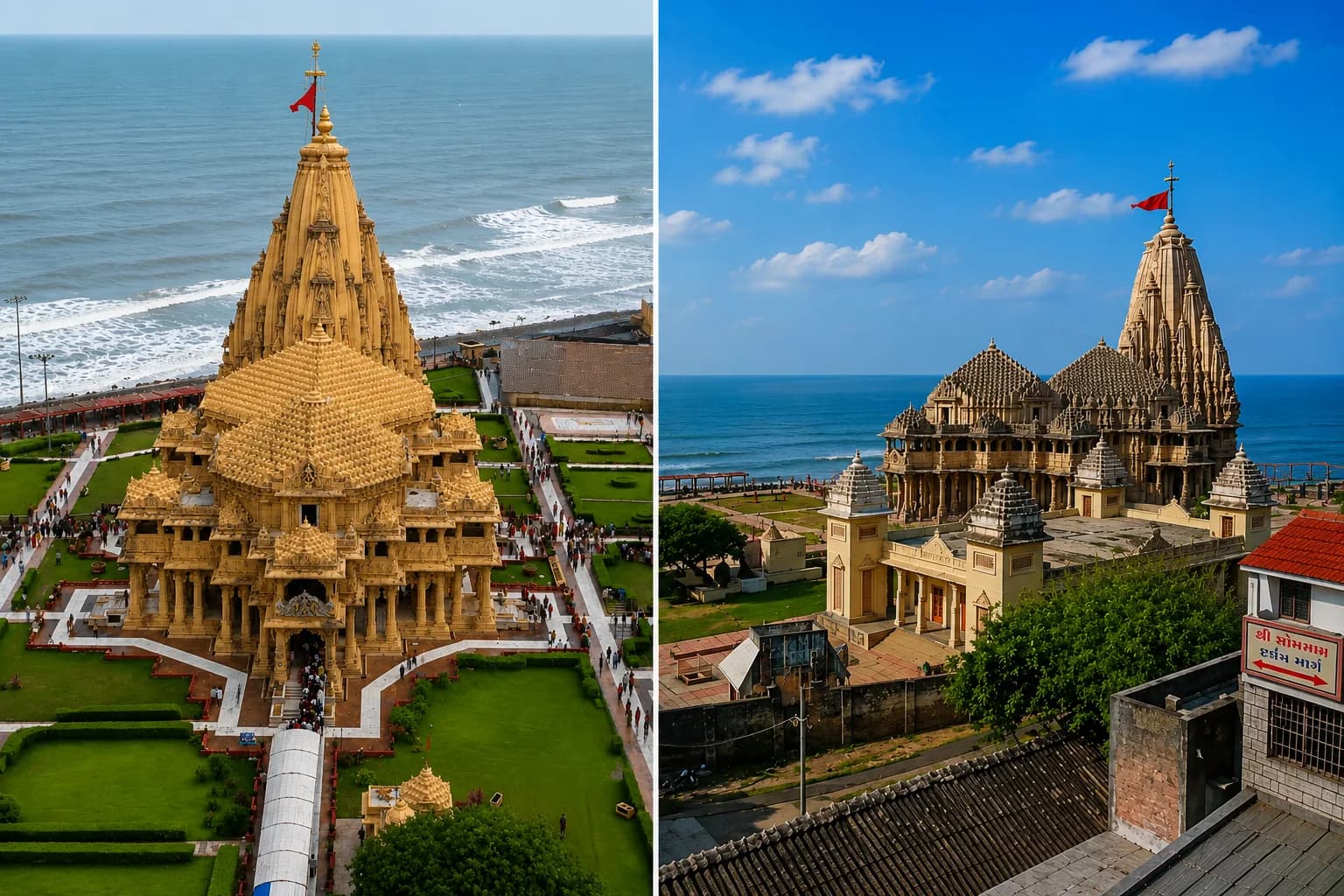
Somnath, at Prabhas Patan near Veraval on the Saurashtra coast, is where this journey begins. It is revered as the first of Lord Shiva's twelve Jyotirlingas, the Adi Jyotirlinga, linked in Hindu tradition to the Moon God and the sacred Prabhas Kshetra and it stands on the shore of the Arabian Sea near the Triveni Sangam confluence. Destroyed and rebuilt many times across the centuries, including after the raid of Mahmud of Ghazni in 1026 CE, the present Chalukya-style temple was reconstructed after independence on Sardar Patel's initiative and consecrated in 1951. Before setting off for Kutch, most travellers take darshan and perhaps the evening light show and you can plan the timings with our Somnath Jyotirlinga significance guide.
About Kutch, the destination
Kutch or Kachchh, is India's largest district by area, covering some 45,674 sq km on Gujarat's western edge, with Bhuj as its headquarters. Its defining feature is the Great Rann of Kutch, a vast seasonal salt marsh that dries into dazzling white flats after the monsoon and stretches north toward the border. Beyond the Rann, Kutch is famous for its handicrafts, from embroidery and Rogan art to Bandhani, its historic towns and the coastal beauty of Mandvi and its vibrant folk culture. The seasonal Rann Utsav cultural festival, centred on the tent city at Dhordo, has made Kutch one of India's most celebrated winter destinations, which is why the long journey from Somnath to reach it is so popular among travellers exploring the breadth of Gujarat.
Best time to make the journey
The best time to travel from Somnath to Kutch is the winter season, from November to February, for two reasons. First, the weather across Saurashtra and Kutch is cool and pleasant, making the long drive far more comfortable than in the summer heat. Second and most importantly, this is the season of the Rann Utsav, when the White Rann is dry, dazzling and at its most spectacular and the tent city at Dhordo is fully operational. Full-moon nights in this window are especially magical on the salt flats. Travelling in summer means a hot, draining drive and a less impressive Rann, while the monsoon brings the possibility of a flooded Rann and tougher road conditions, so the cool months are overwhelmingly the time to make this trip.
Tips for the Somnath to Kutch trip
A few pointers make the long journey smoother:
Allow a full day: the drive to Bhuj is 8 hours or more and the Rann adds a couple more, so plan a full travel day or an overnight stop.
Consider a Rajkot stop: breaking the journey at Rajkot, roughly midway, rests the driver and lets you see the city.
Book the Rann permit ahead: arrange the White Rann permit online in advance and carry original photo ID with a photocopy.
Travel in winter: come between November and February for the best weather and the full Rann Utsav experience.
Prefer a private vehicle: for a trip taking in both ends and the Rann, a private cab is far more flexible than buses or trains.
Start early: set off from Somnath in the morning to reach Bhuj or the Rann in good time.
Planning a Somnath and Kutch journey
Combining Somnath and Kutch makes for a grand cross-Gujarat journey, pairing the sacred Saurashtra coast with the desert spectacle of the north. Many travellers build it into a larger loop that also takes in Dwarka and the Gir lion forest, turning a single long drive into a rich multi-destination tour. Because the distances are considerable, a well-planned itinerary with the right overnight stops makes all the difference and our 7 days Gujarat tour itinerary guide offers a framework that can link the coast, the temples and the Rann. With sensible pacing, the long haul from Somnath to Kutch becomes part of the adventure rather than a chore.
Plan your Gujarat trip
Experience My India can plan a Gujarat journey that links Somnath and Kutch with the right routing, stops and timing, so the long distances are handled smoothly and you arrive at the Rann rested and ready. Our Somnath Dwarka tour packages and wider Gujarat tour packages can weave Somnath, Kutch and the Rann into one complete trip, with a stay at well-placed hotels and comfortable local transport for the drives.
Related guides
To plan your Gujarat journey further, these related guides help:
Related guide | What it covers |
Sequencing the Saurashtra coast and temples. | |
The four great pilgrimage shrines of the state. | |
The coastal route linking the two great shrines. |
Plan your visit
Experience My India can arrange your Somnath, Kutch and wider Gujarat journey. Browse more travel guides, message us on WhatsApp or call +91 73006 20809.

Harsh Rawat
Somnath–Dwarka circuit planning
Harsh Rawat runs Somnath Dwarka Tour Package on the ground in Gujarat, part of Experience My India. Since 2018 he has been planning and driving the Somnath–Dwarka circuit — the darshan timings, the road hours between temples and the stops worth adding — and the routes, fares and timings published across this site are the ones he maintains.