Char Dham of Gujarat: The Four Sacred Dhams and How to Visit

The Char Dham of Gujarat refers to the four most sacred pilgrimage abodes of the state, most commonly Somnath, Dwarka, Ambaji and Palitana, honouring Lord Shiva, Lord Krishna, the Mother Goddess and the Jain tradition. Dwarka is also one of India's four national Char Dham.
Gujarat is one of the most sacred lands in India, home to a Jyotirlinga, a Char Dham, a great Shakti Peeth and revered Jain and Krishna shrines. Together, its holiest sites form what is popularly known as the Char Dham of Gujarat. This guide, from the team behind Somnath Dwarka Tour Package, a unit of Experience My India, explains what the Char Dham of Gujarat is, describes each of the four dhams and shows how to plan a pilgrimage that takes them in, along with the other great dhams of the state.
What is the Char Dham of Gujarat?
The Char Dham of Gujarat refers to the four most revered pilgrimage abodes within the state, a regional circuit distinct from the national Char Dham of India. The four are most commonly listed as Somnath, the first Jyotirlinga of Lord Shiva; Dwarka, the Char Dham city of Lord Krishna; Ambaji, the foremost Shakti Peeth of the Mother Goddess; and Palitana, the great Jain tirtha of Shatrunjaya. Together they represent the four major devotional traditions of Gujarat under one journey. It is worth noting that the grouping varies: some traditions and yatras include Girnar, Dakor or Pavagadh in place of or alongside, Palitana and Gujarat's sacred geography holds many more holy places besides. What unites them all is the idea of a single, soul-cleansing pilgrimage across the state, taking in the abodes of Shiva, Vishnu, the Devi and the Jain tirthankaras, so that a devotee can pay homage to the full breadth of Gujarat's faith in one blessed journey.
Char Dham of Gujarat at a glance
Dham | Tradition | Location |
Somnath | Lord Shiva, first Jyotirlinga | Prabhas Patan, Saurashtra coast |
Dwarka | Lord Krishna, national Char Dham | Western tip of Saurashtra |
Ambaji | Mother Goddess, Shakti Peeth | Banaskantha, north Gujarat |
Palitana | Jain tirthankaras, Shatrunjaya | Bhavnagar district |
1. Somnath, the first Jyotirlinga
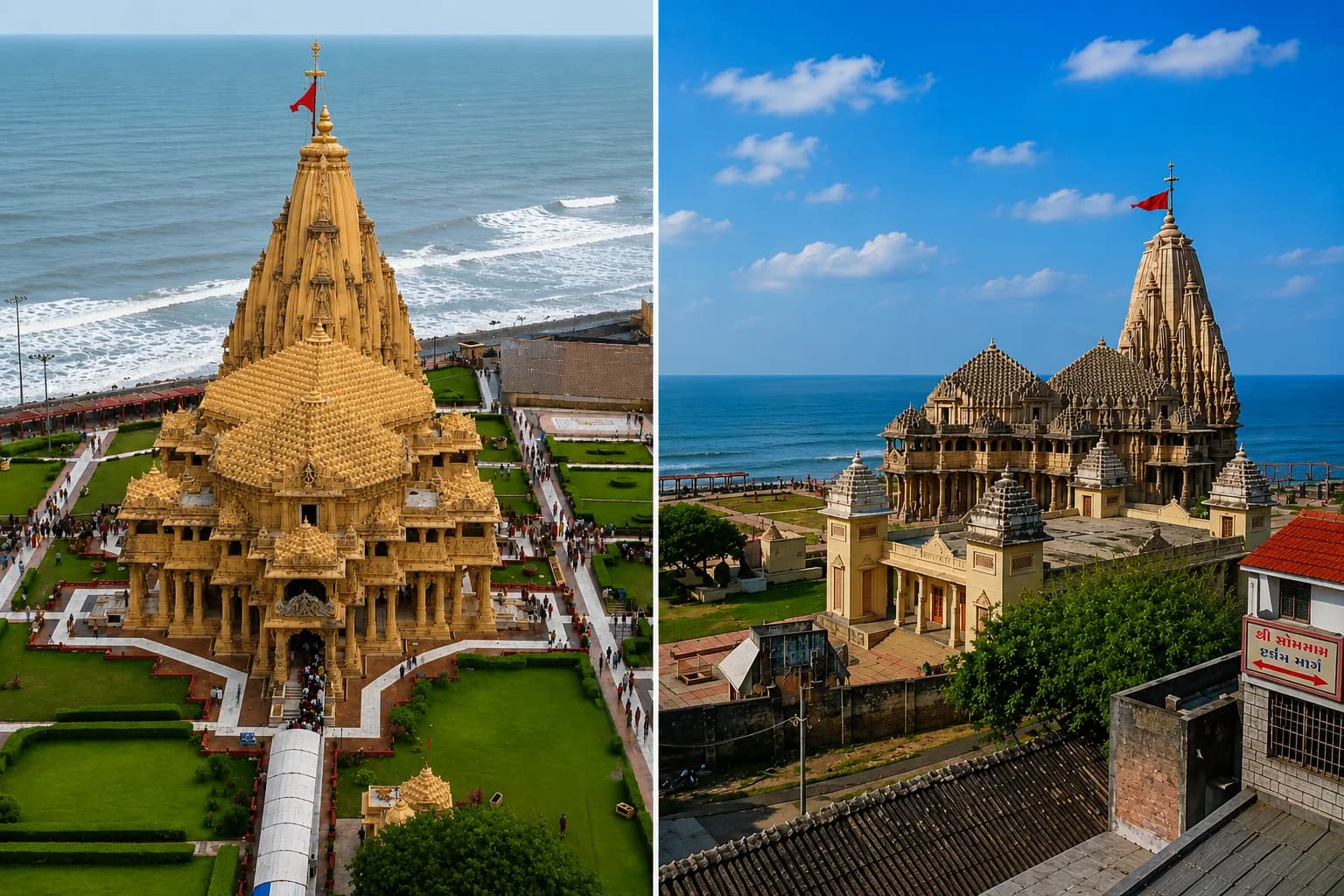
Somnath, on the southern coast of Saurashtra at Prabhas Patan, is the eternal shrine of Lord Shiva and the first among the twelve Jyotirlingas, making it one of the holiest Shaiva sites in all of India. Destroyed and rebuilt many times over the centuries, the present temple rises majestically by the Arabian Sea. Beyond the main temple lie the sacred Bhalka Tirth and the Triveni Sangam. The evening aarti and the sound-and-light show are deeply moving. Plan around the Somnath temple timings and use how to reach Somnath to plan your visit to Somnath.
2. Dwarka, the city of Krishna
Dwarka, at the far western tip of Saurashtra, is the legendary golden city of Lord Krishna and one of the four national Char Dham, giving it a doubly special status in any Gujarat pilgrimage. Its soaring Dwarkadhish temple, the Jagat Mandir, is the heart of the city, with the sacred Gomti Ghat beside it. Nearby lie Bet Dwarka, Krishna's island and the Nageshwar Jyotirlinga, another of the twelve. Use how to reach Dwarka to plan your visit to Dwarka.
3. Ambaji, the great Shakti Peeth
Ambaji, in the Banaskantha district of north Gujarat near the Rajasthan border, is one of the most important Shakti Peeths in India and the foremost abode of the Mother Goddess in Gujarat. Uniquely, the temple has no idol; instead, a sacred Shri Yantra is worshipped as the goddess, never shown fully to devotees, who are asked to close their eyes during its darshan. Set amid the Aravalli hills, with the nearby Gabbar hill believed to be the original seat of the goddess, Ambaji draws millions of devotees, especially during the grand Bhadarvi Poonam fair held on the full moon of the month of Bhadarva. It represents the Shakti or Devi, tradition in the Char Dham of Gujarat, completing the circuit's embrace of Shiva, Vishnu and the Mother Goddess.
4. Palitana, the Jain tirtha of Shatrunjaya
Palitana, in the Bhavnagar district, is home to the Shatrunjaya hills, among the holiest of all Jain pilgrimage sites. The hilltop is crowned with hundreds of intricately carved marble temples, built over centuries, reached by a climb of thousands of steps that devout pilgrims often make barefoot and fasting. It is a place of extraordinary devotion and beauty and represents the Jain tradition in the Char Dham of Gujarat. As noted, some pilgrims count Girnar, itself sacred to both Jains and Hindus or the Krishna shrine of Dakor, as the fourth dham instead, reflecting the rich variety of Gujarat's holy sites and the many ways in which the state's great pilgrimage circuit is understood.
Other great dhams of Gujarat
Gujarat's sacred geography extends well beyond these four dhams. Depending on the tradition, a wider Gujarat pilgrimage may also include:
Girnar: the sacred mountain near Junagadh, holy to both Hindus and Jains, with a demanding climb of thousands of steps or a ropeway, covered in our Girnar guide.
Dakor: the popular Ranchhodrai temple of Lord Krishna near Kheda, a major Vaishnava pilgrimage centre.
Pavagadh: the Mahakali temple atop Pavagadh hill near Champaner, another revered Shakti shrine.
Bet Dwarka and the Pancha Dwarka: the island and the five Dwarkas revered by devotees of Krishna.
Gujarat Char Dham and the national Char Dham
It helps to understand how the Char Dham of Gujarat relates to the famous national Char Dham. The original national Char Dham, established by Adi Shankaracharya, consists of Badrinath in the north, Dwarka in the west, Puri in the east and Rameswaram in the south, the four abodes at the corners of India. Dwarka, in Gujarat, is one of these four. The Char Dham of Gujarat is a separate, regional circuit of the state's own holiest sites, in which Dwarka appears again alongside Somnath, Ambaji and Palitana. So Dwarka is unique in belonging to both the national and the Gujarat Char Dham, a distinction that makes it the natural centrepiece of any pilgrimage to the state and a fitting place to begin or end the yatra.
How to plan a Gujarat Char Dham yatra
A Gujarat Char Dham yatra can be planned over about five to seven days, given the distances involved. Somnath and Dwarka lie close together on the Saurashtra coast and are easily combined, while Ambaji is in the far north of the state and Palitana in the Bhavnagar region, so the circuit covers a lot of ground. A common approach is to base the coastal leg around Somnath and Dwarka, then travel to Ambaji and Palitana as separate legs. A well-planned tour with a car and driver makes the long distances manageable, letting you focus on darshan rather than logistics. Many pilgrims begin and end in Ahmedabad, looping down to the coast for Somnath and Dwarka, up to Ambaji in the north and across to Palitana near Bhavnagar, weaving the four dhams into one continuous, unhurried journey of devotion.
Best time for the Gujarat Char Dham yatra
The best time for the Gujarat Char Dham yatra is the cooler season, October to March, when the weather is pleasant for temples, coast and the hill climbs at Palitana and Ambaji, in line with the best time to visit Gujarat. This is also the peak pilgrimage and festival season, with fairs like Ambaji's Bhadarvi Poonam, so book ahead. Avoid the hot summer for the climbs and take care in the monsoon, when hills can be slippery and the coast rainy. Early starts help you enjoy the aartis and beat the crowds and heat.
How to reach the dhams
The dhams are spread across Gujarat, so most yatras begin from Ahmedabad or Rajkot. Ahmedabad, the state's main hub, is the usual starting point for Ambaji in the north, while Somnath and Dwarka on the coast are reached via Rajkot and Palitana via Bhavnagar. All are connected by road, with the nearest airports and railheads being Ahmedabad, Rajkot, Bhavnagar, Jamnagar and the coastal stations. A car with a driver is the most practical way to link the widely spread dhams into one smooth pilgrimage, saving you the trouble of juggling multiple train and bus connections across the state and letting you set your own pace at each holy site.
Tips for the Gujarat Char Dham yatra
A few pointers make the pilgrimage smoother:
Allow five to seven days to cover the four dhams comfortably, given the long distances between them.
Combine Somnath and Dwarka on the coast, as they lie close together and pair naturally.
Prepare for the climbs at Palitana and Ambaji's Gabbar or use the ropeway where one is available.
Start temple visits early to catch the aartis and beat the crowds and heat.
Dress modestly, follow temple rules and note that phones and cameras may be restricted inside.
Hire a car with a driver to link the widely spread dhams into one smooth journey without stress.
Plan your Gujarat Char Dham yatra
Experience My India can plan a Gujarat Char Dham yatra around your time and devotion. The coastal heart of the pilgrimage, Somnath and Dwarka, is our speciality and can be extended to Ambaji, Palitana and the other dhams. Explore the Somnath Dwarka tour packages and the wider Gujarat tour packages, book Somnath Dwarka hotels and let a Somnath Dwarka taxi service handle the travel across the state.
Related guides
To plan your Gujarat pilgrimage, these related guides help:
Related guide | What it covers |
The site where Krishna left his mortal body, near Somnath. | |
The sacred ghat and aarti beside the Dwarkadhish temple. | |
Distance, ropeway and steps for the Girnar climb. | |
The best months for the Dwarka coast. | |
The sights within the Somnath temple town. | |
When to add a lion safari to your pilgrimage. |
Plan your yatra
Experience My India can arrange your Gujarat Char Dham yatra. Browse more travel guides, message us on WhatsApp or call +91 73006 20809.

Harsh Rawat
Somnath–Dwarka circuit planning
Harsh Rawat runs Somnath Dwarka Tour Package on the ground in Gujarat, part of Experience My India. Since 2018 he has been planning and driving the Somnath–Dwarka circuit — the darshan timings, the road hours between temples and the stops worth adding — and the routes, fares and timings published across this site are the ones he maintains.