Somnath Jyotirlinga Significance: Why the First Jyotirlinga Matters
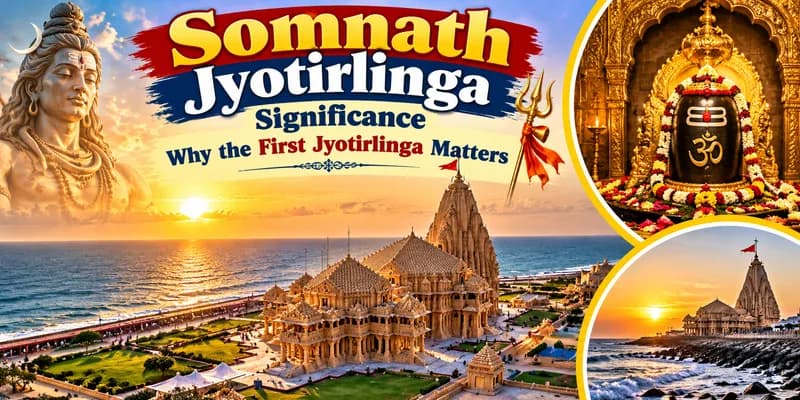
The Somnath Jyotirlinga is revered as the first of the twelve sacred Jyotirlingas, the first place Lord Shiva manifested as a column of light. Its name means Lord of the Moon, from the legend of Chandra Dev's curse and it is famed as the Shrine Eternal for surviving repeated destruction and rebuilding. This guide, from Experience My India, explains its significance.
Few temples in India carry the spiritual weight of Somnath. As the first of the twelve Jyotirlingas, standing on the western shore at Prabhas Patan, it holds a foundational place in Hindu worship and endures as a symbol of spiritual resilience and civilisational continuity. This guide, from the team behind Somnath Dwarka Tour Package, a unit of Experience My India, explains the significance of the Somnath Jyotirlinga: why it is the first, the legend of the Moon God that gives it its name, its link to the final journey of Lord Krishna and the extraordinary Shrine Eternal story of destruction and rebuilding that makes it a lasting emblem of faith.
What is the Somnath Jyotirlinga?
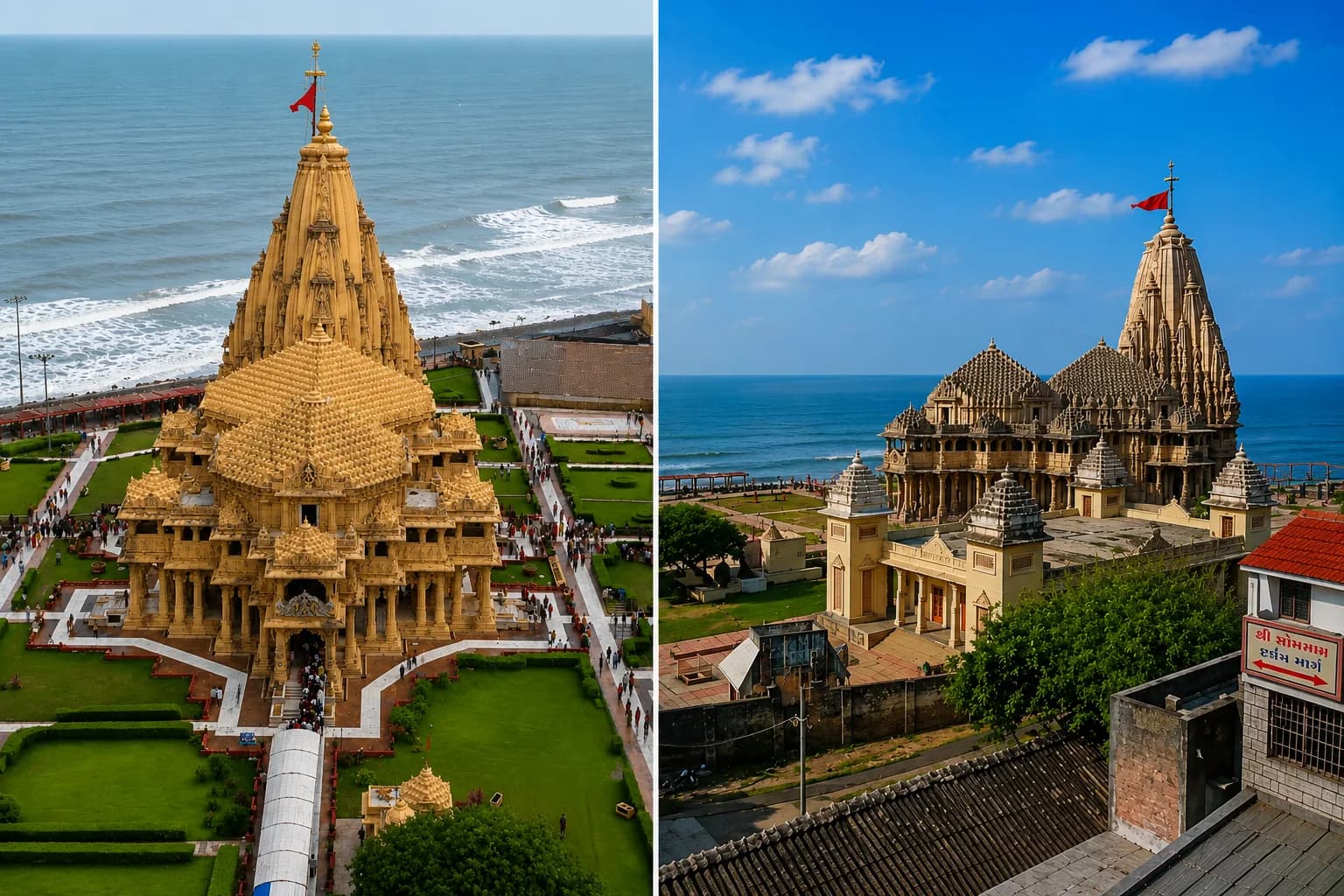
A Jyotirlinga is a shrine where Lord Shiva is worshipped as a Jyoti, a column or pillar of divine light, rather than in an ordinary idol form and there are twelve such supremely sacred Jyotirlingas across India. Somnath is revered as the first, the Aadi Jyotirlinga, which places it at the very head of this sacred network and makes it one of the holiest Shiva shrines anywhere. The temple stands at Prabhas Patan, near Veraval, right on the shores of the Arabian Sea and its significance is woven from three strands: its primacy among the Jyotirlingas, the mythology of the Moon God that names it and its unbreakable history of survival. You can see where it sits among the others in our guide to the twelve Jyotirlingas of India.
Somnath Jyotirlinga at a glance
Status | The first or Aadi, of the twelve Jyotirlingas |
Meaning | Somnath means Lord of the Moon |
Location | Prabhas Patan, near Veraval, Gir Somnath, Gujarat |
Setting | On the Arabian Sea at the Triveni Sangam |
Known as | The Shrine Eternal, for its many reconstructions |
Architecture | Chalukya or Maru-Gurjara, style |
Consecrated | The modern temple, in May 1951 |
The first of the twelve Jyotirlingas
The single greatest source of Somnath's significance is its status as the first Jyotirlinga. It is revered as the first place where Lord Shiva manifested himself as a fiery column of light, the Jyotirlinga and this primacy places it at the head of the twelve. For devotees, this makes Somnath not merely one sacred Shiva shrine among many but the origin point of the entire Jyotirlinga tradition, a distinction that draws pilgrims from across India and the world. Many undertake a pilgrimage to all twelve and Somnath is where that sacred journey begins. This foundational role is the root of its spiritual authority and it is why a visit here feels like standing at the source of one of Hinduism's most profound forms of worship. The wider set of twelve and the Char Dham of Gujarat circuit to which Somnath also belongs, are covered in the related guides below.
The legend of the Moon God
The name Somnath means Lord of the Moon and it comes from one of the most beautiful legends in the Puranic tradition. According to sacred texts, Chandra Dev, the Moon God, lost his lustre because of a curse laid on him by his father-in-law, Daksha Prajapati. Stricken and dimmed, Chandra came to this spot and performed severe penance, worshipping Lord Shiva with deep devotion. Moved by his prayers, Shiva partially relieved him of the curse, restoring the moon's light and its emotional balance, which is why the moon still waxes and wanes rather than remaining forever dark. The temple thus marks the place where the Moon God was healed and his radiance returned and the story gives Somnath its name and a tender, redemptive significance, as a place where even the heavens came to seek Shiva's grace and found it.
The end of Krishna's earthly journey
Prabhas Patan is made doubly sacred by its connection to Lord Krishna. Nearby sits Bhalka Tirth, the site where Lord Krishna is believed to have ended his earthly manifestation, struck by a hunter's arrow as his time on earth drew to a close. This places the Somnath Jyotirlinga within the same sacred landscape as the conclusion of the Krishna story, binding together two of the most important strands of Hindu devotion, the worship of Shiva and the life of Krishna, in one small stretch of the Gujarat coast. For pilgrims, this overlapping sanctity deepens the significance of the whole Prabhas Patan region and many visit the Krishna sites alongside the great temple, feeling the weight of two divine narratives meeting at the edge of the sea.
The Shrine Eternal
Somnath is famously called the Shrine Eternal and this title captures perhaps its most powerful significance of all, as a symbol of unbreakable faith. Scriptural lore tells that the temple was originally built in gold by the Moon God, rebuilt in silver by Ravana, in sandalwood by Lord Krishna and later in stone by King Bhimdev, a lineage of reconstruction stretching back into myth. In historical times, owing to its legendary wealth and status, the temple was targeted, looted and desecrated repeatedly by invaders, most notably by Mahmud of Ghazni in 1026, Ulugh Khan in 1299 and the Mughal emperor Aurangzeb in 1706. Yet each time it was plundered, Hindu rulers rose to rebuild it, among them the Paramaras, the Chalukyas and the Marathas and Queen Ahilyabai Holkar of Indore built an adjacent Old Somnath temple in 1783 so that worship could continue uninterrupted. This endless cycle of destruction and renewal is the heart of the Shrine Eternal, a monument to the idea that faith itself cannot be destroyed.
The modern chapter is just as significant. Following India's independence, Sardar Vallabhbhai Patel, the first Deputy Prime Minister, championed the complete restoration of the main temple on its original site as a symbol of national pride and renewal. Built in the magnificent Chalukya or Maru-Gurjara, architectural style, the grand structure standing today was consecrated in May 1951 by the first President of India, Dr Rajendra Prasad. Seeing the temple now, rising again in full splendour on the coast where it was so often cast down, is to understand its significance at a glance. The deeper visitor-side story of the shrine today is covered across our other Somnath guides, including the Somnath temple rules.
The sacred location
The significance of Somnath is heightened by its extraordinary setting. The temple stands at Prabhas Patan, near Veraval in the Gir Somnath district of Gujarat, right on the shores of the Arabian Sea at the Triveni Sangam, the holy confluence of three mythological rivers, the Kapila, the Hiran and the Saraswati. A confluence of sacred rivers meeting the sea is among the most auspicious of locations in Hindu geography, a place of natural power and purification and to have the first Jyotirlinga standing on this exact spot magnifies the sanctity of both. The sound of the waves against the temple walls, the open horizon of the sea and the meeting of the rivers all combine to give Somnath an atmosphere that visitors find profoundly moving, a setting entirely worthy of the significance the shrine carries.
Daily rituals and timings
The temple is open every day for devotees and its daily rhythm of worship is part of experiencing its significance. The primary schedule is as follows:
Activity | Timing |
Temple opening hours | 6:00 AM to 10:00 PM |
Darshan timings | 6:00 AM to 10:00 PM |
Morning Mangala Aarti | 7:00 AM |
Midday Aarti | 12:00 PM |
Evening Aarti | 7:00 PM |
Sound and light show | 8:00 PM to 9:00 PM, can be suspended in the monsoon |
Attending one of the three daily aartis, especially amid the chants and lamplight, is the most direct way to feel the living significance of the shrine and the evening Somnath sound and light show tells its story dramatically against the temple facade. Before visiting, it is worth reading the Somnath temple dress code, as the temple maintains strict rules.
Festivals and the best time to visit
Somnath is deeply spiritual year-round, but it comes most alive during its great festivals. Maha Shivratri is the most grandly celebrated, usually falling in February or March, when the temple fills with devotees through the night. The holy month of Shravan, around July and August, is dedicated entirely to Lord Shiva and draws massive crowds for daily Rudrabhishek rituals and Kartik Purnima in November brings a major traditional fair to the beachside temple. The best time to visit for pleasant coastal weather is between October and March and our best time to visit Somnath guide helps you plan your dates around both the weather and the festival calendar.
Experiencing the significance on a visit
To feel the full weight of Somnath's significance, give yourself time around the temple and the wider Prabhas Patan area. Beyond darshan, there is much to see, as set out in our things to do in Somnath and places to visit in Somnath in one day guides, including the ancient Sun Temple and the Prabhas Patan Museum with its salvaged relics of the older shrines. The nearby Somnath Beach offers beautiful sunset views of the temple and for the full local flavour see our what to eat in Somnath guide.
Combining your visit with the coast
A pilgrimage to the Somnath Jyotirlinga sits naturally within a wider Saurashtra journey. Up the coast lies Krishna's holy city of Dwarka, itself a Char Dham site, while inland are the lions of Gir and the heritage of Junagadh and Girnar. The drive inland to the forest is covered in our Somnath to Gir distance guide and the short hop from the railhead in our Veraval to Somnath distance guide. Building a few days around Somnath lets you combine the first Jyotirlinga with the temples, beaches and wildlife of the coast.
Plan your Somnath pilgrimage
Experience My India can plan your visit to the Somnath Jyotirlinga with comfortable transport, a stay near the temple and an itinerary timed around the aartis and the festival calendar. Our Somnath Dwarka tour packages and wider Gujarat tour packages weave the temple into a fuller Saurashtra journey taking in Dwarka, Gir and the coast, with a stay at well-placed Somnath Dwarka hotels and our Somnath Dwarka taxi service can handle your local travel.
Related guides
To explore the significance and context of Somnath further, these related guides help:
Related guide | What it covers |
The complete list of the twelve sacred Jyotirlingas and their significance. | |
The four sacred dhams of Gujarat, including Somnath. | |
Another sacred site on the Krishna-linked coast nearby. |
Frequently Asked Questions
What is the significance of the Somnath Jyotirlinga?
Somnath is revered as the first of the twelve sacred Jyotirlingas, the first place where Lord Shiva manifested as a fiery column of light. Its name means Lord of the Moon, from the legend of Chandra Dev and it is famed as the Shrine Eternal for surviving repeated destruction and rebuilding. This combination of primacy, mythology and resilience makes it one of the holiest and most meaningful Shiva shrines in India.
Why is Somnath called the first Jyotirlinga?
Somnath is revered as the Aadi Jyotirlinga, the first of the twelve, because it is held to be the first place where Lord Shiva manifested himself as a Jyotirlinga, a column of divine light. This places it at the very head of the sacred network of twelve Jyotirlingas across India and for many pilgrims it is where the great pilgrimage to all twelve begins.
What does the name Somnath mean?
Somnath means Lord of the Moon. The name comes from the Puranic legend in which Chandra Dev, the Moon God, lost his lustre due to a curse from his father-in-law Daksha Prajapati. He performed severe penance to Lord Shiva at this spot and Shiva partially lifted the curse, restoring the moon's light. The temple marks the place of the Moon God's healing.
What is the legend of the Moon God at Somnath?
According to Puranic tradition, Chandra Dev, the Moon God, was cursed by Daksha Prajapati to lose his lustre. Dimmed and distressed, he came to Prabhas and worshipped Lord Shiva with severe penance. Shiva, pleased, partially relieved the curse and restored the moon's light and emotional balance, which is why the moon waxes and wanes. The temple is named Somnath, Lord of the Moon, after this event.
What is a Jyotirlinga?
A Jyotirlinga is a shrine where Lord Shiva is worshipped as a Jyoti, a column or pillar of divine light, rather than in an ordinary idol form. There are twelve supremely sacred Jyotirlingas across India and Somnath is revered as the first of them. Worshipping at a Jyotirlinga is considered one of the most powerful forms of Shiva devotion in the Hindu tradition.
Why is Somnath called the Shrine Eternal?
Somnath is called the Shrine Eternal because of its incredible cycle of repeated destruction and reconstruction across the centuries. Though plundered and demolished many times by invaders, it was rebuilt again and again by Hindu rulers and finally restored after independence. This endless renewal makes it a powerful symbol of unbreakable faith, a shrine that could be destroyed in stone but never in spirit.
Who destroyed and rebuilt the Somnath temple?
The temple was looted and desecrated repeatedly, most notably by Mahmud of Ghazni in 1026, Ulugh Khan in 1299 and the Mughal emperor Aurangzeb in 1706. Each time, Hindu rulers rebuilt it, among them the Paramaras, Chalukyas and Marathas. Queen Ahilyabai Holkar built an adjacent Old Somnath temple in 1783 and after independence Sardar Vallabhbhai Patel championed the restoration of the main temple, consecrated in 1951.
What is the connection between Somnath and Lord Krishna?
Prabhas Patan, where Somnath stands, is also where Lord Krishna is believed to have ended his earthly manifestation, at nearby Bhalka Tirth, struck by a hunter's arrow. This places the first Jyotirlinga within the same sacred landscape as the conclusion of the Krishna story, binding the worship of Shiva and the life of Krishna together in one stretch of the Gujarat coast and deepening the sanctity of the whole region.
Where is the Somnath Jyotirlinga located?
The Somnath Jyotirlinga is at Prabhas Patan, near Veraval in the Gir Somnath district of Gujarat, India. It stands right on the shores of the Arabian Sea at the Triveni Sangam, the holy confluence of three mythological rivers, the Kapila, the Hiran and the Saraswati. This meeting of sacred rivers with the sea makes the location itself among the most auspicious in Hindu geography.
What are the Somnath temple timings?
The temple is open every day from 6:00 AM to 10:00 PM for darshan. Three aartis are performed daily, the Mangala Aarti at 7:00 AM, the midday Aarti at 12:00 PM and the evening Aarti at 7:00 PM. The Jay Somnath sound and light show runs from about 8:00 PM to 9:00 PM, though it can be suspended during the monsoon season.
What is the architectural style of the Somnath temple?
The current temple, consecrated in May 1951, is built in the magnificent Chalukya style, also known as Maru-Gurjara architecture, a classical temple style of western India celebrated for its soaring shikhara and intricate stonework. It was built as part of the post-independence restoration championed by Sardar Vallabhbhai Patel and consecrated by the first President of India, Dr Rajendra Prasad.
When is the best time to visit Somnath?
The best time to visit is between October and March, when the coastal weather is pleasant. Somnath is spiritual year-round, but it is at its most vibrant during Maha Shivratri, usually in February or March, the holy month of Shravan around July and August and Kartik Purnima in November. Planning around both the weather and these festivals helps you choose the right time for your visit.
Is Somnath part of a larger pilgrimage circuit?
Yes. As the first Jyotirlinga, Somnath is part of the twelve-Jyotirlinga pilgrimage and it is also one of the Char Dham of Gujarat, the four sacred dhams of the state. Many pilgrims combine Somnath with Dwarka, Krishna's holy city up the coast, which is itself a Char Dham site, making the Saurashtra coast one of the most significant pilgrimage regions in western India.
Can Experience My India plan my Somnath pilgrimage?
Yes. Experience My India can plan your visit to the Somnath Jyotirlinga with comfortable transport, a stay near the temple and an itinerary timed around the aartis and the festival calendar and can weave the temple into a fuller Saurashtra journey taking in Dwarka, Gir and the coast, so you experience the significance of the first Jyotirlinga at its fullest.
Plan your visit
Experience My India can arrange your Somnath pilgrimage and wider Saurashtra journey. Browse more travel guides, message us on WhatsApp or call +91 73006 20809.

Harsh Rawat
Somnath–Dwarka circuit planning
Harsh Rawat runs Somnath Dwarka Tour Package on the ground in Gujarat, part of Experience My India. Since 2018 he has been planning and driving the Somnath–Dwarka circuit — the darshan timings, the road hours between temples and the stops worth adding — and the routes, fares and timings published across this site are the ones he maintains.