St Paul's Church Diu: The Baroque Masterpiece of the Island
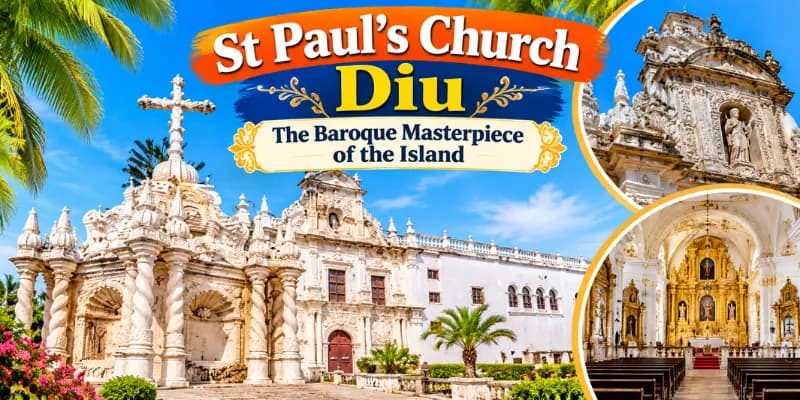
St Paul's Church in Diu is a magnificent 400-year-old Portuguese church, the largest and only working Catholic church on the island and one of India's finest examples of Baroque architecture. Dedicated to Our Lady of Immaculate Conception, it was completed in 1610. Open daily with free entry, it is loveliest in the evening. This guide, from Experience My India, covers it.
St Paul's Church is the jewel of Portuguese heritage in Diu, a soaring Baroque masterpiece that has stood for more than four centuries on this former Portuguese island off the Saurashtra coast. The largest and only operational Catholic church on Diu, it is a place of worship, history and architectural wonder all at once. This guide, from the team behind Somnath Dwarka Tour Package, a unit of Experience My India, covers the history of St Paul's Church, its remarkable architecture and altars, the Jesuit legacy behind it and all the timings and practical details you need to plan your visit, as one of the finest sights near the Diu Fort.
What is St Paul's Church?
St Paul's Church in Diu is a magnificent 400-year-old Portuguese structure that remains the largest and the only operational Catholic church on the island today. Renowned as one of India's finest examples of Baroque architecture, this historical marvel was designed by the Jesuit priest Gaspar Soares. Its foundation stone was laid on 7 April 1601 and construction was completed in 1610, so the church has stood for more than four centuries. Formally dedicated to Our Lady of Immaculate Conception, it captures a timeless blend of European grandeur and local craftsmanship, European in its soaring Baroque forms yet worked by Indian hands in local materials. Still an active church serving Diu's small Christian community, it is at once a living place of worship and a protected heritage treasure and it stands among the most beautiful and historically important buildings anywhere on the island, a direct link to Diu's long Portuguese past.
St Paul's Church at a glance
What it is | Diu's largest and only working Catholic church |
Style | Portuguese Baroque, among India's finest |
Dedicated to | Our Lady of Immaculate Conception |
Designed by | Jesuit priest Gaspar Soares |
Foundation laid | 7 April 1601 |
Completed | 1610, over 400 years old |
Timings and entry | Daily 9:00 AM to 9:00 PM, free |
The history of St Paul's Church
St Paul's Church belongs to the great age of Portuguese presence in Diu. The foundation stone was laid on 7 April 1601 and the church was completed in 1610 and it was formally dedicated to Our Lady of Immaculate Conception. It was designed by the Jesuit priest Gaspar Soares and from its beginning it served not only as a church but as the centre of the Jesuit mission on the island. For over four hundred years it has witnessed the changing fortunes of Diu, from the height of Portuguese power to the island's eventual joining of India and through it all it has remained a living place of Christian worship. Today it is the only operational Catholic church on Diu, still holding masses and services for the local community, which makes it unusual among the island's Portuguese monuments, many of which are now historic shrines rather than working churches. Its long, continuous life gives it a special atmosphere, a place where history is not merely preserved but still lived.
The Baroque facade
The first thing that strikes every visitor to St Paul's is its extraordinary facade. The exterior boasts an incredibly detailed white stucco limestone front, heavily adorned with intricate volutes, shell motifs and scrolling craftsmanship and it is widely considered the most elaborate facade among all the Portuguese churches in India. The gleaming white stucco, worked into curling scrolls and sea-shell forms, gives the church a lightness and exuberance that is the very essence of the Baroque style and the sheer intricacy of the carving rewards slow looking. This facade alone would make St Paul's worth a visit, a piece of seventeenth-century European design executed in Indian limestone on a small island in the Arabian Sea. It is at its most magical in the evening, when the portico is lit, but even by day the white front against the sky is one of the finest architectural sights in Diu.
The altars and interior woodwork
Inside, the glory of St Paul's lies in its woodwork. The church houses three stunning altars carved from Mozambique black-wood, dark and richly worked, while the principal altar is a masterpiece intricately carved out of a single piece of Burmese teak, an astonishing feat of craftsmanship from a single great log. These altars are among the finest church woodcarvings in India, their deep colour and detailed carving glowing in the dim, cool interior. The materials themselves, African black-wood and Burmese teak, speak of the far-flung maritime trade networks of the Portuguese empire that brought such treasures to a church on Diu. Standing before the principal altar, carved from one piece of teak, is one of the most memorable experiences of a visit, a reminder of the devotion and skill that went into this remarkable building over four centuries ago.
The Jesuit legacy
St Paul's Church is deeply tied to the history of the Jesuit order in India. Structurally, it closely resembles the famous Basilica of Bom Jesus in Goa, the great Jesuit church that holds the remains of St Francis Xavier, reflecting their shared Jesuit design heritage. Originally, St Paul's functioned alongside a Jesuit seminary, the College of the Holy Spirit, an important centre of learning where missionaries were taught, including, remarkably, the Arabic language, so that they could visit and converse at the court of the Mughal emperor Akbar. This connects the small island church to one of the great cross-cultural encounters of Indian history, the Jesuit missions to Akbar's famously open and curious court. That a church on Diu was part of this story adds a fascinating historical dimension to a visit, linking the island to Goa, to the wider Jesuit world and to the Mughal empire at its height.
The interior and sanctuary
Beyond the altars, the interior of St Paul's rewards exploration. The sanctuary is defined by a high vaulted stone dome that lifts the eye and fills the space with a sense of grandeur. Around it the church houses historical paintings, including depictions of the birth of Jesus, an ornate carved pulpit from which sermons were given and a Lourdes grotto, a replica of the famous French shrine to Mary. Prominent statues stand throughout, including those of the Sacred Heart, of Mary and of various saints, each finely made and devotionally cared for. Together these elements make the interior a rich and peaceful space to explore slowly, full of the art and devotion of four centuries. For visitors of any faith, it is a serene and beautiful place to pause and for the island's Christian community it remains the heart of their worship, cared for and alive.
Timings, entry and amenities
Here is the practical information for your visit to St Paul's Church:
Detail | Information |
Timings | Open daily, 9:00 AM to 9:00 PM |
Services | Masses and services for the local community of about 450 Christians |
Entry fee | Free for all visitors |
Amenities | Restroom on site |
Accessibility | Wheelchair-accessible parking and entrances |
Best time | Evenings, when the portico is illuminated |
The long daily hours, open until 9:00 PM and the free entry make St Paul's an easy and welcoming stop at almost any time of day. As it is an active church, it is respectful to be quiet and unobtrusive if a mass or service is in progress and to dress modestly as you would at any place of worship.
Best time to visit
While St Paul's is beautiful at any hour, the evenings are highly recommended and are when the church is at its most magical. As dusk falls, the magnificent portico and facade are beautifully illuminated by multi-coloured lights, creating a peaceful and almost surreal ambiance, the white Baroque stucco glowing against the night sky. This is the image of St Paul's that stays with most visitors and with the church open until 9:00 PM there is ample time to enjoy it after the heat of the day. The cooler months from October to March are the most pleasant overall for a Diu visit, when the coastal evenings are especially lovely. Timing your visit for the evening illumination, perhaps after a day exploring the island's forts and beaches, is the perfect way to experience this four-century-old masterpiece.
How to reach St Paul's Church
St Paul's Church is situated near the mouth of the Gulf of Cambay on Diu Island, close to the historic Diu Fort and is easily reached on the small island by local rickshaw, taxi or two-wheeler. Diu has its own airport at Nagoa for regional flights and the nearest major railway junctions are Delwada, about 8 km away and Veraval, about 90 km away on the Saurashtra mainland, while the island is well connected by regular state transport and private buses from major cities in Gujarat and Maharashtra. Diu sits close to the Somnath region, so it is often combined with a Somnath and Gujarat trip, as covered in our places to visit near Somnath and Diu guide and the Diu to Somnath distance guide. For comfortable transport around the region, our Somnath Dwarka taxi service can include Diu.
Combining the church with Diu's sights
St Paul's Church is best enjoyed as part of a fuller day exploring Diu, which is rich in Portuguese heritage and natural beauty. It pairs naturally with the mighty fort close by and with the moving INS Khukri Memorial. For nature and leisure there is the famous Nagoa Beach, the curious Naida Caves and the unique Gangeshwar Mahadev Temple where the sea washes the Shiva lingams. Together these make Diu a destination with a rich blend of faith, history, remembrance and nature, well worth a day or two as part of a wider Somnath, Gir and Junagadh Girnar journey through Saurashtra.
Tips for visiting St Paul's Church
A few pointers help you enjoy the visit:
Visit in the evening, when the portico and facade are beautifully illuminated by multi-coloured lights, for the most magical experience.
Take time to study the elaborate white stucco facade, the most intricate of any Portuguese church in India.
Look closely at the altars, especially the principal one carved from a single piece of Burmese teak.
Remember it is an active church, so be quiet and respectful during any mass or service and dress modestly.
Entry is free and the church is open until 9:00 PM, so it fits easily into the end of a day of sightseeing.
The church has a restroom and wheelchair-accessible parking and entrances, making it comfortable for all visitors.
Pair the visit with the nearby Diu Fort and the island's beaches and other sights for a full day in Diu.
Plan your Diu visit
Experience My India can plan your Diu visit to include St Paul's Church alongside the island's forts, beaches, memorial and temples, with comfortable transport and a well-paced itinerary that catches the church's evening illumination. You can combine Diu with the Somnath temple, the lions of Gir, the heritage of Junagadh and the holy town of Dwarka, stay at well-placed Somnath Dwarka hotels and let the Experience My India Somnath Dwarka tour packages or the wider Gujarat tour packages bring the island and the whole region together in one memorable journey. For when to go, see our best time to visit Gujarat guide.
Related guides
To plan the rest of your Diu and Saurashtra trip, these related guides help:
Related guide | What it covers |
Air, rail and road access to the Somnath region near Diu. | |
The drive from the Somnath coast to the Gir lions. | |
The full library of Somnath, Dwarka and Diu guides. |
Plan your visit
Experience My India can arrange your Diu trip and wider Saurashtra journey. Browse more travel guides, message us on WhatsApp or call +91 73006 20809.

Harsh Rawat
Somnath–Dwarka circuit planning
Harsh Rawat runs Somnath Dwarka Tour Package on the ground in Gujarat, part of Experience My India. Since 2018 he has been planning and driving the Somnath–Dwarka circuit — the darshan timings, the road hours between temples and the stops worth adding — and the routes, fares and timings published across this site are the ones he maintains.