Bhavnath Fair: Junagadh's Mahashivratri Mela at Girnar
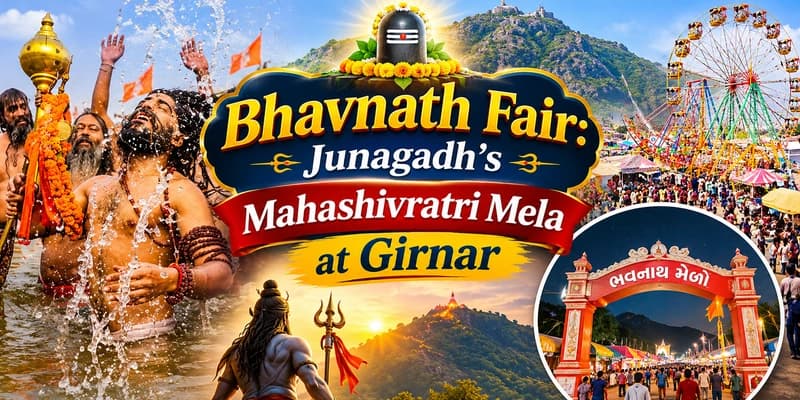
The Bhavnath Fair or Bhavnath Mela, is a five-day Mahashivratri festival at the Bhavnath Mahadev Temple at Girnar Taleti near Junagadh, often called the Mini Kumbh of Gujarat. It climaxes on Maha Shivratri night with the Ravadi procession of Naga Sadhus and their midnight ritual bath at the Mrigi Kund. This guide, from Experience My India, covers it.
The Bhavnath Fair is one of Gujarat's most electrifying spiritual gatherings, a historic five-day mela held each year at the foot of sacred Mount Girnar during Maha Shivratri. Often called the Mini Kumbh of Gujarat, it draws hundreds of thousands of pilgrims and thousands of Naga Sadhus for a spectacle of torch-lit processions, martial displays and midnight ritual at the Bhavnath Mahadev Temple. This guide, from the team behind Somnath Dwarka Tour Package, a unit of Experience My India, covers the fair's dates and five-day span, the grand Ravadi procession, the Naga Sadhus and the sacred Mrigi Kund bath, its legends and significance and everything you need to witness this extraordinary festival.
What is the Bhavnath Fair?
The Bhavnath Fair, also known as the Bhavnath Mahadev Mela, is a historic spiritual gathering celebrated annually during Maha Shivratri at the Bhavnath Mahadev Temple at Girnar Taleti, the foothills of Mount Girnar, near Junagadh. It is so vast and ancient that it is often called the Mini Kumbh of Gujarat, a reference to the great Kumbh Mela, for like the Kumbh it draws immense crowds of pilgrims and, above all, thousands of Naga Sadhus, the ascetic mystics who descend from their Himalayan akhadas for the occasion. Over five days the fairgrounds fill with devotion, folk culture and the raw spiritual energy of the sadhus, building to a dramatic midnight climax on Maha Shivratri. The general festival of Maha Shivratri, celebrated across India, is covered in our Maha Shivratri guide; this page focuses on the Bhavnath Mela itself.
The Bhavnath Fair at a glance
What it is | A five-day Mahashivratri fair, the Bhavnath Mela |
Known as | The Mini Kumbh of Gujarat |
Where | Bhavnath Mahadev Temple, Girnar Taleti, near Junagadh |
Setting | On the Suvarnarekha River, in the Girnar forest |
When | Five days around Maha Shivratri, usually February or March |
Climax | The Ravadi procession and midnight Mrigi Kund bath |
Draws | Thousands of Naga Sadhus and vast pilgrim crowds |
Dates and the five-day span
The Bhavnath Fair officially begins five days before Maha Shivratri, on Maagha Vad Navmi in the Hindu calendar, with a formal flag-hoisting ceremony at the temple and it runs through to the grand finale on Maha Shivratri night. As an illustration, in 2027 the fair is scheduled from 2 March to 6 March, with the main Maha Shivratri night and its climactic rituals culminating at midnight on 6 March. Because the dates follow the lunar calendar, they shift each year with Maha Shivratri, which usually falls in February or March, so check the Shivratri date for your year of travel. While the fairgrounds, exhibitions and free community kitchens run continuously through all five days, the core spiritual events follow a strict traditional schedule that peaks on the final night.
Day one: the flag hoisting
The fair formally commences with the hoisting of the sacred flag, the Dhwaja Arohan, at the Bhavnath Temple during the morning hours of the opening day. This flag-raising marks the official start of the five-day mela and the beginning of the gathering of pilgrims and sadhus. From this moment the fairgrounds come to life, with the annakshetras, the free community kitchens, opening, the exhibitions and bazaars setting up and the first waves of devotees arriving. The opening is a quieter, devotional prelude to the intensity of Shivratri night and it sets the sacred frame around everything that follows over the coming days at the foot of Girnar.
Maha Shivratri night: the Ravadi procession
The heart of the Bhavnath Fair is the Ravadi, the grand torch-lit procession on Maha Shivratri night, which begins from around 9:00 PM. In it, the Naga Sadhus march through the lanes of Bhavnath in an unforgettable display, dancing, performing martial arts, blowing conch shells and chanting Mahadev, their presence electrifying the crowds. The procession is the moment the mela's spiritual energy becomes visible and overwhelming, as the ascetics who have come from across the country parade in their thousands by torchlight. For visitors it is the defining spectacle of the fair, a rare chance to witness the Naga Sadhus, who live apart from society for most of the year, in full procession and it builds the fervour towards the midnight ritual that follows.
The Mrigi Kund ritual bath
At the stroke of midnight, the climax of the fair arrives. The Naga Sadhus reach the Mrigi Kund, the sacred tank within the temple complex, for their holy ritual bath, plunging into its waters in one of the most charged moments of the entire festival. Immediately after this holy dip, the Midnight Mahapuja of the Shiva Lingam commences, the Nishita Kaal Mahapuja, continuing inside the temple until the early morning. Taking a dip in the holy Mrigi Kund on Shivratri night is firmly believed to grant moksha, liberation from the cycle of rebirth and devotees believe that Lord Shiva himself visits the shrine during these midnight rituals. It is this combination of the sadhus' bath, the midnight mahapuja and the belief in Shiva's presence that makes the night at Bhavnath so profoundly sacred.
The Naga Sadhu spectacle
The Naga Sadhus are the soul of the Bhavnath Fair and their presence is its greatest draw. Thousands of them come from different Himalayan akhadas, marching down on elephants, blowing conch shells, waving religious flags and performing intricate martial arts and sword dances known as the Damru Yatra. These ascetics, who renounce worldly life and usually dwell in remote caves and mountains, gather here in extraordinary numbers and seeing them in procession and ritual is a once-in-a-lifetime experience. Their martial displays, their chanting and their sheer spiritual intensity give the mela its reputation as the Mini Kumbh and for many pilgrims and visitors the chance to witness and seek the blessings of these mystics is the very reason to attend the Bhavnath Fair.
History and legends
The Bhavnath Fair is rooted in ancient legend. According to the Skanda Purana, while Lord Shiva and Goddess Parvati were travelling across the sky in their chariot, their divine garment accidentally fell over the spot where the temple's pond stands today and because of this the area is historically known as Vastra Putakshetra. The core Shiva Lingam at the Bhavnath Temple is believed to be swayambhu, self-manifested out of divine intention rather than installed by human hands, which gives the shrine its deep sanctity. The precise historical origin of the fair itself is so ancient that it remains unknown, lost in the depths of time, which only adds to the sense that at Bhavnath one is taking part in a ritual gathering that reaches back beyond memory to the earliest ages of devotion at Girnar.
Spiritual significance
Mount Girnar, which towers above the fair, is revered as the eternal abode of the nine immortal Naths and the eighty-four Siddhas, religiously enlightened souls and local folklore strongly holds that these divine mystics emerge from the hidden caves of the mountain as invisible spirits to join the festivities. This belief gives the Bhavnath Fair an atmosphere charged with the unseen, as though the living sadhus below are joined by the immortal masters above. Combined with the belief that a dip in the Mrigi Kund on Shivratri night grants moksha and that Lord Shiva himself visits the shrine at midnight, the fair becomes far more than a celebration: it is held to be a moment when the barrier between the human and the divine grows thin at the foot of the sacred mountain, which is why it draws the devout in such numbers.
The Girnar Parikrama connection
Many pilgrims combine the fair with a circumambulation of the sacred Girnar hills, a roughly seven-kilometre parikrama performed before entering the fairground, as an act of devotion to the holy mountain. Girnar is one of the most sacred peaks in India, climbed by its famous thousands of steps and ringed by temples and the parikrama is a cherished part of the pilgrimage here. Our guide to the Girnar Parikrama covers the sacred circuit of the mountain in full and our Girnar steps count guide covers the great climb, both of which add depth to a Bhavnath Fair pilgrimage for those who wish to honour the mountain as well as the mela.
Free amenities and the cultural vibe
True to its ancient tradition of hospitality, the Bhavnath Fair looks after its vast crowds. The local administration and temple setups run annakshetras, free community kitchens, providing free meals and accommodation in massive public domes and tents for the hundreds of thousands of visiting pilgrims, so that no devotee goes hungry or without shelter. Beyond the rituals, the fairgrounds are alive with continuous folk music, traditional Gujarati Ras and Garba, devotional bhajans and local vendors selling rudraksha beads, brassware and traditional handicrafts. This blend of free hospitality, folk culture and commerce around the sacred core gives the mela the warm, bustling character of a true pilgrimage fair, where devotion and daily life mingle for five days at the foot of Girnar.
Location and how to reach
The fair is held at the Bhavnath Mahadev Temple at Girnar Taleti, the foothills of Mount Girnar, on the banks of the Suvarnarekha River and surrounded by the dense Girnar forest, approximately 5 to 8 km from the historic city of Junagadh. Junagadh is well connected by road and rail and the temple is a short drive from the city, though expect heavy traffic and crowds during the fair. Our Somnath Dwarka taxi service can arrange transport and because the region is busy at Shivratri, planning your travel and any stay well ahead is wise. The forested Girnar Taleti setting adds greatly to the atmosphere of the mela.
Combining the fair with Junagadh and Girnar
A trip to the Bhavnath Fair pairs naturally with the sights of Junagadh and Girnar. The great mountain itself, with its temples, can be climbed or reached by the Girnar ropeway and its summit shrines include the Dattatreya temple and the Girnar Jain temples. In Junagadh city are the Uparkot Fort and the Mahabat Maqbara and more are gathered in our places to visit in Girnar guide. The lions of Gir and the coastal temples of Somnath lie within easy reach for a fuller Saurashtra journey.
Tips for visiting the Bhavnath Fair
A few pointers help you experience the fair well:
Check the Maha Shivratri date for your year, as the five-day fair shifts with the lunar calendar.
Be at Bhavnath for Shivratri night to witness the Ravadi procession from around 9:00 PM and the midnight Mrigi Kund ritual.
Expect enormous crowds; keep your group together, mind your belongings and be patient with the congestion.
Dress modestly and respectfully and observe the Naga Sadhus with courtesy rather than intruding.
Make use of the free annakshetra meals, but carry water and essentials for the long night.
Consider the roughly seven-kilometre Girnar parikrama beforehand if you wish to honour the mountain.
Plan transport and any accommodation well in advance, as Junagadh fills up around Shivratri.
Plan your Bhavnath Fair visit
Experience My India can plan a trip around the Bhavnath Fair, with transport to Girnar Taleti, a well-timed itinerary for the Shivratri-night rituals and a comfortable base in Junagadh, then weaving in the mountain and city sights. Our Gujarat tour packages and Somnath Dwarka tour packages can build the fair into a fuller Saurashtra journey taking in Somnath, Dwarka and Gir, with a stay at well-placed hotels.
Related guides
To plan your Junagadh and Girnar trip around the fair, these related guides help:
Related guide | What it covers |
Dress code and customs before you climb the sacred mountain. | |
Seasons, the climb and the festival calendar at Girnar. | |
The sacred reservoir at the foot of Girnar nearby. |
Plan your visit
Experience My India can arrange your Bhavnath Fair and wider Saurashtra journey. Browse more travel guides, message us on WhatsApp or call +91 73006 20809.

Harsh Rawat
Somnath–Dwarka circuit planning
Harsh Rawat runs Somnath Dwarka Tour Package on the ground in Gujarat, part of Experience My India. Since 2018 he has been planning and driving the Somnath–Dwarka circuit — the darshan timings, the road hours between temples and the stops worth adding — and the routes, fares and timings published across this site are the ones he maintains.