Famous Art and Craft of Gujarat: A Complete Guide
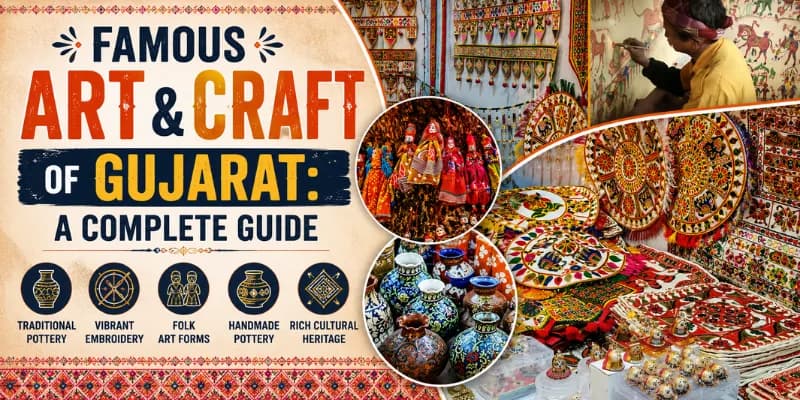
Gujarat's most famous arts and crafts include the Patola silk of Patan, Bandhani tie-dye, Kutch embroidery and mirror work, Ajrakh block printing, and the rare Rogan art of Nirona. The state has 28 GI-tagged crafts, many from the Kutch region, its craft heartland.
Few states in India are as rich in traditional arts and crafts as Gujarat, where centuries-old skills in weaving, dyeing, embroidery, painting and metalwork are still practised by artisan communities. This guide, from the team behind Somnath Dwarka Tour Package, a unit of Experience My India, explores the famous art and craft of Gujarat, what makes each one special and where you can see and buy them. Like the state's food, covered in our famous food of Gujarat guide, its crafts are a window into its vibrant culture.
Gujarat, a land of art and craft
Gujarat's crafts are the pride of its many communities, from the desert villages of Kutch to the weaving towns of Patan and Surendranagar. The recognition is official too: as many as 28 handloom and handicraft products from Gujarat have been awarded the prestigious Geographical Indication or GI, tag, protecting their traditional knowledge and giving global recognition to local artisans. Kutch, in particular, is often called the craft capital of India, home to an astonishing variety of embroidery, block printing, weaving and metalwork under one region. Together, these crafts tell the story of Gujarat's people, faith and landscape in colour and thread.
Famous art and craft of Gujarat at a glance
Textiles | Patola, Bandhani, Ajrakh, Tangaliya, Mashru |
Embroidery | Kutch embroidery, mirror work, Suf, Rabari |
Painting | Rogan art, Mata ni Pachedi, Pithora |
Metal and wood | Copper bells, Sankheda lacquered furniture |
Clay and beads | Khavda pottery, Moti Bharat beadwork |
Craft heartland | Kutch, with Patan, Surendranagar and Surat |
1. Patola of Patan
The Patola of Patan is perhaps the most celebrated of all Gujarat's crafts, a double ikat silk textile so intricate that both the warp and weft threads are resist-dyed before weaving, so the pattern appears identically on both sides. Woven by a handful of master families over months for a single sari, the Patan Patola is legendary for its geometric motifs, glowing colours and eye-watering price and it carries a GI tag. A true Patan Patola is one of the finest handwoven textiles in the world and a treasured heirloom.
2. Bandhani, the art of tie-dye
Bandhani or Bandhej, is Gujarat's famous tie-dye craft, in which thousands of tiny knots are tied by hand into the fabric before dyeing, creating dotted patterns of dazzling colour once the ties are opened. Used for sarees, dupattas, turbans and the auspicious red-and-white Gharcholu wedding cloth, Bandhani is especially associated with Jamnagar and Kutch, both of which hold GI tags for their versions. The skill and patience behind each piece, with its countless resist dots, make Bandhani one of the most beloved textiles of the state.
3. Kutch embroidery and mirror work
The embroidery of Kutch is world-renowned, a dazzling family of styles practised by communities such as the Rabari, Ahir, Mutwa and Suf embroiderers, each with its own stitches, motifs and colours. Rich in chain stitch, satin stitch and intricate geometric work and famously studded with small mirrors or abhla, Kutch embroidery adorns garments, bags, wall hangings and more. Several forms, including Kutch embroidery and Suf embroidery, carry GI tags and the craft is a glittering symbol of the region's artistic heritage.
4. Ajrakh block printing
Ajrakh is Gujarat's magnificent natural-dye block printing craft, centred on the village of Ajrakhpur near Bhuj. Using hand-carved wooden blocks and natural dyes like indigo and madder, artisans build up complex geometric and floral patterns through many painstaking stages of printing, washing and dyeing. The deep blues, reds and blacks of Ajrakh, inspired by nature and tradition, make it one of the most sophisticated printed textiles in India. Kutch Ajrakh holds a GI tag and the craft is treasured by textile lovers worldwide.
5. Rogan art of Nirona
Among the rarest crafts in the world, Rogan art is practised by just a few families of the Khatri community in the village of Nirona, near Bhuj. The artisan boils castor oil for hours until it forms a thick, brightly coloured paste, then draws it out into fine threads with a metal stylus, laying them onto cloth to create intricate, embossed patterns without the brush ever touching the fabric. Often the design is folded to mirror onto the other half. This exquisite, GI-tagged art form, once nearly extinct, has gained fame far beyond Gujarat.
6. Tangaliya weaving
Tangaliya is a distinctive handwoven textile from the Surendranagar region, traditionally made by the Dangasia community. Its signature is the raised dot pattern, created by twisting tiny beads of contrasting coloured thread around the warp during weaving, so the motifs seem to float on the surface of the cloth. Used for shawls, dupattas and dress material, this roughly 700-year-old craft received a GI tag in 2007 and is now enjoying a well-deserved revival, prized for its geometric beauty and tactile texture.
7. Mata ni Pachedi
Mata ni Pachedi, meaning behind the mother goddess, is a striking painted and block-printed temple cloth traditionally made by the Vaghari community of Ahmedabad. When denied entry to temples, the community is said to have created their own portable shrines by painting the mother goddess and her stories onto cloth, using natural dyes in deep reds, blacks and whites. Both a sacred object and a stunning folk art, this GI-tagged craft is a powerful example of devotion expressed through art and is increasingly collected and displayed.
8. Lippan Kaam, mud and mirror art
Lippan Kaam or mud and mirror work, is the beautiful traditional wall art of the Kutch region, seen adorning the interiors of the round mud houses or bhungas, of local communities. Artisans, often women, model raised patterns in a mix of clay and camel dung on the walls, then inlay them with small mirrors that catch and scatter the light. The result is a shimmering, tactile decoration of flowers, peacocks and geometric motifs. Once purely a home craft, Lippan Kaam is now popular as decorative panels and art pieces.
9. Copper bells of Nirona
The village of Nirona in Kutch is famous not only for Rogan art but also for its handcrafted copper-coated bells, made by the Luhar community. Each bell is shaped by hand without any welding, coated in a special powder and fired, then carefully tuned to a precise musical note, so that a set of bells creates a harmonious range of sounds. Traditionally hung on cattle, these melodious bells are now sought after as wind chimes and decorative pieces, a wonderful example of Gujarat's metal craft.
10. Sankheda lacquered furniture
From the town of Sankheda comes Gujarat's famous lacquered woodwork, a GI-tagged craft of turned teak furniture decorated with bright lacquer and gold and maroon patterns. Chairs, cradles, swings and tables are shaped on a lathe and then coated and hand-painted using a distinctive technique that gives them a glossy, ornate finish. Sankheda furniture, especially its traditional swings and baby cradles, is prized across Gujarat for weddings and homes, blending fine craftsmanship with festive colour.
11. Pithora painting
Pithora is a sacred ritual folk painting of the Rathwa and Bhil tribal communities of eastern Gujarat, especially around Chhota Udepur. More a spiritual act than mere decoration, these vivid wall paintings, filled with horses, animals, gods and scenes of daily life, are created on the walls of homes to invoke blessings, prosperity and wellbeing. Painted by ritual artists called lakharas, the GI-tagged Pithora is a living tradition that offers a rare glimpse into the beliefs and artistry of Gujarat's tribal heartland.
12. Beadwork, pottery and more
Gujarat's craft treasury runs deeper still. Moti Bharat, the intricate beadwork of communities like the Bharwad, turns tiny beads into torans, ornaments and decorative items, while the potters of Khavda in Kutch shape and hand-paint elegant terracotta using clay from the Rann. The zari and zardozi metallic thread work of Surat, the Mashru weaving that blends silk and cotton and fine agate and carnelian craft from Khambhat all add to a dazzling range that makes Gujarat one of India's great craft destinations.
Where to see and buy Gujarat's crafts
The best way to experience these crafts is to see them being made and to buy directly from the artisans:
Kutch craft villages: Nirona, Ajrakhpur, Bhujodi and others near Bhuj, for embroidery, Rogan, Ajrakh, bells and weaving.
Patan: for the legendary Patola, where you can watch the double ikat weaving at family workshops.
Surendranagar: for Tangaliya weaving and beadwork.
Ahmedabad: for Mata ni Pachedi, textiles and the excellent Calico Museum of Textiles.
Craft fairs and the Rann Utsav: the winter festival in the white desert of Kutch is a superb place to see and buy crafts under one roof.
Tips for buying authentic Gujarat crafts
A few pointers help you buy well and support the artisans:
Buy directly from artisans or trusted co-operatives where possible, for authenticity and fair prices.
Look for the GI tag or certification for crafts like Patola, Ajrakh and Tangaliya.
Ask about the technique and community, as genuine handwork takes time and skill.
Be wary of cheap machine-made imitations, especially of Bandhani and Patola.
Handmade pieces vary slightly, which is a sign of authenticity, not a flaw.
Carry cash, as many village artisans do not accept cards.
Plan a Gujarat craft and culture trip
Gujarat's crafts pair beautifully with its temples, wildlife and desert. You can combine a Dwarka and Somnath pilgrimage with a craft-focused journey into Kutch, timed with the winter Rann festival. Plan the season with the best time to visit Gujarat and explore the wider state with our Gujarat tour packages. A trip that weaves together devotion, nature and craft is one of the most rewarding ways to experience the state and Experience My India can tailor it to your interests.
Plan your Gujarat trip
Experience My India can plan a Gujarat trip that takes in its crafts, temples and landscapes. Browse the Somnath Dwarka tour packages, book Somnath Dwarka hotels and let a Somnath Dwarka taxi service handle the travel while you explore the state's rich culture.
Related guides
To plan the rest of your Gujarat trip, these related guides help:
Related guide | What it covers |
Air, rail and road access to the Dwarka coast. | |
Access for the Somnath end of the coast. | |
What to eat around the temple town. | |
The best months for the Dwarka coast. | |
When to plan a lion safari on your trip. | |
The sights within the Somnath temple town. |
Plan your visit
Experience My India can arrange your Gujarat trip, taking in its crafts, temples and landscapes. Browse more travel guides, message us on WhatsApp or call +91 73006 20809.

Harsh Rawat
Somnath–Dwarka circuit planning
Harsh Rawat runs Somnath Dwarka Tour Package on the ground in Gujarat, part of Experience My India. Since 2018 he has been planning and driving the Somnath–Dwarka circuit — the darshan timings, the road hours between temples and the stops worth adding — and the routes, fares and timings published across this site are the ones he maintains.