The Rukmini Temple Story, Dwarka: Why Krishna's Queen Stands Apart
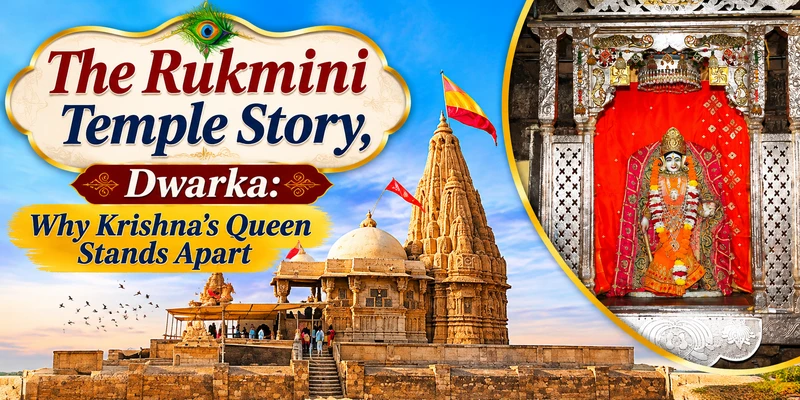
The Rukmini Devi Temple, about 2 km from the main Dwarkadhish Temple in Dwarka, honours Rukmini, Lord Krishna's chief queen and an incarnation of Lakshmi. Legend says Sage Durvasa cursed Rukmini to live apart from Krishna for twelve years, which is why her temple stands separate from his. This 12th-century shrine is a mandatory stop on the Dwarka pilgrimage and this guide, from Experience My India, tells the story and how to visit.
One of the most intriguing questions a pilgrim asks on reaching Dwarka is why Rukmini, the beloved chief queen of Lord Krishna, has her own temple set well apart from his. The answer lies in a tender and cautionary legend and the Rukmini Devi Temple that preserves it is one of the holiest and most atmospheric shrines on this coast. This guide, from the team behind Somnath Dwarka Tour Package, a unit of Experience My India, tells the full story of the Rukmini Temple: the curse of Sage Durvasa, why the temple stands two kilometres from Krishna's, the unique water-offering custom born of the legend, the shrine's ancient architecture and everything you need to plan your visit.
Quick facts
Temple | Rukmini Devi Temple (Rukmini Mata Mandir) |
Dedicated to | Goddess Rukmini, Krishna's chief queen and an incarnation of Lakshmi |
Location | About 2 km northeast of the Dwarkadhish Temple, on the outskirts of Dwarka |
Morning darshan | 6:00 AM to 12:00 PM (some schedules open at 6:30 AM) |
Evening darshan | 4:00 PM to 7:30 PM (up to 8:00 or 8:30 PM by season) |
Entry fee | Free for all visitors |
Best time to visit | October to March; late afternoon light suits the stone carvings |
Built | 12th century (ancient origins, later 19th-century renovations) |
The story: why the temple is separate
The legend behind the temple is told in the Skanda Purana and explains the shrine's unusual distance from Krishna's own. It is said that Lord Krishna and Rukmini once honoured the short-tempered sage Durvasa by inviting him home for a meal and in their humility the divine couple themselves pulled the chariot that carried the sage toward their palace. On the way, Rukmini grew very thirsty and asked Krishna for water. Krishna pressed his toe into the ground and brought forth the holy waters of the Ganges for her to drink, a miracle performed out of love for his queen.
The curse of Sage Durvasa
Here the story turns. Rukmini drank the water to quench her thirst, but in that moment she forgot to first offer some to Sage Durvasa, their honoured guest. The sage, famed for his fiery temper, took this as a deep insult. In his anger he cursed Rukmini to be separated from her beloved Krishna, condemning her to live apart from him for twelve years. It is a poignant reminder, woven into the sacred geography of Dwarka, of how even a small lapse in courtesy toward a guest was believed to carry great consequence and of the humility with which the legend treats even divine figures.
Why the temple stands two kilometres away
It is because of this curse of separation that the Rukmini Devi Temple stands about two kilometres away from the main Dwarkadhish Temple, where Krishna is enshrined as king. The physical distance between the two shrines is understood by devotees as the living memory of the twelve-year separation the curse imposed, turning the very layout of Dwarka into a retelling of the legend. Far from diminishing the queen, the separate temple honours her all the more and tradition holds that no visit to Krishna's city is complete without also paying respects to Rukmini in her own shrine.
The Jal Daan water custom
The legend also gave rise to a unique and touching ritual practised at the temple. Because the story tells that the land around the shrine suffered from brackish or scarce water as a result of the divine curse, devotees here perform Jal Daan, the offering or donation of drinking water to the temple. Pilgrims bring and donate water as an act of devotion and compassion, symbolically easing the thirst that the legend remembers and honouring the moment when Rukmini's own thirst set the story in motion. It is one of the most distinctive customs of any shrine in Dwarka and it makes a visit to the Rukmini Temple feel quietly different from the grander rituals of the main temple.
History and architecture
The Rukmini Devi Temple is a shrine of real antiquity and beauty. While the sacred site's origins are traced back as far as 2,500 years, the structure standing today is believed to date to the 12th century, with some later renovations in the 19th century. It is built in the classic Nagara style of temple architecture and its exterior is its glory: the weathered sandstone is richly carved with figures of gods and goddesses, bands of human figures known as naratharas and rows of elephants, the gajatharas, running along the base platform and up the spire. The late-afternoon sun throws these carvings into relief, which is why October to March and the hours before sunset, are the finest time to admire the exterior.
Inside, the inner sanctum houses a graceful marble idol of Goddess Rukmini. As an incarnation of Lakshmi, she is depicted holding the four emblems of divinity in her hands: the shankha or conch; the chakra or discus; the gada or mace; and the padma, the lotus. The contrast between the ornate, weathered exterior and the serene idol within gives the temple its special character.
Spiritual significance
For pilgrims, the Rukmini Devi Temple is far more than a beautiful monument. Tradition dictates that a pilgrimage to Dwarka is considered incomplete without offering prayers at the Rukmini Temple after visiting the main shrine, so most devotees come here directly after taking darshan of Krishna, whose daily rituals are set out in our Dwarkadhish temple aarti timings guide. Honouring the queen completes the homage to the divine couple and the Jal Daan custom adds an act of charity to the visit. The shrine sits within the wider sacred landscape of Dwarka, one of the four Char Dham of Gujarat and a key part of the Krishna story told across his three cities, which you can read in our guide to Krishna's three cities.
The Kalyanotsavam wedding festival
The temple's most spectacular celebration is the Kalyanotsavam, the re-enactment of the sacred wedding of Krishna and Rukmini, held with great pomp during May and June. A ceremonial procession sets out from the Dwarkadhish Temple and makes its way to the Rukmini Temple, symbolically uniting the divine couple and, for a joyous moment, overcoming the separation that the curse imposed. For devotees, the festival is a vivid and moving spectacle and it is a wonderful, if busy, time to experience the living devotion that surrounds the shrine.
Visiting the Rukmini Temple
The temple is open for darshan in the morning from 6:00 AM to around 12:00 PM and in the evening from about 4:00 PM to 7:30 PM, with the evening session running later in some seasons and entry is free for everyone. It lies about two kilometres northeast of the Dwarkadhish Temple, conveniently along the road that leads toward the Nageshwar Jyotirlinga and Bet Dwarka, so it is easy to fold into a single smooth circuit. A short auto-rickshaw or taxi ride connects it to the main temple and Experience My India can arrange this leg as part of a guided circuit. Please observe the Dwarka temple rules that apply across the region's shrines and consider bringing water for the Jal Daan offering.
Plan your Dwarka pilgrimage
Experience My India can plan a Dwarka pilgrimage that includes the Rukmini Devi Temple alongside the Dwarkadhish temple, Nageshwar Jyotirlinga and Bet Dwarka, with a smooth, well-paced itinerary. Our Somnath Dwarka tour packages and wider Gujarat tour packages weave the shrine into a fuller Saurashtra journey taking in Somnath and Gir, with a stay at well-placed hotels and comfortable local transport throughout. The temple also pairs beautifully with a walk down to the Gomti Ghat in the heart of the city.
Related guides
To explore the shrine and its region further, these related guides help:
Related guide | What it covers |
A compact plan of the holy city's key sights. | |
The footbridge across the Gomti creek in Dwarka. | |
The 8th-century monastery of Adi Shankaracharya. |
Plan your visit
Experience My India can arrange your Dwarka pilgrimage and wider Saurashtra journey. Browse more travel guides, message us on WhatsApp or call +91 73006 20809.

Harsh Rawat
Somnath–Dwarka circuit planning
Harsh Rawat runs Somnath Dwarka Tour Package on the ground in Gujarat, part of Experience My India. Since 2018 he has been planning and driving the Somnath–Dwarka circuit — the darshan timings, the road hours between temples and the stops worth adding — and the routes, fares and timings published across this site are the ones he maintains.