Zampa Gateway Diu: The Crimson Gate of the Walled City
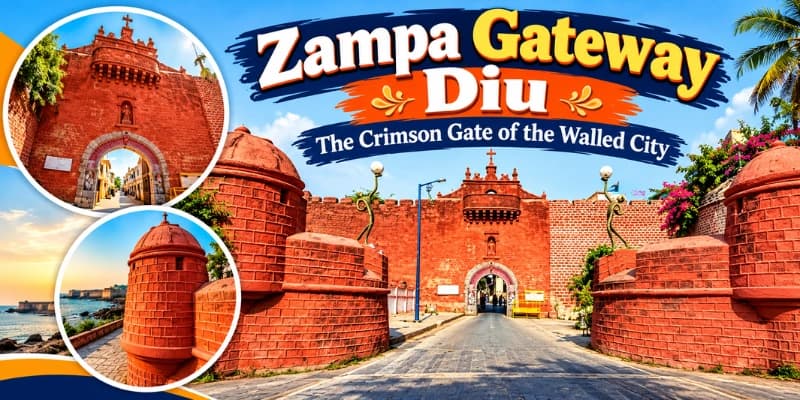
The Zampa Gateway, also called the Diu Fort Gate, is the striking crimson-red Portuguese land gate of Diu's walled old city, built into the medieval city wall near the Naida Caves. Carved with lions, angels and a priest and holding a hidden chapel from 1702, it is a prominent heritage landmark on an active public street. This guide, from Experience My India, covers it.
The Zampa Gateway is one of the most photographed and historically important landmarks in Diu, the great crimson gate through which travellers have passed into the old walled city for centuries. A relic of the island's long Portuguese era, it blends European and Indian design in a single vivid monument. This guide, from the team behind Somnath Dwarka Tour Package, a unit of Experience My India, covers what the Zampa Gateway is, its location in the walled city, its strategic and architectural significance, the hidden chapel within it and how to visit, as one of the essential heritage sights alongside the Diu Fort.
What is the Zampa Gateway?
The Zampa Gateway, also known as the Diu Fort Gate, is one of the most prominent historical and architectural landmarks in Diu. It is the grand land gate of the old walled city, a medieval Portuguese structure built directly into the city wall, through which all movement into and out of the fortified township once passed. Painted a striking crimson red and adorned with carved figures, it is instantly recognisable and has become one of the defining images of Diu. Unlike many monuments that stand apart as museum pieces, the Zampa Gateway remains a living part of the town, an active public street still passing through it, so that modern travellers enter Diu's heritage quarters through the very same gate as the garrisons and traders of centuries past. It is both a historic fortification and a working doorway into the old city, which gives it a special, lived-in character and makes it a wonderful introduction to the layered history of the island.
The Zampa Gateway at a glance
What it is | The Portuguese land gate of Diu's walled old city |
Also known as | The Diu Fort Gate |
Era | The Portuguese colonial period, 1535 to 1961 |
Location | Built into the medieval city wall, northern Diu |
Colour | A vivid, striking crimson red |
Carvings | Lions, angels and a priest above the archway |
Hidden feature | An inner chapel with an image from 1702 CE |
Where is the Zampa Gateway?
The Zampa Gateway is strategically located in the historic centre of northern Diu, built directly into the expansive medieval city wall. The old town of Diu is essentially sandwiched between this landward gateway on its western side and the massive Diu Fort on its east, so the gate and the fort together frame the historic quarter. It sits roughly 1 km from the Diu Bus Station and very close to the famous rock-cut Naida Caves and it acts as a passing point on the route leading towards the waterfront. This central position means you will very likely pass through or by the Zampa Gateway as you explore the old city and it makes an easy and natural stop between the bus station, the caves and the fort, right in the heart of Diu's heritage zone.
Historical and strategic significance
Dating back to the medieval Portuguese colonial era, which lasted in Diu from 1535 to 1961, the gateway held immense strategic and military importance. It served as the main land entrance to the fortified township and to the island itself, the key point of control through which the Portuguese military garrison could watch and patrol all movement between the outer harbour, the trade routes and the local residential sectors. In an age when control of a port meant wealth and power, a gate like this was a vital instrument of authority. Combined with the city walls, the Zampa Gateway helped fortify Diu into a powerful defensive bulwark, part of the system of fortifications that enabled the small island to withstand historical sieges from regional sultans, the Ottoman Empire and the Dutch. To stand at the gate is to stand at the very threshold that armies and traders alike had to pass, a place where the long, contested history of this strategic island is written in stone.
Architectural significance
The Zampa Gateway is celebrated as much for its beauty as for its history, with a distinct visual identity born of cultural fusion. Its most immediate feature is its colour, for the monument is painted in a striking, vibrant crimson red that makes it stand out boldly from the surrounding urban landscape, impossible to miss and wonderful to photograph. Its design is a beautiful blend of Indian and European styles, an east-meets-west fusion typical of the best Portuguese colonial architecture in India. The highlight is the carved stone panel set above the archway, which features intricate figurative carvings of lions, angels and a priest, an expressive mingling of imperial power, Christian faith and local craft in a single sculpture. This combination of vivid colour and detailed, symbolic carving gives the gateway a character all its own and it is this fusion of cultures in stone that makes it so beloved by visitors and photographers alike.
The hidden chapel
One of the most charming and little-known features of the Zampa Gateway is its hidden chapel. Just inside the inner side of the gateway there is a small historical chapel, easy to miss if you simply pass through, containing an inscription and a sacred image of the Virgin Mary and Child dating back to 1702 CE. This quiet shrine, tucked into the great gate, adds a layer of devotional meaning to what might otherwise seem a purely military structure, a reminder that for the Portuguese the defence of the island and their faith went hand in hand. For the visitor who takes a moment to look, the three-centuries-old image is a lovely and unexpected discovery and it rewards a slower, more curious exploration of the gateway rather than a quick glance in passing. It is exactly the kind of hidden detail that makes exploring Diu's Portuguese heritage so rewarding.
Visiting the Zampa Gateway today
What makes the Zampa Gateway special among heritage sites is that it is not a detached museum piece behind a fence but a vibrant, living part of the town. An active public street still runs through it, so the gateway welcomes modern travellers into Diu's heritage quarters just as it always has, with the everyday life of the island flowing around and through it. There is no ticket and no set visiting time, since it is simply part of the open streetscape, so you can see it at any hour and it takes only a short stop to admire the crimson facade, study the carvings above the arch and seek out the hidden chapel within. This living quality is part of its charm and it means the gateway fits effortlessly into any walk through the old city, a grand and colourful landmark encountered in the natural course of exploring Diu on foot or by rickshaw.
How to reach the Zampa Gateway
The Zampa Gateway is in the historic centre of northern Diu, about 1 km from the Diu Bus Station and close to the Naida Caves, easily reached on the small island by local rickshaw, taxi or two-wheeler or on foot as part of a walk through the old city. Diu is reached by road from the Saurashtra coast and sits close to the Somnath region, so it is often combined with a Somnath and Gujarat trip, as covered in our places to visit near Somnath and Diu guide and the Diu to Somnath distance guide. For a comfortable way to reach Diu and tour the island and the wider region, our Somnath Dwarka taxi service can include it and our how to reach Somnath guide covers the approach to this corner of the coast.
Combining the gateway with Diu's sights
The Zampa Gateway is best seen as part of a wider exploration of Diu's rich heritage and it sits conveniently among the island's main sights. The great fort stands at the eastern end of the old city that the gateway guards to the west and the rock-cut caves are a short step away. Elsewhere on the island are the Baroque St Paul's Church, the moving INS Khukri Memorial, the famous Nagoa Beach and the unique Gangeshwar Mahadev Temple where the sea washes the Shiva lingams. Together they make Diu a destination with a rich blend of history, faith, remembrance and nature, well worth a day or two as part of a wider Somnath, Gir and Junagadh Girnar journey through Saurashtra.
Tips for visiting the Zampa Gateway
A few pointers help you enjoy the visit:
Look up at the carved stone panel above the archway to see the lions, angels and priest, the gateway's finest detail.
Seek out the hidden chapel just inside the gate, with its image of the Virgin Mary and Child dating to 1702.
The crimson facade photographs beautifully, so have your camera ready, especially in the softer light of morning or evening.
There is no ticket or set timing, as it is part of an active public street, so you can see it at any hour on your walk.
Combine it with the nearby Naida Caves and the Diu Fort, which frame the old city the gateway guards.
Explore the old city on foot or by rickshaw to appreciate how the gate fits into the historic walled quarter.
Take a moment to picture the garrisons and traders who once passed through this very gate over the centuries.
Plan your Diu visit
Experience My India can plan your Diu visit to include the Zampa Gateway alongside the island's forts, churches, beaches and temples, with comfortable transport and a well-paced itinerary through the old city. You can combine Diu with the Somnath temple, the lions of Gir, the heritage of Junagadh and the holy town of Dwarka, stay at well-placed Somnath Dwarka hotels and let the Experience My India Somnath Dwarka tour packages or the wider Gujarat tour packages bring the island and the whole region together in one journey. For when to go, see our best time to visit Gujarat guide.
Related guides
To plan the rest of your Diu and Saurashtra trip, these related guides help:
Related guide | What it covers |
When to add a Gir safari to your Diu and Saurashtra trip. | |
The full library of Somnath, Dwarka and Diu guides. |
Plan your visit
Experience My India can arrange your Diu trip and wider Saurashtra journey. Browse more travel guides, message us on WhatsApp or call +91 73006 20809.

Harsh Rawat
Somnath–Dwarka circuit planning
Harsh Rawat runs Somnath Dwarka Tour Package on the ground in Gujarat, part of Experience My India. Since 2018 he has been planning and driving the Somnath–Dwarka circuit — the darshan timings, the road hours between temples and the stops worth adding — and the routes, fares and timings published across this site are the ones he maintains.