Baldev Gufa Somnath: The Cave Where Balarama Left the World
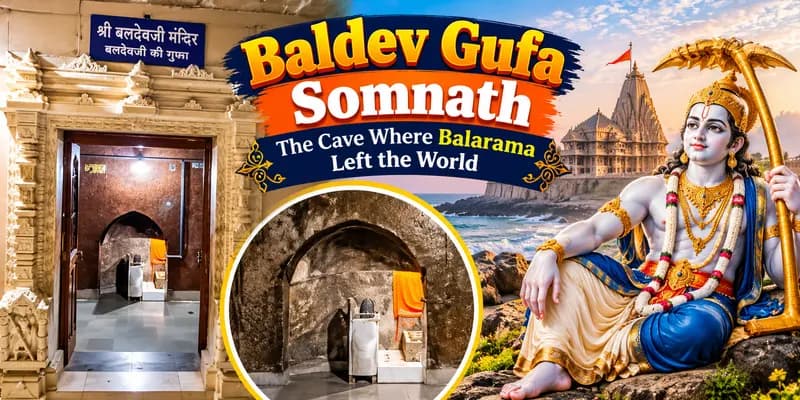
Baldev Gufa, also called Balaram Gufa or Dauji-ni Gufa, is a revered cave temple in the Golok Dham Teerth complex near Somnath, Gujarat, held to be the spot where Lord Balarama left the mortal world as the serpent Sheshnag. It is open 6:00 AM to 6:00 PM, entry is free and it sits about 2 km from the main temple. This guide, from Experience My India, covers it.
Baldev Gufa is one of the most spiritually charged sites around Somnath, a quiet cave temple set on the banks of the Hiran River that marks the final chapter of a great Puranic story. Revered as the place where Lord Balarama, the elder brother of Lord Krishna, relinquished his earthly form, it draws pilgrims seeking peace and liberation and it completes the sacred circuit of Krishna's departure that unfolds across Prabhas Patan. This guide, from the team behind Somnath Dwarka Tour Package, a unit of Experience My India, covers the cave's profound legend, its atmosphere, its place within the Golok Dham Teerth complex and the timings, location and travel details you need to include this deeply meaningful shrine in your Somnath visit.
What is Baldev Gufa?
Baldev Gufa, known variously as Balaram Gufa or Dauji-ni Gufa, is a highly revered cave temple located within the Shri Golok Dham Teerth complex in Prabhas Patan, Gujarat. The cave holds profound mythological importance as the exact spot where Lord Balarama departed from the mortal world in his primordial form as the multi-headed serpent deity, Sheshnag. It is not a grand or ornate structure but a simple, atmospheric cave shrine and its power lies entirely in its sacred associations and the deep stillness within. For pilgrims visiting Somnath, it is an essential part of the wider spiritual landscape, the counterpart to the nearby sites where Lord Krishna ended his own earthly journey and a place of quiet, intense devotion rather than spectacle.
Baldev Gufa at a glance
Also known as | Balaram Gufa, Dauji-ni Gufa |
What it is | A revered cave temple of Lord Balarama |
Significance | Where Balarama left the world as Sheshnag |
Location | Shri Golok Dham Teerth complex, Prabhas Patan |
Opening hours | 6:00 AM to 6:00 PM daily |
Entry fee | Free of charge |
Time needed | About 30 to 45 minutes |
The legend of Balarama's departure
The cave's importance flows from one of the most poignant episodes in the Krishna story. According to ancient Puranic legend, after Lord Krishna was wounded at Bhalka Tirth, he walked to the banks of the Hiran River to complete his earthly journey. His elder brother, Lord Balarama, known affectionately as Baldev or Dauji, sat in deep meditation inside this quiet cave and relinquished his human form. The two brothers, whose lives were so closely entwined through the great epics, thus concluded their time on earth within the same sacred stretch of Prabhas Patan. This is why the cave is so revered, for it marks not an ordinary death but the serene, willed departure of a divine being and standing within it pilgrims feel themselves at the very threshold of that cosmic moment.
The reincarnation as Sheshnag
What makes Baldev Gufa especially remarkable is the belief about how Balarama departed. Traditional belief states that Balarama emerged from the cave in his primordial form as the great cosmic serpent Sheshnag, the thousand-headed naga on whom Lord Vishnu reclines and crawled directly into the netherworld, Patala, through the cave's deep recesses. The cave is therefore seen as a literal doorway between the mortal world and the realms below, the passage by which the serpent deity returned to the cosmic depths. This is the source of the cave's mystique and of the intense reverence in which it is held and it is why the deep, dark recesses of the cave carry such a powerful charge for the devout.
The cave and its atmosphere
Visitors to Baldev Gufa often speak of its intense spiritual vibrations. The cave houses a shrine dedicated to Lord Baldev and Sheshnag, where pilgrims come to pray for peace and liberation and the atmosphere within is hushed, cool and deeply meditative, a world away from the bustle of the main temple town. It is a place to slow down, to sit quietly and to feel the weight of the legend that surrounds it. Many find it one of the most moving stops in the whole Somnath circuit precisely because of this stillness, the sense of standing in a sacred threshold where a divine journey ended. Even for those drawn more by history and culture than by faith, the cave offers a profound and memorable encounter with the living mythology of the region.
Location within Golok Dham Teerth
Baldev Gufa sits inside the Shri Golok Dham Teerth campus, also known as Dehotsarg Tirth, on the scenic banks of the Hiran River near the Triveni Sangam Ghat, the sacred confluence where three rivers meet the sea. This places it within the holiest cluster of sites in Prabhas Patan, the same riverside stretch associated with the final earthly moments of Lord Krishna. The cave lies roughly 2 km east of the primary Shree Somnath Jyotirlinga Temple, close enough to visit easily as part of the same trip yet set in its own tranquil riverside setting. The walk down to the Hiran and the Triveni Sangam adds to the sense of pilgrimage and the whole complex rewards an unhurried, reflective visit.
Timings and entry
Visiting Baldev Gufa is simple and free. Here are the essentials:
Opening hours | 6:00 AM to 6:00 PM daily |
Entry fee | Free of charge |
Time needed | About 30 to 45 minutes for the cave and complex |
Location | Golok Dham Teerth, about 2 km east of the main temple |
The cave is open every day from 6:00 AM to 6:00 PM and there is no entry fee. Around 30 to 45 minutes is enough to tour the cave and the immediate temple complex at a relaxed pace, taking in the riverside setting along with the shrine, so it slots easily into a wider day of sightseeing around Somnath. As with all temples in the area, modest dress is appropriate and the quiet, meditative nature of the cave is best respected with a calm and unhurried visit.
The Golokdham Utsav festival
While the cave is open to visitors year-round, its most spiritually charged event is the Golokdham Utsav, which commemorates the divine departure of Lord Krishna and Lord Balarama. Managed directly by the Shree Somnath Trust, the annual festival aligns strictly with the spring lunar cycles of the Hindu calendar, so its date shifts a little each year. It was observed on 30 March in 2025 and on 19 March in 2026 and following this spring pattern it falls in late March or early April. If your visit coincides with the Utsav, you will find the normally tranquil cave and complex transformed by special observances and large numbers of devotees, a profoundly atmospheric time to experience this sacred site, though the cave is deeply moving to visit at any time of year.
How to reach Baldev Gufa
Baldev Gufa is about 2 km east of the main Somnath temple, within the Golok Dham Teerth complex on the Hiran River, so it is a short hop from the heart of the temple town, easily reached by taxi or auto-rickshaw. Most visitors fold it into a round of the Prabhas Patan pilgrimage sites. Somnath itself is well connected by road, rail and air, with Veraval the nearest railhead and our how to reach Somnath guide covers the routes in full. For comfortable local transport that can take in the cave along with the other sites, our Somnath Dwarka taxi service can help and our best time to visit Somnath guide helps you choose your season.
Combining Baldev Gufa with Somnath's sites
Baldev Gufa is best experienced as part of the wider Somnath pilgrimage. The great Somnath Jyotirlinga temple is the heart of any visit, with its daily rituals set out in our Somnath aarti timings guide and its visitor rules in our Somnath Temple dress code guide. There is much more to see around the town, as covered in our things to do in Somnath and sightseeing places in Somnath guides. Further afield lie Krishna's holy city of Dwarka, the lions of Gir and the heritage of Junagadh and Girnar, so the cave fits neatly into a fuller Saurashtra journey.
Tips for visiting Baldev Gufa
A few pointers help you get the most from a visit:
Visit between 6:00 AM and 6:00 PM and allow about 30 to 45 minutes for the cave and the riverside complex.
Combine it with the main Somnath temple and the other Prabhas Patan pilgrimage sites in one trip.
Dress modestly and keep your visit calm and quiet in keeping with the cave's meditative atmosphere.
Take time to walk down to the Hiran River and the Triveni Sangam Ghat nearby.
If you can, time your visit for the Golokdham Utsav in spring for the most charged atmosphere.
Reach it easily by taxi or auto-rickshaw, as it is only about 2 km from the main temple.
Entry is free, so it is an easy and rewarding addition to any Somnath itinerary.
Plan your Somnath visit
Experience My India can plan your Somnath pilgrimage to include Baldev Gufa alongside the main temple, Bhalka Tirth, the Triveni Sangam and the town's other sacred sites, with comfortable transport and a thoughtfully paced itinerary. Our Somnath Dwarka tour packages and wider Gujarat tour packages weave these sites into a fuller Saurashtra journey taking in Dwarka, Gir and the coast, with a stay at well-placed Somnath Dwarka hotels.
Related guides
To plan the rest of your Somnath visit, these related guides help:
Related guide | What it covers |
How to arrange a quicker darshan at the main temple. | |
Another of the twelve Jyotirlingas, near Dwarka up the coast. | |
The drive from the Somnath coast to the Gir lions. |
Plan your visit
Experience My India can arrange your Somnath pilgrimage and wider Saurashtra journey. Browse more travel guides, message us on WhatsApp or call +91 73006 20809.

Harsh Rawat
Somnath–Dwarka circuit planning
Harsh Rawat runs Somnath Dwarka Tour Package on the ground in Gujarat, part of Experience My India. Since 2018 he has been planning and driving the Somnath–Dwarka circuit — the darshan timings, the road hours between temples and the stops worth adding — and the routes, fares and timings published across this site are the ones he maintains.