Diu Museum: The Archaeological Treasure in St Thomas Church
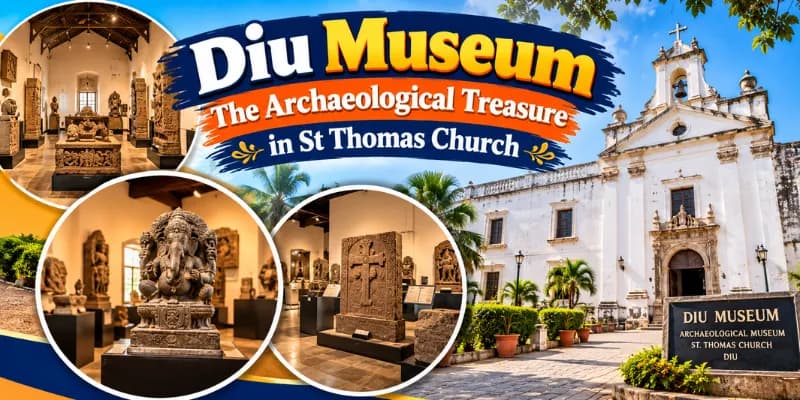
The Diu Museum is an archaeological treasure house on Diu Island, housed inside the 16th-century former St Thomas Church, a Gothic Portuguese building. It holds 400-year-old statues, stone inscriptions, Hindu idols and relics, with free entry. Note it is undergoing restoration at the time of writing. This guide, from Experience My India, covers it.
The Diu Museum is one of the most atmospheric heritage attractions on Diu Island, an archaeological treasure house set inside a beautiful decommissioned sixteenth-century Portuguese church. Its exhibits trace the island's long Gujarati and Portuguese history, in a building that is itself a monument. This guide, from the team behind Somnath Dwarka Tour Package, a unit of Experience My India, covers what the Diu Museum is, the remarkable story of the church that houses it, its major exhibits and all the timings and practical details you need to visit, as one of the heritage highlights near the Diu Fort.
What is the Diu Museum?
The Diu Museum is an archaeological museum on Diu Island, famously housed inside a decommissioned sixteenth-century Portuguese church, the former St Thomas Church. Converted to a museum in 1992, it acts as a visual timeline of the island's history, displaying statues, inscriptions, idols and relics that span the Gujarati and Portuguese colonial eras. What makes it special is the setting, for the exhibits are shown within a genuine old Gothic church, so that the building and its contents together tell the story of Diu's layered past. It is a quiet, evocative place, where centuries-old Christian statues stand alongside ancient Hindu idols and stone inscriptions, all beneath the vaults of a church that has seen the island change hands and change use many times over. For anyone interested in the history of Diu and its unusual blend of Indian and European heritage, the museum is a fascinating and moving stop, as much for the building as for the treasures it holds.
The Diu Museum at a glance
What it is | An archaeological museum in a former church |
Housed in | The 16th-century St Thomas Church |
Built | 1598, by order of Bishop D. Aleixo Menezes |
Style | Gothic Portuguese architecture |
Became a museum | In 1992 |
Entry | Free (remove footwear before the main hall) |
Note | Undergoing restoration at the time of writing |
From church to museum: the history
The building that houses the Diu Museum has a rich and unusual history. It was built in 1598 by the order of Bishop D. Aleixo Menezes and originally served as the very first parish church of Diu, the St Thomas Church, in a distinct Gothic style. After it ceased to function as a regular parish church, the edifice was repurposed many times over the centuries for a variety of secular uses, serving at different times as an orphanage, a nursing home and home for the aged, a local police station and even housing an Angolan battalion in the period before the liberation of Diu from Portuguese rule. This remarkable sequence of lives, from church to orphanage to police station to barracks, mirrors the turbulent history of the island itself. Finally, in 1992, the government officially converted the long-abandoned structure into an archaeological museum, giving it its present and most fitting role. Regular prayer services are no longer held, but a special annual mass is still observed here on All Saints' Day, the first of November, a lovely link to the building's sacred origins.
The Gothic architecture
As one of the oldest churches built on Diu, the St Thomas Church that houses the museum is a fine example of Gothic Portuguese architecture and the building is an exhibit in its own right. Its elegant external facade, with the pointed forms and detailing of the Gothic style, makes it one of the handsome landmarks of Diu town and even when the interior is not fully open, the exterior is well worth admiring. Standing on an elevated platform, the whitewashed church presents a dignified, slightly austere beauty, quite different from the exuberant Baroque of the island's working church. Faint old Portuguese frescoes can still be seen on the whitewashed walls inside, ghostly traces of the building's devotional past and the whole structure carries the atmosphere of its four centuries. For lovers of architecture and history, the building is reason enough to visit, a rare surviving Gothic church from the earliest days of the Portuguese presence on the island.
Major exhibits and artifacts
The museum's collection acts as a visual timeline of Diu's Gujarati and Portuguese history, with several categories of treasure to see:
400-year-old statues. Intricately carved wooden and marble statues of Christian figures such as St Thomas and St Benedict, showcasing a unique blend of European styles mixed with native Indian craftsmanship.
Archaeological findings. Ancient stone inscriptions left behind by regional historic rulers, antique idols of Hindu deities and artifacts excavated from around the island, spanning its pre-Portuguese and colonial past.
Unique collectibles. Rare shadow-clocks or sundials, old Portuguese frescoes faintly visible on the whitewashed walls and the multi-coloured fountains that dot the pathway outside.
Together these exhibits tell the layered story of Diu, where European and Indian, Christian and Hindu, ancient and colonial all meet. The side-by-side display of Christian statues and Hindu idols in a former church is especially striking and captures the cultural fusion that defines the island's heritage.
Timings, entry and current status
Here is the practical information for your visit to the Diu Museum:
Detail | Information |
Timings | Historically 9:00 AM to 7:00 PM or 8:00 AM to 6:00 PM by season |
Entry fee | Free for all visitors |
Footwear | Visitors are requested to remove footwear before the main hall |
Current status | Undergoing extensive restoration and renovation |
Address | St Thomas Church Building, Government Quarters, Diu Town 362520 |
Best paired with | St Paul's Church, about 450 m away |
Please note that at the time of writing the museum is undergoing extensive restoration and renovation. While visitors can still admire its beautiful external Gothic facade, parts of the interior exhibits may be temporarily limited or inaccessible, so it is worth checking locally on the current state of access before you go. Entry is free and visitors are requested to remove their footwear before entering the main hall, as a mark of respect in the former church.
Diu Museum and St Paul's Church: two different churches
It is worth being clear that Diu has two important church buildings that visitors sometimes confuse. The Diu Museum is set in the former St Thomas Church, the island's first parish church, built in 1598 in the Gothic style, which is now a museum rather than a working church. The St Paul's Church is a different building, a magnificent Baroque church completed in 1610 and dedicated to Our Lady of Immaculate Conception, which remains the island's only active Catholic church. The two stand only about 450 metres apart, so they are easily seen together and seeing both lets you compare the earlier Gothic church, now a museum, with the later Baroque church that is still alive with worship, a wonderful contrast of styles and fortunes within a short walk.
How to reach the Diu Museum
The Diu Museum is centrally located in Diu town, on an elevated platform within the Diu Fort complex area, at the St Thomas Church building in the Government Quarters. It is roughly 1.5 km from the Diu Bus Stand and just a short walk, about 450 metres, from the active St Paul's Church, so it is easily reached on the small island by local rickshaw, taxi or on foot. Diu is reached by road from the Saurashtra coast and sits close to the Somnath region, so it is often combined with a Somnath and Gujarat trip, as covered in our places to visit near Somnath and Diu guide and the Diu to Somnath distance guide. For comfortable transport around the region, our Somnath Dwarka taxi service can include Diu and our how to reach Somnath guide covers the approach to this corner of the coast.
Combining the museum with Diu's sights
The Diu Museum sits right among the island's main attractions, making it easy to combine into a heritage walk. Close by are the mighty fort and the crimson Zampa Gateway, along with the rock-cut Naida Caves and the moving INS Khukri Memorial. For leisure there is the famous Nagoa Beach and for a unique experience the Gangeshwar Mahadev Temple where the sea washes the Shiva lingams. Together they make Diu a destination with a rich blend of history, faith, remembrance and nature, well worth a day or two as part of a wider Somnath, Gir and Junagadh Girnar journey through Saurashtra.
Tips for visiting the Diu Museum
A few pointers help you enjoy the visit:
Check locally on the current state of access first, as the museum is undergoing extensive restoration and parts may be limited.
Even if the interior is restricted, admire the beautiful external Gothic facade of the old St Thomas Church.
Remove your footwear before entering the main hall, as requested, out of respect for the former church.
Look for the 400-year-old statues of St Thomas and St Benedict, the faint old frescoes and the ancient inscriptions and idols.
Pair the museum with St Paul's Church, just 450 metres away, to compare the Gothic and Baroque churches of Diu.
Entry is free, so it is an easy addition to a heritage walk around the Diu Fort complex area.
Combine it with the fort, the Zampa Gateway and the island's other sights for a full day in Diu.
Plan your Diu visit
Experience My India can plan your Diu visit to include the Diu Museum alongside the island's forts, churches, beaches and temples, with comfortable transport and a well-paced itinerary through the heritage quarter. You can combine Diu with the Somnath temple, the lions of Gir, the heritage of Junagadh and the holy town of Dwarka, stay at well-placed Somnath Dwarka hotels and let the Experience My India Somnath Dwarka tour packages or the wider Gujarat tour packages bring the island and the whole region together in one journey. For when to go, see our best time to visit Gujarat guide.
Related guides
To plan the rest of your Diu and Saurashtra trip, these related guides help:
Related guide | What it covers |
When to add a Gir safari to your Diu and Saurashtra trip. | |
The full library of Somnath, Dwarka and Diu guides. |
Plan your visit
Experience My India can arrange your Diu trip and wider Saurashtra journey. Browse more travel guides, message us on WhatsApp or call +91 73006 20809.

Harsh Rawat
Somnath–Dwarka circuit planning
Harsh Rawat runs Somnath Dwarka Tour Package on the ground in Gujarat, part of Experience My India. Since 2018 he has been planning and driving the Somnath–Dwarka circuit — the darshan timings, the road hours between temples and the stops worth adding — and the routes, fares and timings published across this site are the ones he maintains.