Dwarka Mahatmya: The Sacred Greatness of Krishna's City
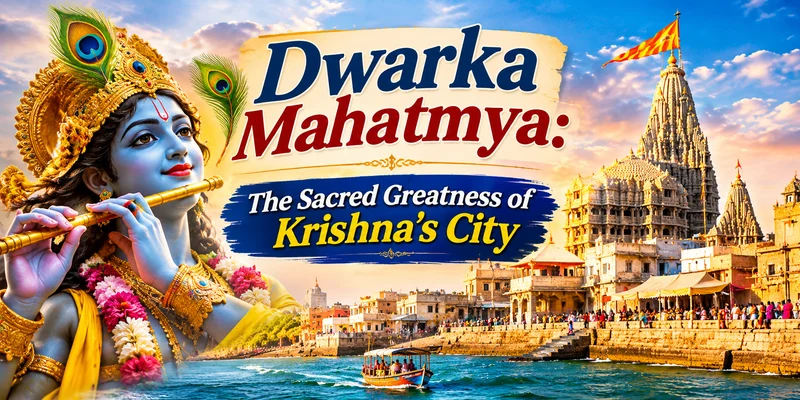
The Dwarka Mahatmya, meaning the glorious greatness of Dwarka, is a sacred text within the Skanda Purana that sets out why Dwarka, the capital of Lord Krishna, is one of Hinduism's holiest places. It explains the city's divine founding, the 16 Kalas Krishna left in its idol, and the great spiritual merit and liberation a pilgrim earns here. This guide, from Experience My India, explains the Mahatmya and the sacred sites it glorifies.
Every great pilgrimage city of India has its Mahatmya, a sacred text that proclaims its greatness and for Dwarka that text is the Dwarka Mahatmya. More than a legend, it is a spiritual and devotional manual that explains why this city on the far western coast of Gujarat is counted among the holiest places in the world, what merit a pilgrim earns here and which sacred sites to honour. This guide, from the team behind Somnath Dwarka Tour Package, a unit of Experience My India, explains what the Dwarka Mahatmya is, where it comes from, the profound spiritual framework it lays out and the sacred geography it glorifies across Krishna's holy city.
What is the Dwarka Mahatmya?
The word Mahatmya means greatness or glory and a Mahatmya text is a scriptural account of the sanctity of a holy place, telling pilgrims why it is sacred and how to earn its blessings. The Dwarka Mahatmya is exactly this for Dwarka: a comprehensive spiritual and historical manual detailing the supreme sanctity of Krishna's legendary capital and providing guidelines for the pilgrims who visit this sacred region. It gathers the city's origins, its divine associations and its promises of merit and liberation into a single revered discourse and it is the scriptural foundation on which Dwarka's standing as a great pilgrimage centre rests.
Scriptural origins of the text
The Dwarka Mahatmya is preserved as an important section within the Skanda Purana, the largest of the eighteen major Puranas, where it sits in the Prabhasa Khanda, the portion devoted to the holy places of this coast. The discourse comprises forty-four chapters and it is framed as a revelation delivered by the great devotee Saint Prahlada to a gathering of curious sages who wished to understand the greatness of Dwarka. This framing, a realised devotee instructing earnest seekers, is a classic device of the Puranas and it lends the text both authority and warmth, presenting the glory of Dwarka not as dry doctrine but as knowledge lovingly shared with those who seek it.
The founding of the golden city
The Mahatmya chronicles the divine founding of the city. It tells how Lord Krishna migrated from Mathura to protect the Yadava people from the tyrant Jarasandha, reclaimed twelve Yojanas of land, about 96 square kilometres, from Samudra, the Sea God and had the divine architect Vishwakarma raise a majestic golden city upon it, known as Kushasthalipuri or Dvaravati. This founding story is the setting for the whole of Dwarka's greatness and we tell it in full, as part of Krishna's journey across his three cities, in our guide to Krishna's three cities, which traces his path from Mathura through Vrindavan to Dwarka.
The submergence and the enduring deity
The Mahatmya does not shy away from the city's end. It addresses the transition into Kali Yuga, the dark age, describing how, following Krishna's departure from the mortal plane, the physical golden city was reclaimed by the ocean. Yet the text makes clear that the spiritual essence of Dwarka remained anchored through the main deity, installed by Krishna's great-grandson Vajranabha, so that the holiness of the place endured even after the city itself was lost beneath the waves. The remarkable evidence that marine archaeology has since found for this submerged city is explored in our guide to how deep underwater Dwarka is.
The 16 Kalas and the Chaturbhuj idol
One of the most profound teachings of the Dwarka Mahatmya concerns the deity of the Dwarkadhish Temple itself. The text relates that, before leaving the earth, Lord Krishna infused all sixteen of his divine attributes, the sixteen Kalas, into the four-armed Chaturbhuj idol worshipped at Dwarka as Tribhuvan Vishnu or Ranchhodraiji. In Hindu thought the sixteen Kalas represent the complete fullness of divinity and it is said that Krishna alone among all avatars was a complete, sixteen-Kala incarnation. By pouring all sixteen into the idol, Krishna transformed it into a permanent gateway of divine presence, so that worshipping at Dwarka is believed to bring the devotee before the complete and undiminished presence of the Lord. The daily worship of this deity is set out in our Dwarkadhish temple aarti timings guide.
The curse of separation
Among the narratives within the Mahatmya is a memorable test of humility involving the short-tempered Sage Durvasa. The story relates that, because of a momentary misstep in hospitality, Durvasa cursed Krishna's consort Rukmini with thirst and with separation from Krishna. This is the scriptural explanation for why the Rukmini Devi Temple stands distinct and detached, outside the main city boundary, rather than beside Krishna's own shrine and for the unique water-offering custom practised there. The episode is a gentle reminder, set even among the divine, of the importance of courtesy and humility toward one's guests.
Moksha and the merit of pilgrimage
At its heart, the Dwarka Mahatmya is a promise of spiritual reward, which is what makes it so beloved of pilgrims. It explains the exact framework that places Dwarka among the Sapta Puri, the seven holy cities that grant liberation and as a cornerstone of the Char Dham pilgrimage. The text declares that every step taken toward the holy shrine yields merit equivalent to performing an Ashwamedha Yagya, the great horse sacrifice of the kings of old and that taking a holy dip at the Chakra Tirtha or where the Gomti meets the sea, washes away the sins of generations and grants release from the cycle of rebirth. It is this guarantee of moksha that draws devotees from across India to the Gomti Ghat to bathe in its sacred waters.
The sacred sites the Mahatmya glorifies
The Mahatmya does not glorify the Dwarkadhish Temple alone but a whole sacred landscape. The territory it praises lies on the extreme western tip of the Okhamandal peninsula, at the scenic confluence where the Gomti River meets the Arabian Sea and the text encompasses a constellation of holy grounds around the main shrine. These include the Chakra Tirtha and the Gopi Talav sacred pond, the separate Rukmini Devi Temple and the offshore island of Bet Dwarka, believed to be Krishna's residence. The wider sacred region also holds the Nageshwar Jyotirlinga and the monastery of Shri Shardapeeth, established by Adi Shankaracharya, which together make Dwarka an intellectual as well as a devotional capital.
Visiting Dwarka in the spirit of the Mahatmya
To experience the virtues the Mahatmya describes, pilgrims align their visit with the rituals of the main Dwarkadhish Temple, which opens for darshan in the morning from about 6:30 AM to 1:00 PM, with the Mangla Aarti, Abhishekam and Shringar Darshan and in the evening from about 5:00 PM to 9:30 PM, closing with the Shayan Aarti. A holy dip at the Gomti confluence before darshan follows the Mahatmya's own counsel. Please observe the Dwarka temple rules that apply across the region's shrines and allow extra time during Janmashtami, when timings change and the city fills with devotees.
Plan your Dwarka pilgrimage
Experience My India can plan a Dwarka pilgrimage that follows the sacred geography of the Mahatmya, taking in the Dwarkadhish temple, the Gomti Ghat, the Rukmini temple, Bet Dwarka and the Nageshwar Jyotirlinga in a smooth, well-paced itinerary. Our Somnath Dwarka tour packages and wider Gujarat tour packages weave Dwarka into a fuller Saurashtra journey taking in Somnath and Gir, with a stay at well-placed hotels and comfortable local transport throughout.
Related guides
To explore Dwarka and its sacred sites further, these related guides help:
Related guide | What it covers |
A compact plan of the holy city's key sights. | |
The footbridge across the Gomti creek in Dwarka. | |
The nine sacred Dwarka temples of the Krishna tradition. |
Plan your visit
Experience My India can arrange your Dwarka pilgrimage and wider Saurashtra journey. Browse more travel guides, message us on WhatsApp or call +91 73006 20809.

Harsh Rawat
Somnath–Dwarka circuit planning
Harsh Rawat runs Somnath Dwarka Tour Package on the ground in Gujarat, part of Experience My India. Since 2018 he has been planning and driving the Somnath–Dwarka circuit — the darshan timings, the road hours between temples and the stops worth adding — and the routes, fares and timings published across this site are the ones he maintains.