How Deep Is Underwater Dwarka? The Submerged City Explained
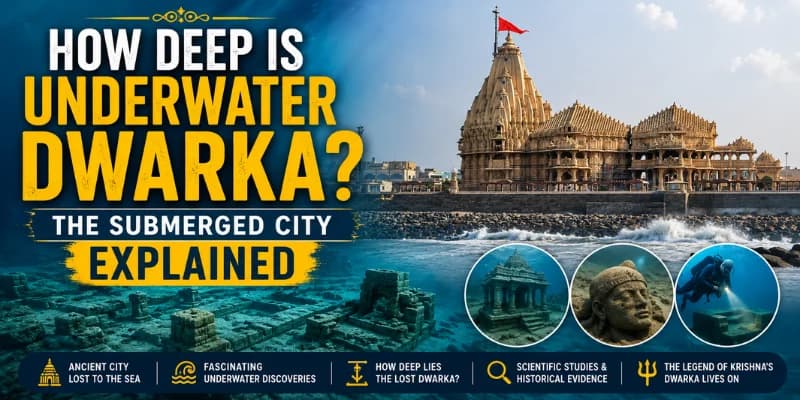
The submerged remains off Dwarka lie at about 3 to 12 metres, roughly 10 to 40 feet, below the sea near the Samudranarayan temple, where marine archaeologists found walls, pillars and stone anchors. The much deeper 20 to 40 metre anomalies often quoted belong to the separate Gulf of Khambhat site, not to Dwarka itself.
Few questions capture the imagination like the depth of the legendary sunken city of Dwarka, the ancient capital of Lord Krishna said to have been claimed by the sea. This guide, from the team behind Somnath Dwarka Tour Package, a unit of Experience My India, answers exactly how deep underwater Dwarka lies, what marine archaeologists actually found and clears up the common confusion with the deeper Gulf of Khambhat discoveries. For the full story of the submerged city, see our underwater Dwarka overview.
How deep is underwater Dwarka?
The well-documented submerged remains off the Dwarka coast lie at a depth of about 3 to 12 metres, which is roughly 10 to 40 feet, beneath the Arabian Sea. Marine archaeologists from India's National Institute of Oceanography explored a large area between these depths off the Samudranarayan temple and found clear evidence of ancient stone structures. The near-shore finds sit in shallower water of around 3 to 6 metres, while further out, submerged blocks and sonar anomalies appear at around 10 to 12 metres. Here is a clear breakdown:
Site or finding | Approximate depth |
Near-shore ruins off Dwarka | About 3 to 6 m (10 to 20 ft) |
Further submerged blocks and sonar anomalies | About 10 to 12 m (33 to 40 ft) |
ASI 2007 offshore excavation area | About 6 to 10 m |
Gulf of Khambhat anomalies (separate, debated) | About 20 to 40 m |
So when people ask how deep underwater Dwarka is, the honest answer for the main, verified site is about 3 to 12 metres. It is relatively shallow water, which is one reason the ruins were accessible to divers in the first place. This shallowness fits the idea of an ancient coastal town and harbour that was gradually overtaken by the sea, rather than a city that plunged into the deep ocean and it is very different from the far deeper features reported elsewhere along the Gujarat coast.
What lies at each depth
The submerged remains are spread across a range of depths, telling the story of an ancient coastal settlement:
3 to 6 metres: the shallower, near-shore zone holds dressed stone blocks, wall remains and many stone anchors, the classic signs of an old harbour or anchorage.
6 to 10 metres: the area worked in the 2007 offshore excavation, where divers documented submerged structural remains and scattered architectural members.
10 to 12 metres: further out, side-scan sonar recorded a series of anomalies and stone blocks with straight joins and angular cuts, strongly suggesting deliberate human work rather than natural rock.
The archaeological discovery of underwater Dwarka
The search for the lost city of Dwarka is one of the great stories of Indian marine archaeology. Underwater explorations off Dwarka were carried out almost every year between 1983 and 1992 by the Marine Archaeology Unit of the National Institute of Oceanography, led by the pioneering archaeologist Dr S R Rao. These investigations revealed submerged stone building blocks, including the remains of walls, pillars and bastions, along with a variety of stone anchors, spread across a wide area of the seabed. Later, in 2007, the Archaeological Survey of India, with the help of Navy divers, carried out further offshore excavations to study the antiquity of the site, documenting sunken structures and architectural remains through drawings and photography. What makes the work so compelling is that it began with the ancient texts: archaeologists studied the scriptures and local tradition describing a submerged city, then went looking for it under the waves and found genuine ruins where the legend said they would be. A large area of roughly 980,000 square metres was explored off the Samudranarayan temple alone.
How the depth was explored and measured
Discovering and measuring these underwater ruins took specialised marine technology. Teams used SCUBA diving and self-contained systems to reach the seabed, along with an underwater scooter called the Aquazepp to cover ground. Survey boats were fitted with underwater cameras, an underwater television system and airlift equipment for careful excavation. Side-scan sonar surveys, conducted at depths of around 10 metres, mapped anomalies on the seafloor, while divers physically examined and documented the stone blocks, joins and cut marks that pointed to human construction. It was painstaking work in often murky, tidal waters.
Underwater Dwarka versus the Gulf of Khambhat
A great deal of confusion and many inflated depth figures like 131 feet, come from mixing up two very different underwater sites. The near-shore ruins off Dwarka and Bet Dwarka lie in shallow water of about 3 to 12 metres and are widely accepted as the remains of an ancient port. Separately, in the Gulf of Khambhat, also called Cambay, instrument surveys reported geometric seabed features at much greater depths of around 20 to 40 metres and the meaning of these is still hotly debated among experts. These are two distinct locations, so the deep 20 to 40 metre figures should not be applied to Dwarka itself. When you read that underwater Dwarka is dozens of metres deep, it is usually the Khambhat site being described. Keeping the two apart is the single most important thing to understand about the depth question and it is where most popular articles go wrong, quoting a dramatic figure from one site while showing pictures of the other.
What was found underwater at Dwarka?
The finds off Dwarka paint a picture of a busy ancient maritime settlement rather than a perfectly preserved stone city. Divers and archaeologists recorded dressed stone blocks, sections of wall, pillars, bastions and semicircular and rectangular features, along with a large number of stone anchors of different shapes. This mix of jetty-like blocks and abundant anchors is exactly what an old, active harbour would leave behind, supporting the idea that Dwarka was an important port. The remains lie not far from today's temple town and the sacred Gomti Ghat, linking the modern pilgrimage site with its deep maritime past. The abundance of anchors in particular is telling, as it points to a place where many ships once moored, loaded and unloaded, exactly what you would expect of a thriving ancient trading port on the Arabian Sea.
The legend of Dwarka's submergence
According to tradition, Dwarka was the magnificent golden city built by Lord Krishna, from where he ruled his kingdom. The scriptures say that after Krishna left the world, the sea rose and reclaimed the city, submerging it beneath the waves, an event sometimes linked to Gandhari's curse after the Mahabharata war. For centuries this was regarded as pure legend, until marine archaeology revealed genuine submerged structures off the coast, giving the ancient story a tangible, physical echo. Our Dwarka history guide explores how the city has been built, lost and rebuilt many times over, with the present Dwarkadhish temple standing as the latest in a long line.
How old is underwater Dwarka?
The age of the submerged remains is debated. The mainstream view assigns the underwater structures and anchors off Dwarka to the Harappan or post-Harappan period, roughly 2600 to 1500 BCE, when Dwarka would have been a Bronze Age port. Some researchers, however, point to much older dates and carbon dating of material from the deeper Gulf of Khambhat site has produced controversial claims of ages up to several thousand years earlier. As with the depth, it is important to separate the well-dated near-shore Dwarka finds from the more speculative deeper-water claims. What is clear is that Dwarka has been a settled coastal site for a very long time.
Can you see or dive underwater Dwarka?
Sadly, the main submerged ruins are not currently open to recreational divers, lying in waters with variable visibility and strong currents, though there have been proposals for future underwater tourism. What you can do is experience the setting from above: take a boat towards Bet Dwarka, the island linked to Krishna's story and visit the coast where the explorations took place. For actual underwater adventure, the nearby Shivrajpur beach offers scuba diving and snorkelling among corals and marine life in shallow water, a wonderful way to enjoy the sea off Dwarka even if the ancient city itself remains out of reach.
Visiting Dwarka today
While the sunken city stays hidden, the living Dwarka above the waves is one of India's holiest and most rewarding destinations. Take darshan at the Dwarkadhish temple, bathe at Gomti Ghat, cross to Bet Dwarka and visit the Nageshwar Jyotirlinga. Plan around the best time to visit Dwarka, read our Dwarka city guide for the full picture and use how to reach Dwarka to plan your arrival at Krishna's legendary city.
Underwater Dwarka at a glance
Depth of main ruins | About 3 to 12 m (10 to 40 ft) |
Location | Off the Dwarka coast, near the Samudranarayan temple |
Explored by | National Institute of Oceanography and the ASI |
Key finds | Walls, pillars, bastions and many stone anchors |
Likely nature | An ancient port or harbour settlement |
Open to divers? | Not currently; Shivrajpur nearby offers scuba diving |
Plan your Dwarka trip
Experience My India can plan a trip to Krishna's legendary city, taking in the temple, Bet Dwarka and the coast tied to the underwater legend, along with Somnath. Book Somnath Dwarka hotels near the temple, explore the Somnath Dwarka tour packages and let a Somnath Dwarka taxi service handle the travel so you can focus on the darshan and the history.
Related guides
To plan the rest of your Dwarka trip, these Experience My India guides help:
Related guide | What it covers |
Air, rail and road access to the Somnath coast. | |
The season and festivals that shape when to travel. | |
How to reach Krishna's island of Bet Dwarka. | |
The temple of Krishna's queen near Dwarka. | |
The sea-set Shiva temple on the Dwarka coast. | |
What to eat around the temple town. |
Plan your visit
Experience My India can arrange your trip to Dwarka and the Krishna coast. Browse more travel guides, message us on WhatsApp or call +91 73006 20809.

Harsh Rawat
Somnath–Dwarka circuit planning
Harsh Rawat runs Somnath Dwarka Tour Package on the ground in Gujarat, part of Experience My India. Since 2018 he has been planning and driving the Somnath–Dwarka circuit — the darshan timings, the road hours between temples and the stops worth adding — and the routes, fares and timings published across this site are the ones he maintains.