Gita Jayanti 2026: The Birthday of the Bhagavad Gita
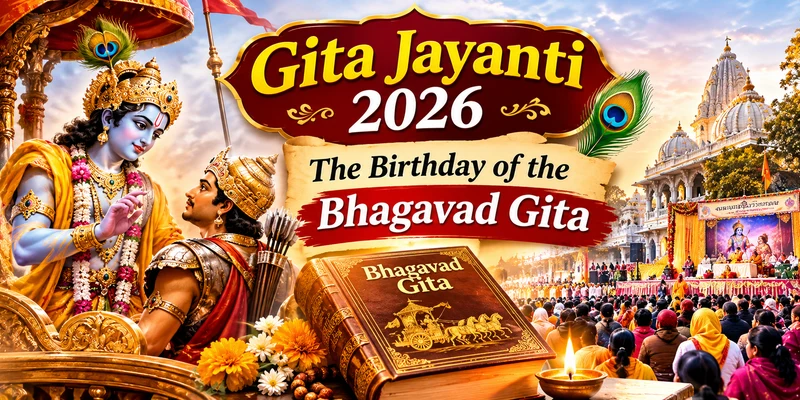
Gita Jayanti marks the day Lord Krishna delivered the Bhagavad Gita to Arjuna on the battlefield of Kurukshetra. In 2026 it falls on Sunday, 20 December, coinciding with Mokshada Ekadashi. Devotees read the Gita, fast and worship Krishna and the great International Gita Mahotsav is held at Kurukshetra. This guide, from Experience My India, covers the date, the story, the teachings and how to observe the day.
Gita Jayanti is one of the most meaningful days in the Hindu calendar, honouring not a god's birth but the birth of a scripture, the Bhagavad Gita, the timeless dialogue between Lord Krishna and the warrior Arjuna. For devotees across India and for pilgrims drawn to the land of Krishna at Dwarka, it is a day to return to the Gita's teachings on duty, devotion and self-realisation. This guide, from the team behind Somnath Dwarka Tour Package, a unit of Experience My India, covers the 2026 date and timings, the story of how the Gita was revealed, its place alongside Mokshada Ekadashi, its core teachings and how the day is observed, along with its deep connection to Krishna's own land in Gujarat.
Gita Jayanti 2026 dates and timings
Festival date | Sunday, 20 December 2026 |
Tithi | Shukla Ekadashi of Margashirsha (Mokshada Ekadashi) |
Ekadashi begins | 10:10 PM on Saturday, 19 December 2026 |
Ekadashi ends | 8:15 PM on Sunday, 20 December 2026 |
Parana (breaking the fast) | Monday, 21 December 2026, after sunrise (about 7:04 AM to 9:12 AM by local sunrise) |
International Gita Mahotsav | 5 December to 25 December 2026 at Kurukshetra |
As the Ekadashi tithi spans two calendar days, the fast and the main observance are kept on Sunday, 20 December 2026, with the fast broken the next morning during the Parana window. Exact timings shift slightly with local sunrise, so confirm them for your city.
What is Gita Jayanti?
Gita Jayanti marks the anniversary of the day the divine dialogue of the Bhagavad Gita was delivered to humanity. It falls on the Shukla Ekadashi, the eleventh day of the bright fortnight, of the month of Margashirsha, which usually corresponds to December. Unlike festivals that celebrate the birth of a deity, Gita Jayanti celebrates the birth of a text, one that has guided seekers for thousands of years. For this reason it is a day of study and reflection as much as of worship, when devotees return to the words Krishna spoke and seek to apply them in their own lives.
The story: the birth of the Bhagavad Gita
The story of Gita Jayanti unfolds on the first morning of the Mahabharata war at Kurukshetra. As the two great armies faced each other, the warrior Arjuna, surveying the ranks, was overwhelmed with despair at the thought of fighting and killing his own kinsmen, teachers and friends. In his anguish he lost his resolve and dropped his bow, unwilling to go on. It was then that Lord Krishna, serving as Arjuna's charioteer, imparted the timeless spiritual discourse that became the Bhagavad Gita, seven hundred verses across eighteen chapters, guiding Arjuna on the nature of duty or dharma, on the self and the Supreme, the Atma and Paramatma and on the path of devotion. The Gita is part of the larger story of Krishna's life, which you can follow across his three cities, from Mathura to Dwarka.
Gita Jayanti and Mokshada Ekadashi
Gita Jayanti falls on the same day as Mokshada Ekadashi and the two observances are deeply intertwined. Mokshada Ekadashi is a sacred fasting day whose very name speaks of moksha or liberation; the fast is believed to absolve sins and to liberate one's ancestors from suffering. Because the Bhagavad Gita, with its teaching on liberation and the eternal self, was revealed on this very tithi, the pairing is especially auspicious. Many devotees therefore keep the strict Ekadashi fast on Gita Jayanti, reading or hearing the Gita through the day, so that the observance combines the merit of the fast with the wisdom of the scripture.
Where Gita Jayanti is celebrated
The epicentre of Gita Jayanti is Kurukshetra in Haryana, the very battlefield where the Gita was spoken. The sites of Jyotisar, traditionally held to be the exact spot of the discourse and the vast Brahma Sarovar tank are the heart of the celebrations. Since 1989 the Haryana Government has organised annual celebrations at Kurukshetra, which have since grown, in collaboration with the Government of India, into the grand International Gita Mahotsav. The 2026 Mahotsav runs from 5 to 25 December and features Bhagwat Katha discourses, Gita conferences, cultural processions, book fairs and artisan expos. Beyond Kurukshetra, Gita Jayanti is observed in Hindu households, in temples and in ISKCON centres across the world, wherever the Gita is cherished.
The Dwarka and Somnath connection
Though the Gita was spoken at Kurukshetra, the one who spoke it is forever tied to the coast of Gujarat, where he reigned as king of Dwarka and where his earthly journey drew to its close. Pilgrims to Krishna's land often mark Gita Jayanti here and the Gita Mandir in Dwarka, a temple whose walls are inscribed with the verses of the Bhagavad Gita, is a fitting place to honour the day. Reading the Gita at Dwarka, the city of the Lord who revealed it, gives the festival a special resonance and the surrounding shrines, from the Dwarkadhish temple to the island of Bet Dwarka, make this a profound place to spend the festival. Dwarka is one of the four Char Dham of Gujarat.
Significance and core teachings
The significance of Gita Jayanti lies in the enduring relevance of the Gita's teachings. The scripture distils the paths to the divine into a few great disciplines that the festival invites devotees to reflect upon:
Karma Yoga: the path of selfless action, performing one's duty without attachment to the results.
Bhakti Yoga: the path of loving devotion and surrender to the divine.
Jnana Yoga: the path of knowledge and discernment of the eternal self beyond the body and mind.
Surrender of the ego: letting go of pride and attachment, offering oneself and one's actions to the Lord.
Together these teachings offer guidance for living with purpose and equanimity, which is why the Gita is revered far beyond its ritual anniversary and why Gita Jayanti is a day of study as much as of celebration.
How Gita Jayanti is observed
Devotees observe the day with a blend of worship, study, fasting and charity:
Waking early for a sacred bath, then placing an image or idol of Lord Krishna alongside the Bhagavad Gita on a clean altar and offering flowers, Tulsi leaves and oil lamps.
Chanting or reading chapters of the Bhagavad Gita, such as Chapter 12 on devotion or Chapter 15 or reciting the Gita Mahatmya that praises the scripture.
Keeping a strict Ekadashi fast, abstaining from grains and taking only fruits or milk, in keeping with Mokshada Ekadashi.
Giving in charity, including donating copies of the Bhagavad Gita, food and clothing and supporting charitable causes.
Attending Gita paths, discourses and Bhagwat Katha at temples or joining the great gatherings at Kurukshetra.
Plan your Dwarka pilgrimage
Experience My India can plan a visit to Krishna's land around Gita Jayanti or at any time of year, taking in the Gita Mandir and Dwarkadhish temple at Dwarka, Bet Dwarka and the Somnath coast where Krishna's journey ended. Our Somnath Dwarka tour packages and wider Gujarat tour packages weave these sacred sites into a smooth, well-paced journey, with a stay at well-placed hotels and comfortable local transport throughout.
Related guides
To explore Krishna's land and its festivals further, these related guides help:
Related guide | What it covers |
A compact plan of the holy city's key sights. | |
The sacred full-moon festival across the region. | |
How the festival of lights is kept in Gujarat. |
Plan your visit
Experience My India can arrange your Dwarka and Somnath pilgrimage and wider Gujarat journey. Browse more travel guides, message us on WhatsApp or call +91 73006 20809.

Harsh Rawat
Somnath–Dwarka circuit planning
Harsh Rawat runs Somnath Dwarka Tour Package on the ground in Gujarat, part of Experience My India. Since 2018 he has been planning and driving the Somnath–Dwarka circuit — the darshan timings, the road hours between temples and the stops worth adding — and the routes, fares and timings published across this site are the ones he maintains.