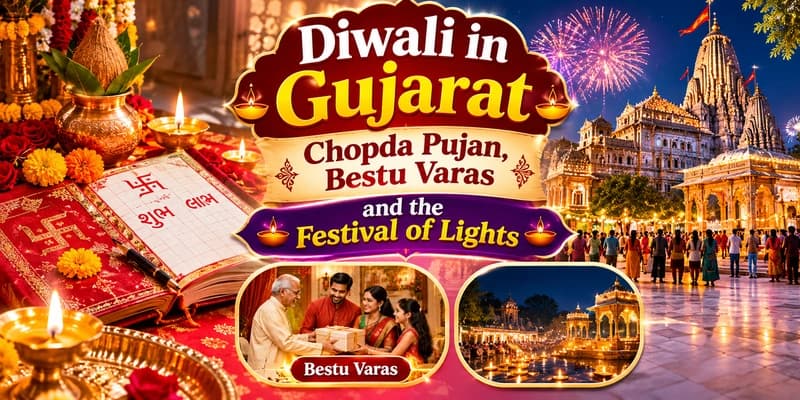
Diwali in Gujarat: Chopda Pujan, Bestu Varas and the Festival of Lights
Diwali in Gujarat has its own distinct character, centred on Chopda Pujan, the blessing of business ledgers, Kali Chaudas and the Bestu Varas Gujarati New Year that follows Diwali. In 2026 Diwali falls on 8 November and the New Year on 10 November; in 2027 Diwali is on 29 October. This guide, from Experience My India, covers Gujarat's unique Diwali customs, dates and celebrations.
Diwali, the festival of lights, is celebrated across India, but in Gujarat it takes on a character all its own. Here it is as much a time of commercial renewal and a New Year as of lamps and fireworks, with unique customs such as Chopda Pujan, the Kali Chaudas rituals and the Bestu Varas New Year that give the Gujarati Diwali its distinct flavour. This guide, from the team behind Somnath Dwarka Tour Package, a unit of Experience My India, covers what makes Diwali in Gujarat different, the five-day calendar and its dates, the key rituals and their timings and where to experience the festival. For the general story and pan-India customs of Diwali, see our Diwali guide.
What makes Diwali in Gujarat different?
While Diwali everywhere honours the triumph of light over darkness, the Gujarati celebration has several distinctive features. For Gujarat's large mercantile community, Diwali is the fiscal year-end, marked by the special ritual of Chopda Pujan, the blessing of account books. The sequence of days differs slightly from northern India, beginning with Vagh Baras and positioning the New Year directly after Diwali rather than later in the calendar. That New Year, Bestu Varas, is the start of the Vikram Samvat year and one of the most important days of the whole festival in Gujarat. Kali Chaudas here carries its own customs of casting off evil and the great temples present magnificent Annakut food offerings on New Year's Day. These features make Diwali in Gujarat a rich blend of devotion, commerce and the turning of the year, quite distinct from how the festival unfolds elsewhere.
Diwali in Gujarat at a glance
What it is | Gujarat's distinct, five-day Diwali and New Year festival |
2026 Diwali | Sunday, 8 November 2026 |
2026 Gujarati New Year | Bestu Varas, 10 November 2026 |
2027 Diwali | Friday, 29 October 2027 |
Signature ritual | Chopda Pujan, the blessing of business ledgers |
The New Year | Bestu Varas, start of the Vikram Samvat year |
On New Year's Day | Annakut food-mountain offerings at temples |
The Gujarat five-day calendar
The Gujarati Diwali sequence runs over several days and starts a little differently from northern India. Here is the calendar for 2026 and 2027:
Festival day | 2026 date | 2027 date |
Vagh Baras / Vasu Baras | 5 November (Thu) | 26 October (Tue) |
Dhanteras | 6 November (Fri) | 27 October (Wed) |
Kali Chaudas / Roop Chaudas | 7 November (Sat) | 28 October (Thu) |
Diwali and Chopda Pujan | 8 November (Sun) | 29 October (Fri) |
Bestu Varas, Gujarati New Year | 10 November (Tue) | 30 October (Sat) |
Bhai Bij, Bhai Dooj | 11 November (Wed) | 31 October (Sun) |
Note that in 2026, due to tithi overlaps, there is a one-day gap between Diwali day and the Gujarati New Year, with a quiet interim day on 9 November for rest and temple visits, whereas in 2027 the New Year follows the day after Diwali as usual. Because of an extra lunar month, Adhik Maas, earlier in 2026, the whole festival that year falls a little later than its usual October window, returning to late October in 2027.
Diwali dates and puja timings
Diwali 2026 falls on Sunday, 8 November and Diwali 2027 on Friday, 29 October. The most important rituals revolve around specific auspicious windows, the muhurats. For 2026, the key timings are:
Dhanteras, 6 Nov 2026 | Pradosh Kaal, 05:54 PM to 07:50 PM |
Kali Chaudas, 7 Nov 2026 | Mahanisha Kaal, 11:39 PM to 12:31 AM |
Diwali and Chopda Pujan, 8 Nov 2026 | Vrishabha Kaal, 05:54 PM to 07:50 PM |
Afternoon Choghadiya, Ahmedabad | Around 01:47 PM to 03:11 PM |
Bestu Varas, 10 Nov 2026 | Early morning onwards, with Annakut |
The primary Lakshmi Puja and Chopda Pujan take place in the evening window on Diwali night, around 05:54 PM to 07:50 PM in 2026, while business houses checking the afternoon Shubh Choghadiya in cities like Ahmedabad typically look between about 01:47 PM and 03:11 PM. As timings shift with the year and vary a little by city, it is always worth confirming the exact muhurat for your location close to the festival.
Chopda Pujan
The most distinctive ritual of the Gujarati Diwali is Chopda Pujan. Rather than only standard home prayers, Gujarat's mercantile and business houses observe this special accounting ceremony on Diwali night. Old financial account books, the chopda, are ceremonially closed and new ledger books are opened and blessed with auspicious markings, including the holy Swastika and the words Shubh Labh, meaning auspiciousness and profit, written in vermillion, kankoo. The books are worshipped to invite prosperity from Goddess Lakshmi and wisdom from Lord Ganesha for the year ahead. This blending of commerce and devotion reflects Gujarat's deep mercantile heritage, where the start of the new financial year is sanctified with prayer and it is one of the defining images of Diwali in the state.
Kali Chaudas
Kali Chaudas, which northern India calls Choti Diwali, has its own strong character in Gujarat, focused heavily on casting off evil spirits and negative energy. It is dedicated to the worship of Lord Hanuman to dispel negativity and families observe the unique custom of preparing spicy fried vada snacks and leaving them at road crossroads. This ritual placing of vadas at intersections symbolises leaving behind internal evil, fears and dark energies, appeasing guardian deities and shielding the household from darkness. It is a vivid, distinctive folk custom, quite different from the lamp-lighting of the other nights and it reflects the protective, cleansing dimension of the Gujarati Diwali, clearing away the old year's negativity before the New Year begins.
Bestu Varas: the Gujarati New Year
Perhaps the most important distinction of Diwali in Gujarat is that it ushers in the New Year. Unlike calendars that mark the new year in spring, the Vikram Samvat Gujarati New Year, Bestu Varas, begins the day after Diwali, marking the mythical day King Vikramaditya was crowned. On this day people wake early to collect Sabras, salt, symbolising the essence of life, wear their best new clothes and visit relatives to exchange greetings of Nutan Varshabhinandan, happy new year. The great temples, including those on the Saurashtra coast, present vast Annakut offerings, mountains of diverse food, to the deities to mark the occasion. Bestu Varas is a day of fresh starts, family bonds and temple visits and it gives the Gujarati Diwali its character as a true turning of the year.
Where to experience Diwali in Gujarat
Diwali is celebrated in every home in Gujarat, but some places offer especially immersive experiences. Ahmedabad and Surat become spectacularly illuminated commercial hubs, with the textile markets of Surat and the historic gates of old Ahmedabad showing unparalleled decorative lighting, alongside street-food trails and community fireworks and traditional markets such as Girdharilal and Ratanpol are hotspots for buying clothes and sweets. The great temples of Somnath and Dwarka present magnificent Annakut food offerings to the deities on New Year's Day, as does the Ambaji Temple, with grand religious decorations. The Statue of Unity at Kevadia hosts high-tech laser shows and family events through the festive week. For a trip that takes in the festival and the coast, see our Gujarat itinerary.
History and significance
Diwali in Gujarat carries layers of spiritual, historical and economic meaning. Universally, it honours the return of Lord Rama, Sita and Lakshmana to Ayodhya after fourteen years of exile, the victory of light over darkness that the lamps celebrate. For Gujarat's mercantile community it represents the fiscal year-end, sanctified through Chopda Pujan and the blessing of the account books to invite Lakshmi's prosperity and Ganesha's wisdom. And through the Kali Chaudas custom of the vadas at the crossroads, it carries the theme of casting off darkness and negativity before the new year. This weaving together of the devotional, the commercial and the protective is what gives the Gujarati Diwali its distinctive depth. The broader mythology and pan-India customs of the festival are covered in our general Diwali guide.
Tips for experiencing Diwali in Gujarat
A few pointers help you enjoy the festival:
• Confirm the exact Lakshmi Puja and Chopda Pujan muhurat for your city close to the festival, as timings vary slightly.
• If visiting a business household, the Chopda Pujan on Diwali evening is a fascinating ritual to witness respectfully.
• Be in Gujarat for Bestu Varas, the day after Diwali, for the New Year greetings and the grand temple Annakut.
• Visit Somnath, Dwarka or Ambaji on New Year's Day to see the magnificent Annakut food offerings.
• Explore the illuminated markets of Ahmedabad and Surat and the traditional Girdharilal and Ratanpol bazaars.
• Book travel and stays well ahead, as the Diwali and New Year period is peak festive season.
• Note the year's calendar quirks, such as the 2026 one-day gap before the New Year due to tithi overlaps.
Plan your Gujarat Diwali trip
Experience My India can plan a trip around Diwali and Bestu Varas in Gujarat, arranging stays, transport and temple visits for the Annakut on New Year's Day and weaving the festival into a fuller journey. Our Gujarat tour packages and Somnath Dwarka tour packages can combine the celebrations with the coastal pilgrimage, with a stay at well-placed hotels and comfortable local transport.
Related guides
To plan your Gujarat festival trip, these related guides help:
Related guide | What it covers |
The state's great autumn festival of folk dance. | |
The later Dev Diwali fair and midnight mahapuja at Somnath. | |
The mithai that fills the Diwali season. |
Plan your visit
Experience My India can arrange your Gujarat festival and pilgrimage trip. Browse more travel guides, message us on WhatsApp or call +91 73006 20809.

Harsh Rawat
Somnath–Dwarka circuit planning
Harsh Rawat runs Somnath Dwarka Tour Package on the ground in Gujarat, part of Experience My India. Since 2018 he has been planning and driving the Somnath–Dwarka circuit — the darshan timings, the road hours between temples and the stops worth adding — and the routes, fares and timings published across this site are the ones he maintains.