Mumbai to Ahmedabad Bullet Train: Route, Stations, Speed and Latest Updates
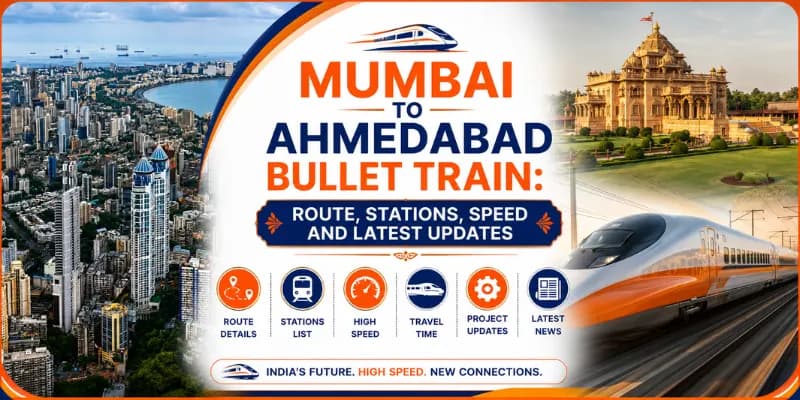
The Mumbai to Ahmedabad bullet train, or MAHSR, is India's first high-speed rail, a 508 km corridor with 12 stations designed for 320 km/h, cutting the journey to under two hours. Built with Japanese Shinkansen technology, its first section, Surat to Bilimora, is targeted for August 2027, with the full line by 2029.
India's first bullet train is fast becoming a reality and it promises to transform travel across western India, including the journey to Gujarat's temples and coast. This guide, from the team behind Somnath Dwarka Tour Package, a unit of Experience My India, explains the Mumbai to Ahmedabad bullet train project: its route and stations, speed, the record-setting undersea tunnel, the trains, the timeline, expected ticket prices and what it will mean for reaching Dwarka and Somnath.
About the Mumbai Ahmedabad bullet train (MAHSR)
The Mumbai to Ahmedabad High-Speed Rail Corridor, popularly called India's first bullet train project, is currently under rapid construction. Spanning 508.18 km, it is designed to cut travel time between India's financial hub and Gujarat's largest city from over six hours to just under two. The project is being executed by the National High Speed Rail Corporation Limited, NHSRCL, using Japanese Shinkansen technology, with technical and financial assistance from Japan. Passing through Maharashtra, Gujarat and the union territory of Dadra and Nagar Haveli, it is one of the largest and most technically ambitious transport projects India has ever undertaken. The major early hurdles are now behind it: the entire land needed has been acquired, all statutory clearances obtained and thousands of utility lines shifted, so the focus has moved firmly to construction and engineering.
Mumbai Ahmedabad bullet train at a glance
Project | Mumbai Ahmedabad High Speed Rail, MAHSR |
Length | 508 km, with 12 stations |
Top speed | 320 km/h, journey under 2 hours |
Technology | Japanese Shinkansen, built by NHSRCL |
First section | Surat to Bilimora, targeted August 2027 |
Full line | Mumbai BKC to Sabarmati, targeted by 2029 |
Why India's first bullet train matters
The Mumbai to Ahmedabad bullet train is far more than a faster train. As India's first high-speed rail corridor, it is a landmark project that will test and prove the technology, engineering and operations for a whole future network of bullet trains across the country. It is expected to reshape travel, business and daily life along its route, bringing two of India's most important economic regions within a two-hour ride of each other and putting mid-sized cities like Surat, Vadodara and Bharuch within rapid reach of both metros. New station-area business districts and cleaner, faster, more comfortable travel are among the wider benefits envisaged. For a travel company like Experience My India, the project also promises a smoother, quicker gateway into Gujarat for the millions who visit its temples and coast each year.
Key project specifications
The bullet train is designed to set new standards for rail travel in India:
Corridor length | 508.18 km across three states and a UT |
Operating speed | Up to 320 km/h |
Travel time | Around 1 hour 58 minutes, down from over 6 hours |
Estimated cost | Around Rs 2.1 lakh crore in revised estimates |
Technology | Japanese Shinkansen, via NHSRCL |
Alignment | About 90 percent elevated viaduct |
The revised cost of around Rs 2.1 lakh crore has been adjusted from the original sanctioned estimate of roughly Rs 1.08 lakh crore, largely due to earlier land-acquisition delays in Maharashtra and pandemic disruptions. About 90 percent of the corridor is elevated on viaducts, built using the fast Full Span Launching Method and the line uses Japanese J-slab ballastless track technology for the first time in India, for a smoother, more durable ride.
The 12 stations on the route
The corridor will have 12 dedicated stations across Maharashtra, Dadra and Nagar Haveli and Gujarat:
Section | Stations |
Maharashtra | Mumbai (Bandra Kurla Complex), Thane, Virar, Boisar |
Gujarat and UT | Vapi, Bilimora, Surat, Bharuch, Vadodara, Anand, Ahmedabad, Sabarmati |
Eight of the twelve stations lie in Gujarat and four in Maharashtra, which is one reason the Gujarat stretch is progressing faster. Each station is being designed to reflect the character of its host city, with modern amenities and multimodal connectivity. The Sabarmati station in Ahmedabad is being built as a major hub linking the bullet train with the metro, buses and the railway network, while the underground BKC station in Mumbai is a striking engineering feat in its own right. For travellers, the Ahmedabad and Sabarmati stations are the most important, as they are where a Gujarat trip would begin, with onward connections to the rest of the state.
Timeline and phased rollout
Rather than opening all at once, the corridor is being commissioned in phases:
Milestone | Target |
First section, Surat to Bilimora | August 15, 2027 |
Full 508 km line, Mumbai BKC to Sabarmati | By 2029 |
The much-anticipated first commercial section, between Surat and Bilimora in Gujarat, is targeted to open around August 15, 2027, subject to testing and safety clearances, with further Gujarat sections following. The Maharashtra stretch, including the complex tunnelling near Mumbai, is expected to take longer, with the entire line from Mumbai to Sabarmati targeted for completion by 2029. As with any project of this scale, these dates are targets and may be refined as construction progresses. Opening the line in phases lets services and revenue begin on the ready Gujarat sections while the harder Mumbai-end engineering is completed, a sensible approach for such a complex first-of-its-kind project.
The trains and the Make in India shift
In a major boost for local manufacturing, the corridor will initially launch using indigenously built B28 high-speed trainsets, also called Bharat trains, being co-developed by BEML Limited and the Integral Coach Factory, ICF, with a design speed of around 280 km/h. Advanced, higher-speed Japanese E10 Series Shinkansen trainsets are then slated to be introduced later, in the early 2030s, under continued India-Japan cooperation. This phased approach lets services begin with home-built trains while the next-generation Shinkansen technology is integrated over time, a significant milestone for India's rail manufacturing and a model that could shape how future high-speed corridors across the country are built and equipped.
India's first undersea rail tunnel
One of the most complex parts of the project is the 21 km underground tunnel between Bandra Kurla Complex and Shilphata in the Mumbai region. Remarkably, about 7 km of this stretch runs beneath Thane Creek, making it India's very first undersea rail tunnel. Instead of digging two separate tubes, engineers are using specialised, extra-large tunnel boring machines to cut a single large-diameter tunnel that houses both the up and down high-speed tracks. Part of the tunnel is also being built using the New Austrian Tunnelling Method and early sections have already been completed, keeping this high-risk underground phase moving on an accelerated timeline. When finished, it will rank among the longest and most technically complex undersea rail tunnels in Asia and a proud engineering first for India.
Undersea tunnel excavation progress
The tunnelling has hit several milestones. A stretch of tunnel has been completed between Ghansoli and Shilphata in Maharashtra and the giant tunnel boring machines have begun their drives towards BKC, including one launched from a deep shaft at Ghansoli and another advancing from Vikhroli. The underground BKC station itself is being built around 32.5 metres below ground, deep enough to support a tall building above it. Several of the 12 stations are already complete or nearing completion and the elevated viaducts are visibly rising across Gujarat, marking the project's shift from plan to tangible infrastructure. The undersea and underground tunnel zone near Mumbai remains the most technically demanding part of the whole corridor, which is why the Maharashtra section is expected to be finished after the Gujarat stretch.
Proposed ticket pricing
While fares are not yet finalised, the NHSRCL has outlined an affordable but sustainable pricing model:
Base fare formula: fares are expected to be roughly 1.5 times the cost of a First Class AC ticket on the Mumbai to Ahmedabad Duronto Express.
Price range: the maximum end-to-end fare from Mumbai BKC to Sabarmati is expected to start at around Rs 3,000, with minimum short-distance fares from about Rs 250.
Seating: standard classes in a 2x3 configuration and a premium business class in a spacious 2x2 layout.
Luggage: like airlines, an additional check-in fee is planned for oversized or very heavy luggage, to keep boarding smooth.
These figures are proposed and may change before the service begins, so treat them as an early guide rather than final fares.
What the bullet train means for travel to Gujarat
For pilgrims and travellers, the biggest impact of the bullet train will be far faster, more comfortable access to Gujarat. Ahmedabad and Sabarmati are the gateway to the state and from there most journeys to Dwarka, Somnath and the Saurashtra coast begin. Reaching Ahmedabad from Mumbai in under two hours will make it far easier to start a Gujarat pilgrimage and mid-sized cities like Surat, Vadodara and Bharuch will also be within rapid reach. Once you arrive, our how to reach Dwarka and how to reach Somnath guides help you plan the onward journey by road or rail.
Plan your Gujarat trip
Whether you arrive by bullet train in the years ahead or by today's flights and trains, Experience My India can plan your onward Gujarat pilgrimage. Explore the Somnath Dwarka tour packages and the wider Gujarat tour packages, plan the season with the best time to visit Gujarat, book Somnath Dwarka hotels and let a Somnath Dwarka taxi service handle the travel once you reach Gujarat.
Related guides
To plan your Gujarat trip, these related guides help:
Related guide | What it covers |
The best months for the Dwarka coast. | |
When to plan a lion safari on your trip. | |
The sights within the Somnath temple town. | |
Krishna's island off the Dwarka coast. | |
The Jyotirlinga of Lord Shiva near Dwarka. | |
The dishes to try across the state. |
Plan your visit
Experience My India can plan your Gujarat pilgrimage once you arrive in the state. Browse more travel guides, message us on WhatsApp or call +91 73006 20809.

Harsh Rawat
Somnath–Dwarka circuit planning
Harsh Rawat runs Somnath Dwarka Tour Package on the ground in Gujarat, part of Experience My India. Since 2018 he has been planning and driving the Somnath–Dwarka circuit — the darshan timings, the road hours between temples and the stops worth adding — and the routes, fares and timings published across this site are the ones he maintains.