The Nageshwar Jyotirlinga Story: Daruka, Supriya and Shiva
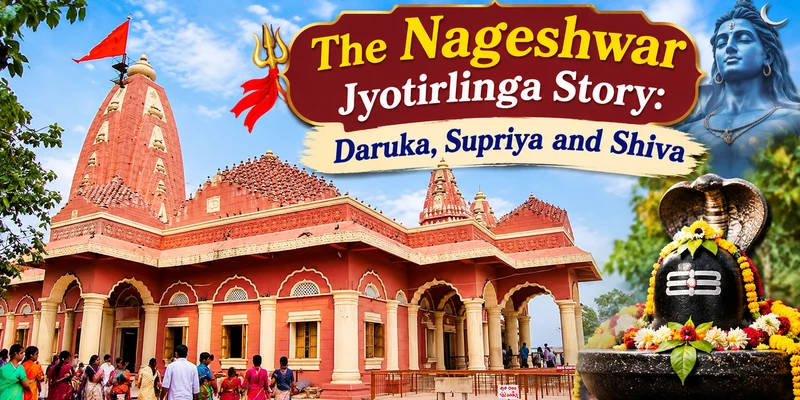
The Nageshwar Jyotirlinga, near Dwarka, is the tenth of the twelve sacred Jyotirlingas of Lord Shiva. Its story, from the Shiva Purana, tells how the demon Daruka imprisoned a devout Shiva worshipper named Supriya and how Shiva, moved by Supriya's unshakeable faith, appeared as a blazing pillar of light, destroyed the demon and stayed forever at the site. This guide, from Experience My India, tells the full legend and what it means.
Among the twelve Jyotirlingas of Lord Shiva, the Nageshwar Jyotirlinga holds a special place, both for its sacred rank and for the dramatic tale behind it. Set on the Saurashtra coast between Dwarka and Bet Dwarka, it is revered as the Lord of Serpents, a shrine said to protect devotees from poison of every kind, from snake venom to the venom of anger and ego. This guide, from the team behind Somnath Dwarka Tour Package, a unit of Experience My India, tells the full story of the Nageshwar Jyotirlinga: the demon Daruka, the devotee Supriya, the appearance of Shiva as a pillar of light, the mystery of the south-facing linga and the significance that draws pilgrims to this coast.
Quick facts
Temple | Nageshwar Jyotirlinga (Nageshwar Mahadev) |
Location | Saurashtra coast, Devbhumi Dwarka district, Gujarat, between Dwarka and Bet Dwarka |
Distance from Dwarka | About 18 km from Dwarka city |
Rank | The 10th of the 12 sacred Jyotirlingas of Shiva |
The linga | A self-manifested, Tri-Mukhi Rudraksha-shaped Shiva linga in an underground sanctum |
Known for | Protection from venom, fear and Kaal Sarp Dosha |
Darshan | Morning and evening (see the main Nageshwar guide for exact timings) |
The demon Daruka and the forest of Darukavana
The story of the Nageshwar Jyotirlinga comes from the Shiva Purana. Long ago, a cruel and powerful demon named Daruka, together with his wife Daruki, terrorised the region and all who passed through it. Daruki had received a boon from Goddess Parvati that allowed her to move their underwater forest, Darukavana, wherever she wished and the demon couple used this power to roam the seas, attacking travellers, merchants and saints without fear of capture. Their reign of terror over the coast forms the backdrop against which the devotion of a single faithful man would shine.
The imprisonment of Supriya
Among the many people the demons captured was a devout Shiva worshipper named Supriya, taken prisoner along with a group of merchants and cast into a dungeon in the demons' stronghold. Even in captivity, Supriya never wavered. He continued to chant "Om Namah Shivaya" without pause, wore his Rudraksha beads and encouraged his fellow prisoners to take refuge in Lord Shiva. His calm, unbroken devotion in the face of fear and imprisonment is the heart of the story, a demonstration that true faith does not depend on freedom or comfort. When the demons learned that Supriya was rallying the captives in worship, they grew enraged and moved to kill him and it was at this moment of greatest danger that his prayers were answered.
The appearance of Lord Shiva
Moved by Supriya's unwavering faith, Lord Shiva appeared at the site in a blazing pillar of light, a Jyotirlinga, rising from the earth before the astonished demons. Shiva vanquished the demon Daruka and freed Supriya and the other prisoners, ending the terror that had gripped the coast. Rather than depart, Shiva chose to remain at the spot forever, establishing his eternal presence there as the Nageshwar Jyotirlinga, the Lord of Serpents. It is one of twelve such self-manifested shrines across India, each marking a place where Shiva revealed himself as a column of light and you can read about all of them in our guide to the 12 Jyotirlingas.
The mystery of the south-facing linga
One of the most distinctive features of the Nageshwar shrine is that its linga faces south, while the image of Parvati faces east, an arrangement found at very few temples. Folklore links this unusual orientation to the devotion of the saint Namdev. It is said that when Namdev stood before the shrine singing his bhajans, he was asked to move aside so he would not block the deity's view and he replied by asking where Shiva was not present, so that he might stand there. In answer, the linga itself is said to have turned to face him, fixing its gaze toward the south where the saint stood. The south-facing linga is thus remembered as a sign that the Lord turns toward sincere devotion wherever it arises, echoing the very lesson of Supriya's story.
The history of the temple
The shrine is of great antiquity, mentioned in ancient texts and epics, with roots traced back over two thousand years to the age of the Mahabharata. Over the centuries the original temple suffered damage from medieval invasions and from the erosion of the sea and the sacred linga is said to have lain buried for a long period before being rediscovered and restored. The temple standing today was rebuilt in the twentieth century in the Maru-Gurjara architectural style, using salt-resistant Porbandar stone to withstand the coastal air and it is marked from afar by a towering statue of a meditating Lord Shiva, about 125 feet tall, that rises beside the temple. For the full visitor experience, darshan timings and how to reach the shrine, see our dedicated guide to the Nageshwar Jyotirlinga.
Significance of the Nageshwar Jyotirlinga
The Nageshwar Jyotirlinga carries deep spiritual meaning for devotees and Experience My India finds that understanding the legend before a visit makes the darshan far more moving:
The tenth Jyotirlinga: it is revered as the tenth of the twelve sacred Jyotirlingas of Lord Shiva, a rank that makes it a major pilgrimage destination in its own right.
Protection from venom and fear: as the Lord of Serpents or Nageshwar, it is believed to shield devotees from physical snake venom as well as the spiritual poisons of anger, ego and jealousy.
Astrological remedies: it is frequently visited by those seeking relief from Kaal Sarp Dosha and other planetary afflictions, who come to pray for release from these influences.
The underground sanctum: the shrine features a sanctum placed slightly below ground level, housing a self-manifested or Swayambhu, Shiva linga shaped like a three-faced Tri-Mukhi Rudraksha, a form found nowhere else.
Visiting as part of the Dwarka pilgrimage
The Nageshwar Jyotirlinga sits on the road between Dwarka and Bet Dwarka, which makes it an easy and natural stop on a Dwarka pilgrimage, one of the four Char Dham of Gujarat. Many pilgrims pair it with the island shrines reached from Okha, covered in our things to do in Bet Dwarka guide and with the tidal sea temple of Bhadkeshwar Mahadev, another of Dwarka's beloved Shiva shrines. The shrine is busiest and most vibrant on Maha Shivaratri, when timings may change and crowds swell, so plan your darshan accordingly and observe the Dwarka temple rules that apply across the region's shrines.
Plan your Nageshwar and Dwarka pilgrimage
Experience My India can plan a Dwarka pilgrimage that includes the Nageshwar Jyotirlinga alongside the Dwarkadhish temple, Bet Dwarka and the sacred coast, with a smooth, well-paced itinerary. Our Somnath Dwarka tour packages and wider Gujarat tour packages weave the Jyotirlinga into a fuller Saurashtra journey taking in Somnath and Gir, with a stay at well-placed hotels and comfortable local transport throughout.
Related guides
To explore the shrine and its region further, these related guides help:
Related guide | What it covers |
A compact plan of the holy city's key sights. | |
The footbridge across the Gomti creek in Dwarka. | |
The 8th-century monastery of Adi Shankaracharya. |
Plan your visit
Experience My India can arrange your Nageshwar and Dwarka pilgrimage and wider Saurashtra journey. Browse more travel guides, message us on WhatsApp or call +91 73006 20809.

Harsh Rawat
Somnath–Dwarka circuit planning
Harsh Rawat runs Somnath Dwarka Tour Package on the ground in Gujarat, part of Experience My India. Since 2018 he has been planning and driving the Somnath–Dwarka circuit — the darshan timings, the road hours between temples and the stops worth adding — and the routes, fares and timings published across this site are the ones he maintains.