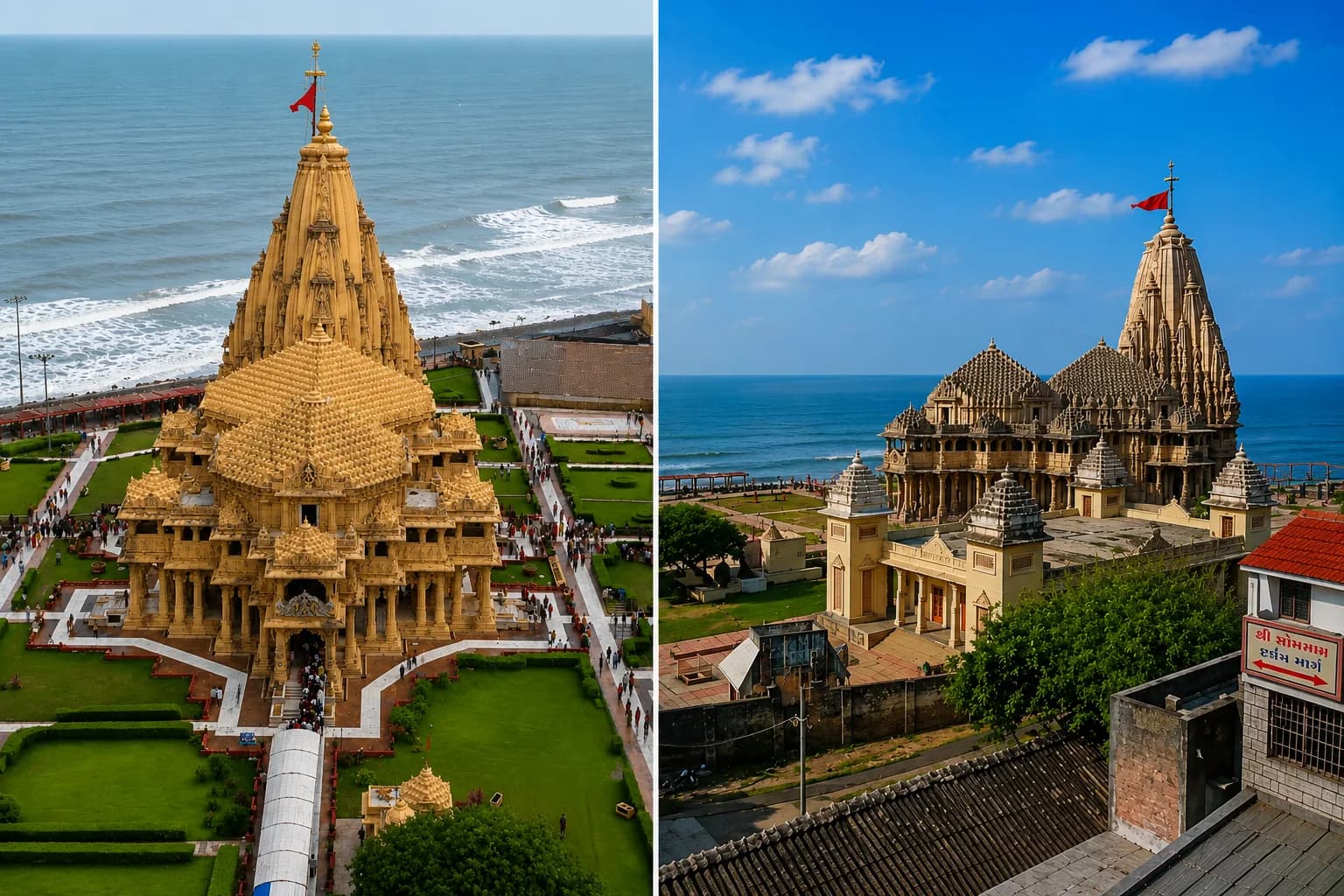
Bhadkeshwar Mahadev Dwarka: The Sea-Submerged Shiva Shrine
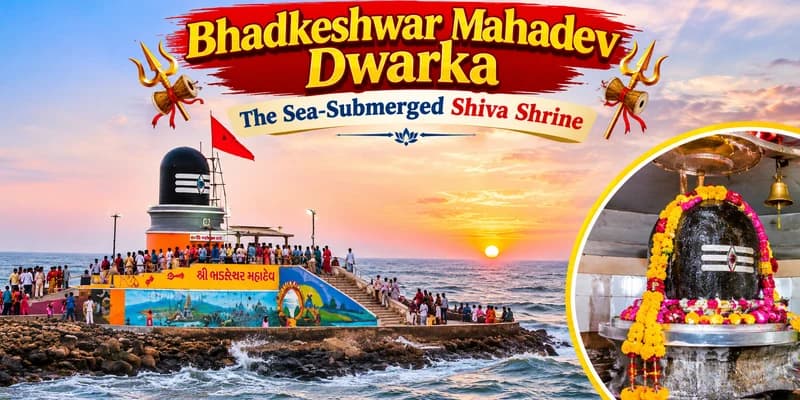
Bhadkeshwar Mahadev is an ancient Shiva temple on a rocky islet at the western edge of Dwarka, famed for the natural Jalabhishek when the monsoon sea submerges its sanctum. Its shore walkway is accessible only at low tide, so visitors must check the day's tides. It is open 6:00 AM to 7:00 PM and entry is free. This guide, from Experience My India, covers it.
Bhadkeshwar Mahadev is one of the most atmospheric and offbeat shrines in Dwarka, a Shiva temple perched on a rocky limestone hillock that juts out into the Arabian Sea at the city's extreme western edge. It is famous for a remarkable natural phenomenon, when the monsoon sea rises to surround and submerge the sanctum and for a shore pathway that is walkable only at low tide, which makes planning around the ocean essential. This guide, from the team behind Somnath Dwarka Tour Package, a unit of Experience My India, covers the temple's tide-dependent timings, its natural Jalabhishek, its ancient history and significance and everything you need to visit this extraordinary sea-washed shrine safely.
What is Bhadkeshwar Mahadev Temple?
Bhadkeshwar Mahadev is an ancient Shiva temple set on a small rocky islet at the far western edge of Dwarka, where the land meets the open Arabian Sea. Connected to the mainland only by a narrow shore pathway and a flight of stairs, it is a shrine shaped entirely by the ocean around it and it is renowned for the way the sea itself seems to worship the Lord Shiva enshrined there. It is a place of raw natural beauty as much as devotion, with waves breaking around the rock and sweeping sea views in every direction and it offers a very different experience from the grand Dwarkadhish Temple in the city. For those who like their pilgrimage with a sense of the elements, Bhadkeshwar Mahadev is one of Dwarka's most memorable and moving stops.
Bhadkeshwar Mahadev at a glance
What it is | An ancient Shiva temple on a sea islet |
Deity | Chandra-Moulishwar Shiva, a Swayambhu Shivalinga |
Setting | A rocky limestone hillock in the Arabian Sea |
Access | A shore pathway and stairs, usable only at low tide |
Opening hours | 6:00 AM to 7:00 PM daily |
Entry fee | Free |
Famed for | The natural monsoon Jalabhishek by the sea |
Timings and the all-important tide rule
Bhadkeshwar Mahadev is open daily for darshan from 6:00 AM to 7:00 PM and admission is completely free. But here the clock matters far less than the ocean. The narrow walkway leading out to the shrine is fully accessible during low tide but gets submerged during high tide, cutting off the island until the water recedes. This makes checking the day's tides the single most important part of planning a visit. There are no fixed public tide boards at the temple, so visitors should consult local shopkeepers or their hotel staff for the day's tide charts before setting out, especially if they are aiming for sunset. Timing your visit for low tide is essential both to reach the shrine and to return safely and it is the key thing to get right about Bhadkeshwar Mahadev.
The natural Abhishekam
The temple is globally renowned for a unique natural phenomenon. Every year during the monsoon season, around June and July, the rising ocean waters completely surround and submerge the temple's sanctum. Devotees view this not as a flood but as the Arabian Sea itself performing a sacred, natural Jalabhishek, a water offering, to Lord Shiva, bathing the deity as a devotee would. It is a profoundly moving sight and idea, the ocean rising each year to worship the Lord enshrined at its edge and it is the source of the temple's fame far beyond Dwarka. During the peak of the monsoon the shrine may be inaccessible or only briefly reachable, so the phenomenon is best appreciated with care and respect for the power of the sea, but the belief that nature itself performs the abhishekam here gives Bhadkeshwar Mahadev a significance quite unlike any ordinary temple.
History and ancient origins
Bhadkeshwar Mahadev is believed to be over 5,000 years old, placing its roots in the deepest antiquity of the Dwarka region. The temple enshrines a self-manifested, Swayambhu, Shivalinga, which tradition holds was discovered at the confluence of the Gomati River and the Arabian Sea by Jagatguru Adi Shankaracharya, the great philosopher-saint who did so much to establish the sacred geography of this coast. The same saint established a religious seat in Dwarka, as covered in our guide to the Shri Shardapeeth of Dwarka, so Bhadkeshwar Mahadev forms part of the deep spiritual heritage he shaped here. This ancient, Swayambhu origin, a Shivalinga that appeared of its own accord by the sea, is central to the reverence in which the shrine is held.
The deity and the temple treasures
The main deity is worshipped as Chandra-Moulishwar Shiva, Shiva who bears the moon upon his crown, a fitting name for a shrine washed by the tides that the moon itself governs. Beyond the central Shivalinga, the temple complex meticulously preserves a remarkable collection of sacred objects, including more than 1,300 small Shiva Lingams, around 1,200 Saligramsheelas, the sacred stones associated with Vishnu and 75 metal relics representing the lineage of Adi Shankaracharya. This gathering of lingams, sacred stones and relics makes the modest sea shrine far richer in sanctity than its small size suggests and it underlines its connection to the Shankaracharya tradition. Together, the Swayambhu deity and these preserved treasures give Bhadkeshwar Mahadev a depth of significance that rewards an unhurried, reverent visit.
Maha Shivratri at Bhadkeshwar Mahadev
Maha Shivratri is the most grandly celebrated festival at this shrine, marked by a vibrant annual fair organised around the coastal complex. Falling usually in February or March, it draws large crowds of devotees to the sea temple for a night and day of worship. On Shivratri a special grand public Jalabhishek window is generally observed through the morning, when devotees can offer water to the Lord and the midnight Nishita Kaal is the most auspicious time for puja. If your visit coincides with Maha Shivratri, expect a festive, crowded and deeply devotional atmosphere by the sea, though you must still plan around the tides to reach the shrine. The festival itself is covered in our Maha Shivratri guide.
Location and how to reach
Bhadkeshwar Mahadev sits on a rocky limestone hillock jutting into the Arabian Sea at the extreme western edge of Dwarka, near the Circuit House and Sunset Point. It is roughly 2 km from the famous Dwarkadhish Temple and about 4 km from the Dwarka railway station, so it is a short ride from the heart of the city, after which a narrow shore pathway and a flight of stairs connect the mainland to the island shrine. Autos and taxis reach the Sunset Point area easily and from there you walk out to the temple, tides permitting. Our Somnath Dwarka taxi service can arrange transport timed for low tide and sunset and for the city's other sights see our things to do in Dwarka guide.
Tips for visiting Bhadkeshwar Mahadev
A few pointers help you visit safely and well:
• Check the day's tide chart with local shopkeepers or your hotel before setting out and go at low tide.
• Allow time to return before the tide rises, so you are not stranded on the island.
• Visit towards late afternoon for sunset over the sea, but only if low tide coincides.
• Wear footwear with grip, as the rocky path and stairs can be wet and slippery.
• Take care during and just after the monsoon, when the sea can surround or submerge the shrine.
• Entry is free and the temple is open 6:00 AM to 7:00 PM, so plan your low-tide window within those hours.
• For Maha Shivratri, expect crowds and a fair and still plan carefully around the tides.
Combining your visit with Dwarka
Bhadkeshwar Mahadev pairs well with Dwarka's other sights, especially as an offbeat addition to the main pilgrimage. Near the city centre are the Gomti Ghat steps and the Sudama Setu footbridge and more unusual spots are gathered in our hidden places to visit in Dwarka guide. For a full plan, see our one day Dwarka itinerary. If the sea-temple theme appeals, the tidal Nishkalank Mahadev Temple elsewhere on the Gujarat coast makes a fascinating comparison and down the coast lies the great Somnath temple, with the lions of Gir inland.
Plan your Dwarka visit
Experience My India can plan your Dwarka visit to include Bhadkeshwar Mahadev at the right low-tide window, alongside the Dwarkadhish darshan and the city's other sights, with comfortable transport and a well-paced itinerary. Our Somnath Dwarka tour packages and wider Gujarat tour packages weave the shrine into a fuller Saurashtra journey taking in Somnath, Gir and the coast, with a stay at well-placed Somnath Dwarka hotels.
Related guides
To plan the rest of your Dwarka visit, these related guides help:
Related guide | What it covers |
What to know before darshan at the Dwarkadhish Temple. | |
A one-day plan of Dwarka's key sights. | |
The four sacred dhams of Gujarat, including Dwarka. |
Plan your visit
Experience My India can arrange your Dwarka pilgrimage and wider Saurashtra journey. Browse more travel guides, message us on WhatsApp or call +91 73006 20809.

Harsh Rawat
Somnath–Dwarka circuit planning
Harsh Rawat runs Somnath Dwarka Tour Package on the ground in Gujarat, part of Experience My India. Since 2018 he has been planning and driving the Somnath–Dwarka circuit — the darshan timings, the road hours between temples and the stops worth adding — and the routes, fares and timings published across this site are the ones he maintains.