Bandhani Saurashtra Shopping: Where to Buy and Spot the Real Thing
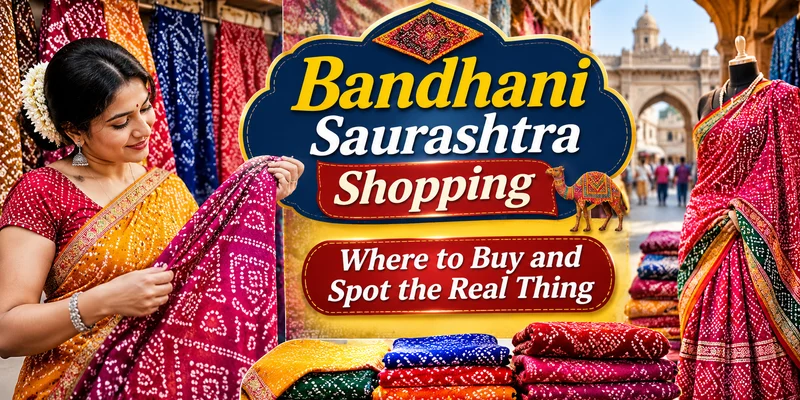
Bandhani, the ancient tie-dye textile art, has Jamnagar and Rajkot as its main production and shopping hubs in Saurashtra, with Junagadh a further stop. Buy Gaji silk for bridal wear and mulmul cotton or georgette for everyday use, look for tiny irregular hand-tied dots with a faint pinhole to spot the real thing and shop in Jamnagar's Chandi Bazar or Rajkot's Gheekanta Road. This guide, from Experience My India, covers the craft, the best stores and how to buy with confidence.
Few textiles capture the colour and spirit of Gujarat like Bandhani and the Saurashtra region is its heartland. Also known as Bandhej, it is a 5,000-year-old tie-dye art whose name comes from the Sanskrit root bandh, meaning to tie and the finest of it is made and sold in and around Jamnagar and Rajkot. This guide, from the team behind Somnath Dwarka Tour Package, a unit of Experience My India, walks you through the craft and its history, the symbolism and motifs, the best places to shop across Saurashtra, how to tell authentic hand-tied Bandhani from printed imitations and how to care for what you buy, so you bring home a genuine treasure. It is one of the proudest strands of the famous art and craft of Gujarat.
What is Bandhani?
Bandhani is a traditional resist-dyeing technique in which patterns are created by tying thousands of tiny portions of fabric with thread before the cloth is dyed, so that the tied spots resist the dye and emerge as pale dots against a coloured ground. The name comes from the Sanskrit bandh, to tie, which perfectly describes the craft. The work is painstaking and done entirely by hand: artisans pinch tiny portions of fabric with their fingernails and bind each one tightly with thread, known as bheendi, before dyeing. A single fine saree can hold tens of thousands of these knots, each tied individually, which is why genuine Bandhani is so prized. The craft was pioneered and preserved in Saurashtra and Kutch by the Khatri community, whose families have passed the skill down through generations, making it a living heritage as much as a textile.
History and origins of Bandhani
Bandhani is one of the oldest textile traditions in the world, with roots deep in the history of Western India and its ancient trade networks. Archaeological evidence links resist-dyeing techniques to the Indus Valley Civilization, around 4000 BC and early visual depictions of tie-dyed garments appear in the 6th-century Ajanta cave paintings, showing how long the art has been part of Indian dress. In Saurashtra and Kutch, the craft was carried forward by the Khatri artisans, who remain its custodians today. Bandhani gained immense prestige during the Mughal era, particularly under Emperor Akbar and was widely worn by the royal courts of Saurashtra and Rajasthan. This blend of ancient origin, continuous practice and royal patronage gives Bandhani a pedigree few textiles can match and it is part of why owning a genuine piece feels like holding a thread of history.
Cultural significance and symbolism
In Saurashtra, Bandhani is far more than fashion; it carries deep social and ritual meaning woven into daily and ceremonial life. A red or maroon Bandhani saree, especially the traditional Gharchola woven with gold zari checks, is considered auspicious for brides and symbolises fertility, good luck and a happy marriage. Colour carries its own language: red represents marriage and fortune, yellow signifies spring, purity and new beginnings and is often worn during Haldi ceremonies, green denotes prosperity and black or maroon is traditionally associated with mourning. This symbolism means a Bandhani piece is chosen for the occasion as much as for its beauty and it is a staple of festive and bridal wardrobes across the region, worn with special pride during Navratri.
Iconic Bandhani motifs
Much of Bandhani's artistry lies in how the knots are grouped to form distinct patterns. Learning a few of the classic motifs helps you appreciate and choose a piece:
Ekdali: the single dot, the simplest and most fundamental unit of the design.
Trikunti: dots grouped in threes, a popular and versatile pattern.
Chaubasi: dots grouped in fours, building richer clusters.
Mothra: diagonal stripes formed by aligning the dots, giving a dynamic effect.
Dungar Shahi: mountain patterns, evoking the landscape in cloth.
Laddu Jalebi: swirling motifs named for the sweets, full of movement and charm.
The density and arrangement of these motifs and the number of colours, are a good guide to the skill and value of a piece.
Jamnagar and Rajkot: the Bandhani hubs
Two cities stand at the centre of Bandhani in Saurashtra. Jamnagar is especially famous for producing the brightest Bandhani and the reason is its water: the local water of the Rangmati river is believed to bring out the sharpest, most vibrant shades in both natural and chemical dyes, giving Jamnagari Bandhani its celebrated glow. Rajkot, the region's commercial heart, is the other great hub, with a bustling old textile market offering extensive variety across cotton, silk and georgette. Junagadh adds a further stop in the belt. These cities are easy to combine with a Dwarka or Somnath pilgrimage and our Jamnagar to Dwarka distance and Junagadh to Dwarka distance guides help you plan the hops between them. Bandhani is also sold in the markets of Dwarka itself, though the widest choice is in these production hubs.
Where to shop for Bandhani in Saurashtra
Across the hubs, a handful of well-known stores stand out, from heritage family showrooms to modern fixed-price retailers. These are among the best known:
Store | City and area | Known for |
Mahavir Bandhani | Chandi Bazar, Jamnagar | One of the oldest, largest showrooms; budget cottons to bridal Gaji silk |
Chhaganlal Topan | Gandhi Chowk, Jamnagar | Heritage store, four generations; hand-tied Jamnagari sarees and dupattas |
KalaSanskruti Retail | Chandi Bazar, Jamnagar | Fixed pricing; contemporary dress materials, sarees, dupattas |
Balaji Bandhani Palace | Akshar Marg, Rajkot | Customised bridal trousseaus and modern designer outfits |
Bandhani Palace | Gheekanta Road, Rajkot | Old textile market; cotton, silk and georgette options |
Heritage of Vanza | Dr Yagnik Road, Rajkot | Since 1974; pure Gaji silk dupattas, sarees, lehenga cholis |
House of Bandhani | Bhavnath, Junagadh | Vibrant traditional sarees and festive wear at reasonable prices |
The main shopping streets are Chandi Bazar in Jamnagar and Gheekanta Road in Rajkot, both lined with Bandhani specialists, so they are the best places to compare quality and price across several shops in one visit.
Bandhani market timings
Most traditional Bandhani markets and showrooms in Saurashtra operate from about 10:00 AM to 8:30 PM or 9:30 PM, Monday to Saturday, with shorter hours or closures on Sundays. A few, such as KalaSanskruti in Jamnagar and House of Bandhani in Junagadh, open daily, while others, including Balaji Bandhani Palace and Heritage of Vanza in Rajkot, close on Sundays, so it is worth checking the day before you plan a dedicated shopping trip. As with most Indian markets, late morning to early evening on a weekday is the most relaxed time to browse, giving you unhurried attention from the shopkeepers and the best light to judge colours.
General hours | About 10:00 AM to 8:30 PM or 9:30 PM, Monday to Saturday |
Sundays | Shorter hours or closed; a few stores open daily |
Best time to browse | Weekday late morning to early evening, for unhurried attention |
Main streets | Chandi Bazar (Jamnagar) and Gheekanta Road (Rajkot) |
Buyer's guide: choosing the right fabric
Bandhani is made on several base fabrics and choosing the right one for your purpose makes all the difference. Gaji silk is the premier choice for weddings and formal occasions, prized for its rich sheen and crisp pleats and it is what the finest bridal Bandhani sarees and dupattas are made on. For breathable everyday or festive wear, mulmul, a fine soft cotton and georgette are ideal, light and comfortable in the warm climate while still carrying beautiful Bandhani work. When you shop, decide first what you need the piece for, a wedding, a festival or daily wear and let that guide your fabric, as it affects both the look and the price significantly. The heritage stores can show you the full range from affordable cottons to heavy bridal silks.
How to spot authentic Bandhani
Because Bandhani commands a premium, machine-printed imitations are common, so knowing how to tell the real thing is essential. Authentic hand-tied Bandhani has tiny, slightly irregular dots, each with a faint pinhole in the centre where the thread was pulled through and because the dye is resisted by a physically tied knot, the pattern shows through clearly on the reverse of the fabric. Machine-printed imitations, by contrast, look flat and overly uniform, with identical, mechanical dots and dye that sits only on the surface, so the reverse is pale or blank. Run your fingers over the cloth too: genuine Bandhani often retains a slightly crinkled texture from the tying and dyeing. Buying from established heritage stores and asking directly whether a piece is hand-tied are your best safeguards against paying a Bandhani price for a print.
Look for irregular dots: tiny, slightly uneven dots with a faint central pinhole mark genuine hand-tied work.
Check the reverse: real Bandhani shows the pattern clearly on the back; prints look pale or blank behind.
Feel the texture: authentic pieces keep a crinkled texture from the tying, which prints lack.
Buy from heritage shops: established family stores and manufacturer-retailers are the most reliable source.
Care and storage of Bandhani
A genuine Bandhani, especially in pure silk with natural dyes, deserves careful handling to keep its colour and texture. Pure silk and traditional natural-dyed Bandhani should only be dry-cleaned, never washed roughly at home, to protect the dyes. Crucially, you should never press Bandhani with a flat household iron, as the heat flattens the signature crinkled texture that is part of its character and value; instead, ask local shops for a traditional roll-press, which refreshes the cloth without crushing it. Store your pieces folded loosely, away from direct sunlight and damp and refold them occasionally along different lines to avoid permanent creases. Treated well, a fine Bandhani saree can last for decades and even become a family heirloom, passed down much as the craft itself has been.
Combining Bandhani shopping with your Saurashtra trip
The joy of Bandhani shopping is that its hubs sit right along the Saurashtra tourist circuit, so you can weave it into a pilgrimage or holiday. Jamnagar lies on the way to Dwarka, Rajkot is the region's central gateway and Junagadh anchors the Junagadh and Girnar belt, so a Bandhani stop fits naturally into a wider tour. Pair your shopping with the region's hearty Kathiyawadi food and Gujarati thali and build it into a longer journey with our 7 days Gujarat tour itinerary guide. A length of vibrant Bandhani makes one of the most meaningful souvenirs of a Gujarat trip, carrying home the colour of Saurashtra itself.
Plan your Saurashtra trip
Experience My India can plan a Saurashtra journey that leaves room for Bandhani shopping in Jamnagar, Rajkot or Junagadh alongside the temples and coast, with a comfortable stay, a well-paced itinerary and transport that makes hopping between the hubs easy. Our Somnath Dwarka tour packages and wider Gujarat tour packages can include the textile towns, with a stay at well-placed hotels and comfortable local transport throughout, so you can shop for Bandhani without the stress of logistics.
Related guides
To explore Gujarat's crafts and festivals further, these related guides help:
Related guide | What it covers |
The region's beloved sweets to taste and take home. | |
The Navratri dances where Bandhani is worn with pride. | |
The rural fair famed for embroidery and folk craft. |
Plan your visit
Experience My India can arrange your Saurashtra journey, Bandhani shopping and wider Gujarat tour. Browse more travel guides, message us on WhatsApp or call +91 73006 20809.

Harsh Rawat
Somnath–Dwarka circuit planning
Harsh Rawat runs Somnath Dwarka Tour Package on the ground in Gujarat, part of Experience My India. Since 2018 he has been planning and driving the Somnath–Dwarka circuit — the darshan timings, the road hours between temples and the stops worth adding — and the routes, fares and timings published across this site are the ones he maintains.