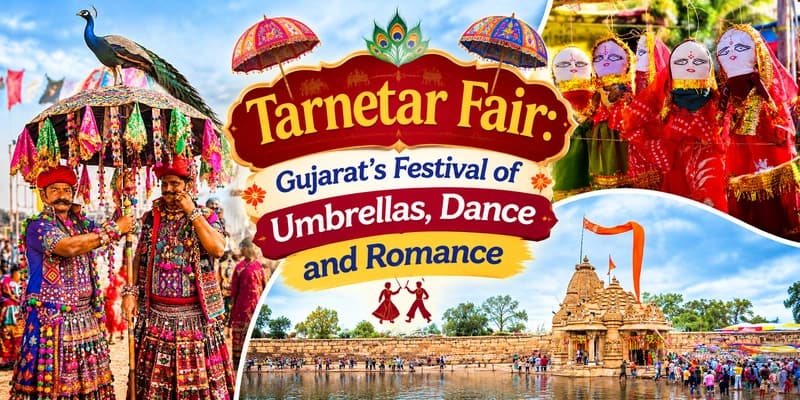
Tarnetar Fair: Gujarat's Festival of Umbrellas, Dance and Romance
The Tarnetar Fair or Trinetreshwar Mahadev Mela, is a vibrant four-day folk festival at the Trinetreshwar Mahadev Temple in Tarnetar village, Surendranagar district, Gujarat. Famed for its embroidered courtship umbrellas, massive folk dances and matchmaking traditions, it is held around the Bhadrapada lunar days, usually late August or September. This guide, from Experience My India, covers it.
The Tarnetar Fair is one of India's most vibrant and unique cultural celebrations, famous worldwide for its matchmaking traditions, energetic folk dances and spectacularly embroidered umbrellas. Held each year around the ancient Trinetreshwar Mahadev Temple in the Saurashtra heartland, it is a riot of colour, rhythm and romance where Gujarat's pastoral communities gather in their finest. This guide, from the team behind Somnath Dwarka Tour Package, a unit of Experience My India, covers the fair's dates and timings, the Mahabharata legend behind it, its famous courtship umbrellas and folk dances, its sacred rituals and modern attractions and everything you need to experience this extraordinary festival.
What is the Tarnetar Fair?
The Tarnetar Fair, also known as the Trinetreshwar Mahadev Mela, is a four-day folk festival held at the Trinetreshwar Mahadev Temple in Tarnetar village in the Surendranagar district of Saurashtra, Gujarat. It is best known for three things: its role as a traditional matchmaking ground for the region's pastoral communities, its spectacular handcrafted courtship umbrellas and its endless, exuberant folk dancing. Rooted in a legend from the Mahabharata and centred on a temple to the three-eyed Lord Shiva, the fair blends deep devotion, living folk culture and joyous romance into one of the most authentic and colourful celebrations anywhere in India. For travellers who want to see traditional Gujarat at its most vivid and unguarded, Tarnetar is an unforgettable experience.
The Tarnetar Fair at a glance
What it is | A four-day folk fair and matchmaking festival |
Also known as | Trinetreshwar Mahadev Mela |
Where | Trinetreshwar Mahadev Temple, Tarnetar village |
District | Surendranagar, Saurashtra, Gujarat |
When | Bhadarva Sud 3 to 6, usually late August or September |
Famed for | Embroidered courtship umbrellas and folk dances |
Peak time | The evenings, when the dance circles form |
Dates and timings
The Tarnetar Fair traditionally runs for four days, spanning the third to the sixth lunar day of the bright half of the Bhadrapada month, Bhadarva Sud 3 to 6 in the Gujarati calendar, which usually falls in late August or September. Because it follows the Hindu lunar calendar, the exact dates shift each year, so it is worth checking the Bhadarva Sud dates for your year of travel; as an illustration, in 2027 the fair is expected to run from 3 to 6 September. The fairgrounds are open all day, but the evenings are the absolute peak, when the energy surges and the great dance circles form, while the afternoons tend to be very hot and slow. Plan to be there for the evenings to see the fair at its most spectacular.
The legend of Draupadi's swayamvar
The fair's origin is tied directly to the Mahabharata. The Panchal region, where Tarnetar sits, is believed to be the native land of Princess Draupadi and this is held to be the very location of her swayamvar, the marriage-alliance contest at which suitors competed for her hand. It was here, legend says, that the great archer Arjun won Draupadi as his bride by performing the near-impossible feat of piercing the eye of a rotating fish while looking only at its reflection in the water below. This mythological matchmaking is the deep root of the fair's enduring role as a place where marriages are made and it gives the whole festival its romantic character. To stand at Tarnetar is to stand at the legendary site of one of the epic's most famous contests.
History and the temple
While its mythological roots reach back to the Mahabharata, the festival in its current form is believed to have officially begun roughly 200 to 250 years ago. Its focal point, the Trinetreshwar Mahadev Temple, is dedicated to the three-eyed form of Lord Shiva, from which Tarnetar takes its name and the present structure was rebuilt in the 19th century by the Gaekwads of Vadodara over original ancient ruins. The temple and its sacred reservoir anchor the fair, giving the exuberant folk celebrations a devotional heart. This layering of ancient legend, an 18th or 19th-century festival tradition and a rebuilt Shiva temple is typical of Saurashtra's living heritage, where myth and history intertwine around a place of worship that still draws its community together each year.
The embroidered umbrellas
The fair's defining visual symbol is its umbrellas. Unmarried young men carry stunning, large umbrellas intricately decorated with elaborate beadwork, patchwork, mirrors and bright cloth tassels, each a labour of love that can take over a year to handcraft. These are no mere sunshades: standing beneath or strolling with one of these dazzling umbrellas serves as a courtship signal to potential brides, a way of announcing that the young man is seeking a match and of displaying the skill and prosperity of his family. The sight of dozens of these vivid, mirror-flecked umbrellas moving through the crowd is the unforgettable image of Tarnetar and the umbrellas have become the emblem of the whole fair, celebrated in photographs and folk art across Gujarat.
The tribal marriage mart
Historically and culturally, the Tarnetar Fair functions as a traditional matchmaking ground for the local pastoral communities of Saurashtra, including the Koli, Bharwad, Rabari and Khant communities. Young men and women come dressed in their finest traditional attire, the men with their courtship umbrellas and the women in vivid, mirror-work clothing and families use the gathering to seek suitable matches for their children, continuing a custom said to echo Draupadi's own swayamvar. While modern life has changed how marriages are arranged, the fair remains a cherished social occasion for these communities, a rare chance for scattered pastoral families to gather, celebrate and connect. For visitors, it offers a fascinating and respectful window into living traditions that are increasingly rare in the modern world.
The folk dances
The Tarnetar Fair is an endless showcase of traditional Gujarati folk art and the dancing is its pulse. Hundreds of women dressed in vivid, mirror-work attire form enormous concentric tiers to perform the region's folk dances, among them the graceful Rasada, the stick-clacking Raas, the Rahado and the spontaneous, high-energy Hudo. These unfold to the rhythm of roaring drums and the distinctive double flutes known as jodia pava, building through the evening into a mesmerising spectacle of swirling colour and sound. Unlike a staged performance, this is folk dance as it has always been, danced by the communities themselves for the sheer joy and tradition of it and it is one of the finest displays of authentic Gujarati folk culture a visitor can hope to witness.
Sacred rituals at the kund
For all its colour and romance, the fair has a sacred core. The Trinetreshwar Mahadev Temple sits on the edge of a reservoir, a kund and local folklore holds that this tank was once connected to the original course of the holy Ganga river. Taking a ritualistic dip in the reservoir is therefore considered highly auspicious and a cleanser of sins and pilgrims come to bathe in its sacred waters as an act of devotion alongside the festivities. This combination of the sacred bath, the Shiva temple and the folk celebrations gives Tarnetar its distinctive character, a fair where a holy dip and a courtship dance happen side by side and where the spiritual and the social are woven together as they have been for generations.
Modern attractions
Alongside the traditional dance and romance, the modern Tarnetar Fair offers plenty more to see. There is a massive livestock and cattle exhibition, important to the pastoral communities who prize fine animals and a bustling local arts and crafts marketplace where you can find the beadwork, embroidery and handicrafts of the region. The fair also features a lively Rural Olympics, with local bullock-cart and horse races that draw big, cheering crowds. These additions make Tarnetar a full day out for every kind of visitor, blending the timeless folk traditions with the fun of a country fair, so that even those who come mainly for the umbrellas and dances find much more to enjoy across the fairgrounds.
How to reach the Tarnetar Fair
The fair is held at Tarnetar village, about 8 km from the town of Thangadh, in the Surendranagar district, roughly 59 km from Surendranagar city and 75 km from Rajkot. The nearest railway station is Thangadh, about 8 km away, while the major junctions of Rajkot and Surendranagar offer broader rail connectivity. The closest domestic airport is Rajkot, about 75 km away. By road, state transport buses run heavily during the festival from Ahmedabad, Rajkot and Jamnagar to Chotila, about 25 km from Thangadh, from where local transport shuttles travellers to the fairgrounds. Because the fair is remote and crowds are large, arranging a private vehicle is the most comfortable way to attend, especially for the all-important evenings.
Nearest railway | Thangadh, about 8 km away |
Nearest airport | Rajkot, about 75 km away |
From Surendranagar | About 59 km |
By bus | Heavy services to Chotila, 25 km away, then local transport |
Tips for visiting the Tarnetar Fair
A few pointers help you get the most from the fair:
Check the Bhadarva Sud dates for your year of travel, as the four days shift with the Hindu lunar calendar.
Come for the evenings, when the energy surges and the great dance circles form; afternoons are hot and slow.
Look for the handcrafted courtship umbrellas, the fair's defining sight and ask before photographing people closely.
Respect the matchmaking traditions and the communities, observing with courtesy rather than intruding.
Arrange a private vehicle, as the village is remote and buses run only to Chotila, 25 km away.
Carry water, sun protection and cash and plan where to stay, as nearby lodging is limited and fills fast.
Take time for the livestock show, the crafts market and the Rural Olympics races beyond the main dance grounds.
Experiencing Gujarat's wider culture
The Tarnetar Fair is a gateway into Gujarat's rich folk culture, which rewards a deeper visit. The nine-night festival of Navratri in Gujarat is the other great showcase of the state's folk dance, while the craftsmanship on display at Tarnetar is celebrated in our famous art and craft of Gujarat guide and the regional cuisine in our Kathiyawadi food and Gujarati thali guide. To build a trip around the festival season, see our Gujarat itinerary, which can be combined with the coastal pilgrimage to Somnath and Dwarka and the lions of Gir.
Plan your Tarnetar visit
Experience My India can plan a trip around the Tarnetar Fair, arranging transport to this remote festival, a well-timed itinerary for the peak evenings and a comfortable base from which to visit, then weaving in the wider culture and pilgrimage of Saurashtra. Our Gujarat tour packages and Somnath Dwarka tour packages can build the fair into a fuller journey, with a stay at well-placed hotels and comfortable local transport.
Related guides
To plan your Gujarat festival and culture trip, these related guides help:
Related guide | What it covers |
The mithai to enjoy during the festival season. | |
The four sacred dhams for a pilgrimage add-on to your trip. | |
The autumn full-moon festival in the Gujarat calendar. |
Plan your visit
Experience My India can arrange your Tarnetar Fair and Gujarat culture trip. Browse more travel guides, message us on WhatsApp or call +91 73006 20809.

Harsh Rawat
Somnath–Dwarka circuit planning
Harsh Rawat runs Somnath Dwarka Tour Package on the ground in Gujarat, part of Experience My India. Since 2018 he has been planning and driving the Somnath–Dwarka circuit — the darshan timings, the road hours between temples and the stops worth adding — and the routes, fares and timings published across this site are the ones he maintains.