Gir National Park Animals: The Wildlife You Can See Beyond the Lion
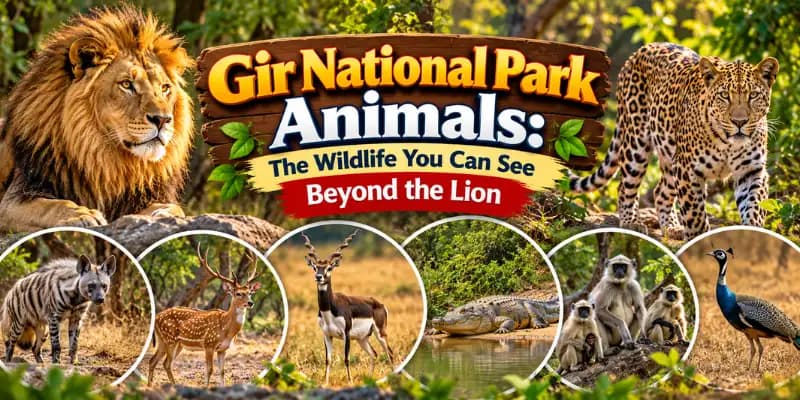
Gir National Park is home to over 2,375 species, including 38 mammals, more than 300 birds and 37 reptiles. Beyond its famous Asiatic lion, Gir has Indian leopards, striped hyenas, jackals, nilgai, sambar, chital, the rare four-horned chausingha, over 300 bird species, and the largest marsh crocodile population in India at Kamleshwar Dam.
While the Asiatic lion is the star of Gir National Park, the forest teems with a rich variety of other wildlife and a safari here rewards you with far more than lions. This guide, from the team behind Somnath Dwarka Tour Package, a unit of Experience My India, covers the animals of Gir National Park: the predators, the deer and antelope, the birds and the reptiles you can hope to see.
The wildlife of Gir National Park
Gir National Park, in the Saurashtra region of Gujarat, spans a vast dry deciduous forest and scrubland ecosystem that supports a remarkable diversity of life, over 2,375 species in all. This includes around 38 species of mammals, more than 300 species of birds, 37 types of reptiles and a host of insects and other creatures. Famous above all as the last home of the wild Asiatic lion, Gir is in truth a complete and thriving ecosystem, where predators, grazers, birds and reptiles all have their place. On a safari, alongside the hope of a lion, you will see graceful deer and antelope, perhaps a leopard or a hyena and a wealth of birdlife, so that every drive is full of surprises. The animals of Gir can be grouped into the apex predators and carnivores, the large herbivores and the birds and reptiles. This balance of hunter and hunted, kept healthy over decades of careful protection, is what makes Gir such a living, breathing forest rather than simply a lion reserve and it is why even a half-day safari can turn up a dozen different creatures.
Gir National Park animals at a glance
Total species | Over 2,375 |
Mammals | About 38 species |
Birds | Over 300 species, an Important Bird Area |
Reptiles | About 37 species |
Star species | The Asiatic lion, found only here |
Other highlights | Leopard, chausingha, marsh crocodile |
The apex predators and carnivores of Gir
Gir is predator country and its carnivores are among the great draws of a safari. The crown jewel is of course the Asiatic lion, found in the wild only here, with a May 2025 census recording 891 individuals in a steadily rising population. But the lion is far from alone:
The Indian leopard. Gir holds a large and thriving population of leopards, which flourish particularly along the rugged terrain and the park boundaries. Elusive and beautiful, the leopard is the second big cat of Gir and a sighting is a special thrill.
The striped hyena and golden jackal. The park's scavengers and smaller predators include the striped hyena, with its distinctive mane and the golden jackal, often heard calling in the dusk. Both play an important role in the forest's health, clearing carcasses and keeping the balance of the wild. Seeing a hyena loping across the track at dusk or hearing the eerie chorus of jackals as the light fades, is one of the quieter pleasures of a Gir safari, away from the drama of the big cats.
The smaller cats and other carnivores. Gir also protects a range of smaller and nocturnal hunters, including the jungle cat, the tiny rusty-spotted cat, one of the world's smallest wild cats, the Bengal fox and the honey badger or ratel, famed for its fearlessness.
The deer, antelope and large herbivores of Gir
The herbivores of Gir are the foundation of the whole ecosystem, the prey that sustains the lions and leopards and they are the animals you will see most often on a safari. Gir has a wonderful variety:
Nilgai, the blue bull. The nilgai is the largest antelope in Asia, a big, powerful animal often seen grazing on the open plains, with the bulls a distinctive blue-grey.
Sambar, India's largest deer. The sambar is the largest deer species in India, a heavy animal that large males can approach around 500 kg, usually found near water sources in the forest.
Chital, the spotted deer. The chital or spotted deer, is the most common and elegant deer of Gir, seen roaming in large herds across the forest and a favourite prey of the lions. Watching a herd of chital move through the dappled light of the forest, alert and graceful, is one of the most beautiful sights of Gir.
Chausingha, the four-horned antelope. One of Gir's rarest and most special animals, the chausingha is the world's only four-horned antelope, a unique and prized sighting for wildlife lovers and a creature found in very few places on earth.
Other herbivores. Gir is also home to the chinkara or Indian gazelle, the wild boar, which roots through the undergrowth and the graceful blackbuck on the open grasslands.
The birds of Gir National Park
Gir is a paradise for birdwatchers, recognised as an Important Bird Area and holding over 300 species of birds. For many visitors, the birdlife is a joy equal to the mammals and a patient watcher is richly rewarded. The highlights include birds of prey such as the crested serpent eagle and the Bonelli's eagle, soaring over the forest; the colourful and much-loved Indian pitta; the brown fish owl and the pygmy woodpecker in the woodland; and, importantly, several species of endangered vultures, for which Gir is a vital refuge. Along the water bodies you may see storks, herons and kingfishers and the forest echoes with birdsong through the day. Whether you are a keen birder or simply enjoy the beauty of birds, the skies and trees of Gir never disappoint, so carry a good pair of binoculars and a little patience to make the most of it.
The reptiles of Gir National Park
Gir's reptiles are led by one remarkable resident: the Kamleshwar Dam reservoir inside the park hosts the largest population of marsh crocodiles or muggers, in India, a striking sight as they bask along the water's edge. Beyond the crocodiles, the park's 37 reptile species include the mighty Indian python, coiled in the undergrowth; the king cobra and other snakes; the monitor lizard, basking in the sun; and the Indian flapshell turtle in the water bodies. The reptiles are a fascinating part of the Gir ecosystem and the crocodiles of Kamleshwar Dam in particular are a highlight for many visitors, as covered among the sights of the wider Gir forest. A good guide will help you spot and safely appreciate these cold-blooded residents of the forest.
Gir wildlife summary
Here is a quick summary of the main animals you can hope to see in Gir:
Group | Animals to look for |
Big cats | Asiatic lion, Indian leopard |
Other carnivores | Striped hyena, golden jackal, jungle cat, rusty-spotted cat, ratel |
Deer and antelope | Nilgai, sambar, chital, chausingha, chinkara, blackbuck |
Birds | Crested serpent eagle, Bonelli's eagle, Indian pitta, owls, vultures |
Reptiles | Marsh crocodile, Indian python, monitor lizard, cobras |
Where and how to see the animals of Gir
The animals of Gir are seen on an open-top gypsy safari through the forest zones, booked in advance through the official permit system, as covered in our Gir safari ticket price guide. The early morning and late afternoon safaris are best, when the animals are most active. For a near-guaranteed sighting of the lion and other wildlife, the fenced Devalia Safari Park or Gir Interpretation Zone, is an excellent option. The best months for wildlife are covered in our best time to visit Gir guide, with the cool winter the most pleasant and the dry summer offering the best sightings as animals gather at water. A knowledgeable guide greatly improves what you see, pointing out the deer, birds and reptiles you might otherwise miss, reading the alarm calls of the forest and knowing where the animals are most likely to be at each time of day.
Tips for seeing Gir's wildlife
A few pointers help you see and enjoy more:
Take the early morning or late afternoon safari, when the animals are most active.
Carry binoculars, as Gir's 300-plus bird species and distant animals reward a closer look.
Do more than one safari to see a wider range of animals, as each drive is different.
Visit the Kamleshwar Dam area for the marsh crocodiles, the largest such population in India.
Listen as well as look, as jackals, birds and alarm calls often reveal nearby wildlife.
Go with a good naturalist guide, who will spot and explain far more than you would alone.
Plan your Gir wildlife trip
Experience My India can plan a Gir wildlife trip with the safari permit, transport and the itinerary arranged. Combine your Gir safari with the Somnath temple and Dwarka, book Somnath Dwarka hotels and let the Experience My India Somnath Dwarka tour packages or the wider Gujarat tour packages include Gir and the region in your itinerary, with the safari booking handled for you.
Related guides
To plan the rest of your Gir and Saurashtra trip, these related guides help:
Related guide | What it covers |
Air, rail and road access to Sasan Gir. | |
The drive from the Somnath coast to Gir. | |
The fort city and sacred mountain near Gir. | |
The summit temple on the sacred Girnar mountain. | |
The sights of the Somnath temple town nearby. | |
The top sights and spots around Dwarka. |
Plan your visit
Experience My India can arrange your Gir wildlife safari and Saurashtra trip. Browse more travel guides, message us on WhatsApp or call +91 73006 20809.

Harsh Rawat
Somnath–Dwarka circuit planning
Harsh Rawat runs Somnath Dwarka Tour Package on the ground in Gujarat, part of Experience My India. Since 2018 he has been planning and driving the Somnath–Dwarka circuit — the darshan timings, the road hours between temples and the stops worth adding — and the routes, fares and timings published across this site are the ones he maintains.