The Krishna Story of Dwarka: How the Golden City Rose and Fell
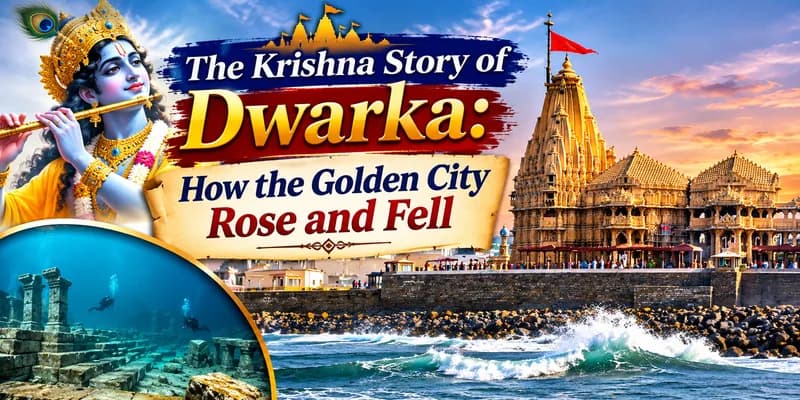
Dwarka is the legendary golden city of Lord Krishna. The story tells how, after killing Kansa in Mathura and facing endless war from Jarasandha, Krishna led the Yadavas west and had Vishwakarma build the fortified Suvarna Dwarka on land granted by the ocean god. He ruled there as Dwarkadhish and after his departure the sea reclaimed the city. This guide, from Experience My India, tells the full story.
Few places in India carry a story as rich as Dwarka, the legendary city of Lord Krishna on the Gujarat coast where the Gomti meets the Arabian Sea. More than a temple town, Dwarka is the setting for one of the great arcs of the Krishna legend, his transformation from the cowherd of Vrindavan and the warrior of Mathura into Dwarkadhish, the king of a golden city built on the sea. This guide, from the team behind Somnath Dwarka Tour Package, a unit of Experience My India, tells the story of Krishna's Dwarka: why he left Mathura, how the golden city was built, his reign of righteousness and the submergence that followed his departure, along with how the legend lives on in the Dwarka of today.
Krishna and the founding of Dwarka
According to the Mahabharata and the Puranas, Dwarka was founded by Lord Krishna himself. After leaving Mathura, he requested land from Samudradeva, the ocean god and commissioned Vishwakarma, the divine architect, to build the golden fortress-city of Dwarkavati, also called Suvarna Dwarka. It became the capital from which Krishna ruled as a king, a place of unmatched splendour and good governance and the stage for the final chapter of his earthly life. The story of Dwarka is therefore the story of Krishna the king, as distinct from Krishna the child of Gokul or the youth of Vrindavan and it marks a profound shift in his life from the pastoral and the heroic to the royal and the statesmanlike. To understand how Dwarka fits into the whole of Krishna's journey, see our guide to
Krishna's three cities, which traces his path from Mathura through Vrindavan to Dwarka.
The exodus from Mathura
The story of Dwarka begins with conflict in Mathura. After Lord Krishna killed the tyrant king Kansa, freeing the people from his cruelty, Kansa's powerful father-in-law, Jarasandha, the king of Magadha, sought revenge and waged seventeen consecutive wars against Mathura. Though Krishna and the Yadavas withstood these assaults, the endless bloodshed threatened the safety and survival of his people. Rather than subject them to perpetual war, Krishna took a momentous decision: to lead the Yadavas away from Mathura and resettle them far to the west, out of Jarasandha's reach. It was for this strategic retreat from the battlefield, choosing the protection of his people over the pride of standing to fight, that Krishna earned the name Ranchhod, he who leaves the battlefield, a title still lovingly used for him in Gujarat today.
The birth of the golden city
Having resolved to resettle his people, Krishna turned to the sea. He prayed to Samudra Deva, the ocean deity, who yielded him twelve yojanas of land, roughly 96 square kilometres, along the coast. On this reclaimed ground Krishna commissioned Vishwakarma, the divine architect of the gods, to build a fortified city worthy of the Yadava people. The result was a marvel: a city built with gold, emeralds and precious gems, so dazzling that it was named Suvarna Dwarka, the Golden Dwarka. Protected by the sea on all sides and by great boundary walls, it was both a stronghold safe from Jarasandha and a capital of extraordinary beauty and prosperity, a thriving port and the seat of Krishna's kingdom. The very name Dwarka, meaning gateway, reflected its role as a gateway both to the kingdom and, in time, to liberation.
Dwarka as a kingdom of righteousness
In Dwarka, Krishna completed his transformation from a cowherd youth into a compassionate and just king, worshipped here as Dwarkadhish, the King of Dwarka. His reign came to represent the ideal of Dharma Rajya, a society and a statecraft rooted entirely in righteousness, wisdom and justice. This is the Krishna of mature kingship, the statesman and guide whose counsel shapes the Mahabharata and Dwarka is the throne from which he exercised that wisdom. To worship at Dwarka is thus to honour not only the beloved god of Vrindavan but the model of the righteous ruler, which is why the city stands for ideal governance in the Hindu imagination. The temple at the heart of the city, the Jagat Mandir, still enshrines Krishna as Dwarkadhish and its customs are set out in our Dwarka temple rules guide.
The submergence of Dwarka
The story of Dwarka ends as dramatically as it began. The Mahabharata records that immediately following Krishna's departure from his mortal body, some 125 years after the city's founding, a massive tidal wave broke the boundary walls of Dwarka and the Arabian Sea reclaimed the land, submerging the entire opulent kingdom beneath the waves. The golden city that the ocean had granted was, in the end, taken back by the ocean. This submergence is one of the most poignant episodes in the Krishna legend, marking the close of a divine age and it has given Dwarka an enduring aura of mystery, a splendid lost capital sleeping beneath the sea off the modern coast. It is this lost-city legend that marine archaeology has since set out to explore.
The underwater city and archaeology
The legend of the submerged city is not myth alone, for modern science has found remarkable support for it. Between 1983 and 1990, marine archaeologists led by Dr S.R. Rao, working with the Archaeological Survey of India, discovered an extensive underwater urban landscape just off the Dwarka coast and near Bet Dwarka. Divers recovered massive fortified stone walls, laid-out cross-roads, pillars and distinctive stone anchors dating back to the protohistoric era, evidence that validated the ancient texts' descriptions of Dwarka as a booming ancient trading port. The discovery bridged ancient literature and modern archaeology, lending striking weight to the tradition of a great city lost to the sea. The full story of these finds and how deep the ruins lie is told in our guide to how deep underwater Dwarka is.
The Jagat Mandir temple today
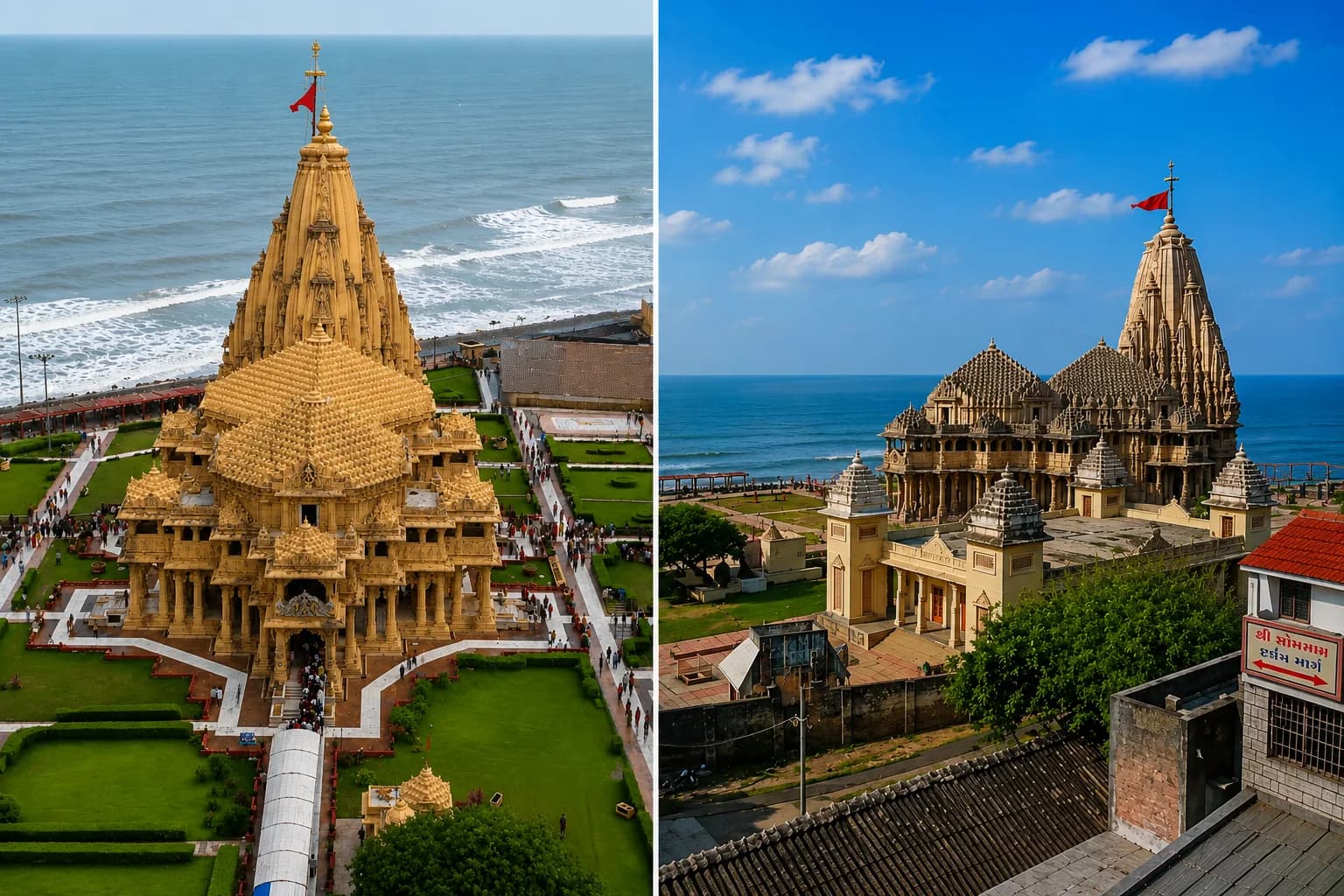
The living heart of Krishna's Dwarka is the Dwarkadhish Temple, the Jagat Mandir. The original Hari-Griha shrine, built over Krishna's own residential chambers, is said to have been founded over 2,500 years ago by his great-grandson Vajranabha and the soaring five-storey structure standing today, raised on seventy-two pillars of limestone and sandstone, dates mainly to the 15th and 16th centuries after earlier destructions, with later renovations. The temple runs on a traditional daily schedule of morning and evening darshan with a long afternoon closure and its famous 52-yard flag is changed five times a day. For the full ritual schedule and the temple's customs, our Dwarka temple guides cover the darshan, the aartis and the dress code in detail, so you can plan your visit to the shrine around the sacred timings.
Spiritual significance
The story of Dwarka gives it immense spiritual significance. It is one of the four supreme Char Dham pilgrimage sites of Sanatana Dharma, representing the southwest and the final liberation and it is counted among the seven holy Sapta Puri cities said to grant moksha. As a Moksha Puri, Dwarka is associated in Hindu sacred geography with the southwest cardinal point and with liberation from the cycle of rebirth. The city's intellectual stature was sealed in the 8th century, when the philosopher Adi Shankaracharya established one of his four cardinal monasteries, the Sharada Peeth, here, as covered in our guide to the Shri Shardapeeth of Dwarka, cementing Dwarka as an intellectual capital of the Vedic tradition as well as a seat of Krishna's kingship.
Experiencing Krishna's Dwarka today
The modern city lets you walk through the living remains of the legend. Beyond the Dwarkadhish Temple, you can bathe at the sacred Gomti Ghat where the river meets the sea, cross the Sudama Setu footbridge and sail or drive to the island of Bet Dwarka, believed to be Krishna's residence, near where the underwater ruins lie. The nearby Nageshwar Jyotirlinga and the Nava Dwarka temples complete the pilgrimage. For a full plan of the city's sights, see our best places to visit in Dwarka and one day Dwarka itinerary guides.
Tips for exploring the story of Dwarka
A few pointers help you connect with the legend on a visit:
Begin at the Dwarkadhish Temple, the Jagat Mandir, the throne-seat of Krishna as king of Dwarka.
Visit Bet Dwarka, believed to be Krishna's residence, near where the submerged ruins were found.
Bathe or take a boat at the Gomti Ghat, where the sacred river meets the sea that reclaimed the city.
Learn the Ranchhod story, as the name is lovingly used for Krishna across Gujarat.
Pair the visit with the Nageshwar Jyotirlinga and the Rukmini Devi temple nearby.
Read about the marine archaeology to appreciate the real evidence beneath the legend.
Time your darshan around the temple's morning and evening sessions and the flag-changing ritual.
Plan your Dwarka pilgrimage
Experience My India can plan your journey through Krishna's Dwarka, with comfortable transport, a stay near the temple and a well-paced itinerary taking in the Dwarkadhish darshan, Bet Dwarka, Nageshwar and the city's sacred sites. Our Somnath Dwarka tour packages and wider Gujarat tour packages weave Dwarka into a fuller Saurashtra journey taking in Somnath, Gir and the coast, with a stay at well-placed hotels and comfortable local transport.
Related guides
To explore the story and sights of Dwarka further, these related guides help:
Related guide | What it covers |
Experiences and activities across Krishna's holy city. | |
The five sacred Dwarka temples of the Krishna tradition. | |
Planning the onward journey from Dwarka to Somnath. |
Plan your visit
Experience My India can arrange your Dwarka pilgrimage and wider Saurashtra journey. Browse more travel guides, message us on WhatsApp or call +91 73006 20809.

Harsh Rawat
Somnath–Dwarka circuit planning
Harsh Rawat runs Somnath Dwarka Tour Package on the ground in Gujarat, part of Experience My India. Since 2018 he has been planning and driving the Somnath–Dwarka circuit — the darshan timings, the road hours between temples and the stops worth adding — and the routes, fares and timings published across this site are the ones he maintains.