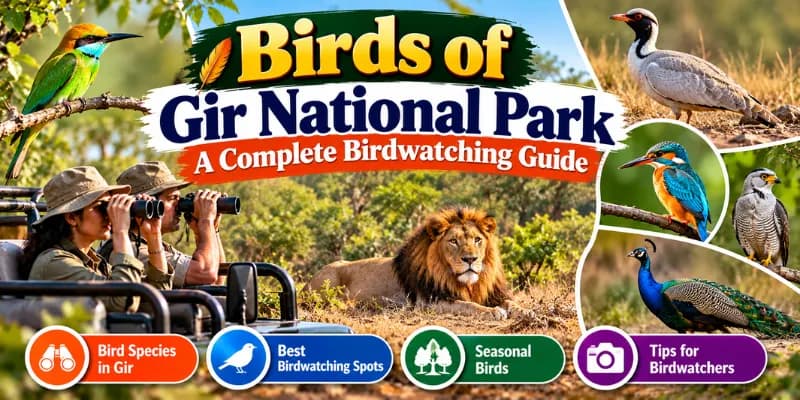
Birds of Gir National Park: A Complete Birdwatching Guide
Gir National Park is an Important Bird Area with over 300 recorded bird species, from critically endangered vultures and soaring eagles to owls, the jewel-like Indian Pitta and rare grassland floricans. This guide, from Experience My India, covers the birds of Gir, where to find them and the best season for birdwatching.
Gir is world famous for its Asiatic lions, but for those who look up as well as out, Gir National Park is one of the richest birding landscapes in western India, a designated Important Bird Area alive with raptors, owls, forest jewels and grassland rarities. This guide, from the team behind Somnath Dwarka Tour Package, a unit of Experience My India, is a complete birdwatcher's guide to the birds of Gir National Park, the key species to look for, the birding hotspots and the best time of year to visit with your binoculars.
Gir, an Important Bird Area
While Gir is celebrated the world over for its Asiatic lions, the sanctuary is also an officially recognised Important Bird Area or IBA and a serious destination for birdwatchers. Depending on the source and the season, the park is reported to harbour anywhere from more than 300 to around 425 species of birds, a remarkable richness for a single protected area. The reason lies in its habitat diversity. Gir is not a single kind of forest but a mosaic of dry deciduous woodland, open grassland, scrub, rocky hills and river courses and each of these supports its own community of birds. The result is a critical breeding ground and refuge for a spectacular mix of resident forest species, soaring raptors and winter migrants that arrive from the north each cold season. For the visitor who loves wildlife beyond the big cats, Gir rewards every safari with a parade of birds and for the dedicated birder, it is a destination worth planning a whole trip around.
Birds of Gir at a glance
Status | Important Bird Area (IBA) |
Species count | More than 300, up to around 425 recorded |
Habitats | Dry deciduous forest, grassland, scrub, rivers |
Flagship groups | Vultures, eagles, owls, pittas, floricans |
Best season | Winter, November to March, for migrants |
How to bird | On the open jeep safari and around the fringe |
Raptors and birds of prey
Gir's mature forest canopy and open grasslands support a high density of formidable birds of prey and for many visitors the sight of a great raptor perched on a dead tree or circling overhead is a highlight of the safari. The forest is home to a range of apex avian hunters. The Crested Serpent-Eagle, with its broad barred wings and loud whistling call, is often seen surveying the canopy for snakes. The Changeable Hawk-Eagle, sometimes crested, hunts smaller mammals and birds through the woodland. The White-eyed Buzzard, a compact resident raptor, perches patiently on exposed branches watching for lizards and large insects. In winter, these residents are joined by migratory visitors such as the Greater Spotted Eagle, a powerful dark eagle that travels south to hunt around the park's wetlands and open ground. Together they make Gir a genuinely exciting place for raptor watching, where a slow drive with eyes on the skyline can turn up several species in a single morning.
Vultures: the critically endangered scavengers
Among the most important birds of Gir are its vultures and the park has become a vital stronghold for species that have collapsed catastrophically across much of India. The critically endangered White-rumped Vulture, once one of the most abundant large birds in the country, survives here in a protected population, as does the critically endangered Indian Vulture, a cliff and tree nesting species. The striking Red-headed Vulture, with its bare crimson head and sombre plumage, is also recorded in the sanctuary. These great scavengers play an irreplaceable role in the ecosystem, cleaning carcasses and keeping the forest healthy and their continued presence at Gir, when they have vanished from so many other regions, makes the park a place of real conservation significance. For a birdwatcher, seeing a wild vulture soar on the morning thermals or gather at a kill is a moving reminder of what careful protection can preserve.
Owls and the nocturnal birds of Gir
As dusk settles over Sasan Gir, a whole second cast of birds comes to life, the owls and nightbirds that rule the forest after dark. The Brown Fish-Owl, one of the larger owls, is often found perched silently near the river streams and water bodies, watching for fish and amphibians below. The Mottled Wood-Owl, a beautiful and heavily streaked owl that is endemic to the Indian subcontinent, thrives in the park's dense, undisturbed tree canopies, its mournful call carrying through the twilight. The tiny Indian Scops-Owl, a master of camouflage, calls from the hollows of old trees and the Indian Nightjar rests by day on the leaf litter where its cryptic plumage makes it almost impossible to see, taking wing at dusk to hawk for insects. Because the core forest closes to visitors at night, most owl sightings come at the edges of the safari slots, at first light and last light or around the fringe lodges, where a patient birder with a torch and a guide can add several of these shy species to the day's list.
Colourful forest and understory birds
The interior trails and foliage of Gir are populated by a wealth of colour-rich birds that dart through the shrubs, the bamboo and the understory and these smaller jewels are often what a birder remembers most. The undisputed star is the Indian Pitta, a dazzling, almost impossibly colourful ground bird sometimes called the nine-coloured bird, which forages in the leaf litter for insects and is most active and vocal in the breeding season. The Asian Paradise-Flycatcher is another showstopper, the male trailing long, streaming white or rufous tail feathers as it dances through the understory after insects. Flocks of Plum-headed Parakeets flash green and plum through the canopy with shrill calls and the forest rings with the drumming of woodpeckers, from the handsome Black-rumped Flameback to the diminutive Brown-capped Pygmy Woodpecker working the smaller branches. Add to these the bee-eaters, drongos, bulbuls, sunbirds and babblers of the woodland and even a casual drive through Gir becomes a feast of colour and song.
Grassland and ground birds
The expansive scrub and open savannah on the fringes of the core forest protect a different and more elusive group, the ground-dwelling and grassland birds that are among the hardest to see and the most prized. The Painted Sandgrouse, beautifully patterned and cryptically coloured, walks in small groups along the gravel tracks, blending into the stony ground until it bursts into flight. Game birds are common terrestrial sights, with the Grey Francolin and the Jungle Bush-Quail scurrying across the safari paths and vanishing into the brush. Most special of all, the taller grasslands around Gir can, with luck and in the right season, hold the highly endangered Lesser Florican, whose leaping breeding display of the male above the grass is one of the great sights of Indian birding. These grassland and ground birds reward the patient and the early riser and they add a quieter, subtler thrill to a Gir birding trip, quite different from the drama of the lions.
Water birds around the rivers and dams
Gir is drained by several seasonal rivers and the water bodies and the Kamleshwar reservoir within and around the sanctuary draw their own community of water birds, especially in the cooler months. Around the still water you can find storks, herons, egrets and cormorants fishing the shallows, ducks and other waterfowl resting in winter and waders probing the margins, while kingfishers flash along the banks and the Brown Fish-Owl keeps watch from the trees above. The water is also where the marsh crocodile or mugger, basks and a quiet stretch of riverbank at dawn is one of the most productive and peaceful places to bird in the whole park.
For the visitor who wants the full picture of Gir's wildlife beyond the birds, the Gir National Park animals guide covers the leopards, deer, antelope and crocodiles that share this landscape with the birds and the Asiatic lion guide covers the king of the forest himself.
Best time for birdwatching in Gir
The best time for birdwatching in Gir is the winter, roughly November through March, when the resident birds are joined by large numbers of migratory species that fly south to escape the northern cold, swelling both the variety and the numbers on show. The weather in these months is also at its most pleasant for long hours in an open jeep, cool in the early morning and mild by day, which is the same window that gives the best lion sightings, as covered in our best time to visit Gir guide. The breeding season from spring into the early monsoon brings its own rewards, with the forest birds in full song and colour and the floricans displaying over the grass, though the heat of April and May is demanding. The park is closed through the monsoon from mid-June to mid-October, so birding is not possible then. For the richest birding, aim for the heart of winter and book your Gir National Park timings slots for the early morning.
Birding hotspots in and around Gir
To make the most of a birdwatching trip, it helps to know where to look, because the birds of Gir are spread across its different habitats rather than concentrated in one place. The open jeep safari routes through the core forest are the obvious starting point, giving access to the woodland and grassland birds along with the raptors overhead. The river courses and the Kamleshwar dam area are the places for water birds, kingfishers and the Brown Fish-Owl. The grassland and scrub on the sanctuary fringes are where the sandgrouse, francolins, quails and, in season, the florican are found. Some of the best birding of all is often done without a safari at all, simply by walking the grounds of the fringe lodges and resorts around Sasan Gir at dawn and dusk, where the gardens, scrub and trees pull in pittas, flycatchers, parakeets, owls and a long list of smaller birds. A good local guide who knows the current roosts and the seasonal movements is worth their weight in gold and many lodges can arrange a dedicated birding guide alongside the standard safari.
Birdwatching and the lion safari
It is worth being clear about how birding fits into a Gir visit, because the park's rules shape it. Almost all birdwatching inside the core forest happens from the open jeep on the standard safari, the Gir jungle trail, since walking and private vehicles are not allowed in the sanctuary for safety. That means the serious birder usually combines the safari, which is timed and routed by the forest department, with unhurried birding around the lodges, the fringe and the water bodies, where there is more freedom to stop and watch. The fenced Devalia Safari Park interpretation zone also holds birds, though it is designed for a quick, near-guaranteed mammal sighting rather than patient birding. The costs of the safari are set out in our Gir safari ticket price guide. The key is to treat Gir as both a lion destination and a birding one and to give yourself more than a single safari so the birds have time to appear.
Tips for birdwatching in Gir
A few pointers help you get the best from the birds of Gir:
Visit in winter, November to March, for the greatest variety, with resident birds joined by migrants.
Take the early morning safari slot, when birds are most active and the light is best for watching and photography.
Carry binoculars and, if you photograph, a long zoom lens and keep a field guide or bird app to hand for identification.
Bird the lodge grounds and the fringe at dawn and dusk, where you can watch at leisure and often see pittas, owls and flycatchers.
Hire a local birding guide who knows the current roosts, the river spots and the grassland for the sandgrouse and florican.
Wear neutral, earthy colours, move and speak quietly and be patient, as the best birds reward stillness.
Do more than one safari and spend at least two nights, so you can cover the forest, the water and the grassland habitats.
Plan your Gir birding trip
Experience My India can plan a birding-focused trip to Gir, with the safari permits booked, a lodge chosen for its birdlife and a local bird guide arranged alongside the standard jeep safari. You can combine your Gir birding with the Somnath temple town and Dwarka, stay at well-placed Somnath Dwarka hotels and let the Experience My India Somnath Dwarka tour packages or the wider Gujarat tour packages weave Gir, its birds and its lions into a fuller journey through Saurashtra. For getting there, see our how to reach Gir guide.
Related guides
To plan the rest of your Gir and Saurashtra trip, these related guides help:
Related guide | What it covers |
The drive from the Somnath coast across to Gir. | |
The fort city and sacred mountain next to Gir. | |
The sights of the Somnath temple town nearby. | |
The shrine atop the sacred Girnar peak near Gir. |
Plan your visit
Experience My India can arrange your Gir birding trip and wider Saurashtra journey. Browse more travel guides, message us on WhatsApp or call +91 73006 20809.

Harsh Rawat
Somnath–Dwarka circuit planning
Harsh Rawat runs Somnath Dwarka Tour Package on the ground in Gujarat, part of Experience My India. Since 2018 he has been planning and driving the Somnath–Dwarka circuit — the darshan timings, the road hours between temples and the stops worth adding — and the routes, fares and timings published across this site are the ones he maintains.