Tulsishyam Temple and Hot Springs: The Sacred Site in Gir
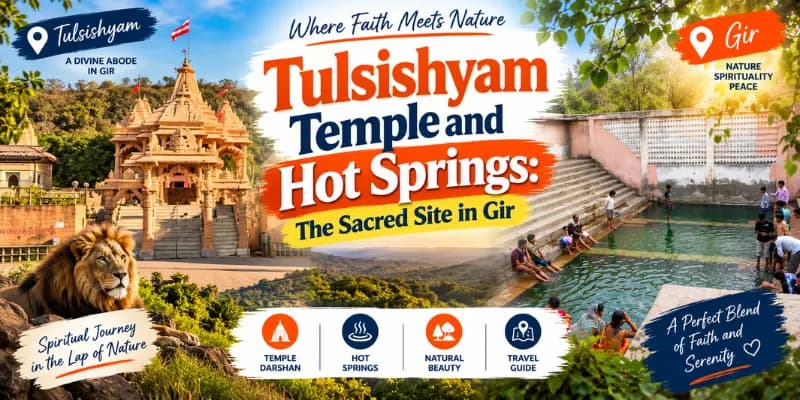
Tulsishyam temple is a sacred Krishna, or Shyam, shrine set deep inside Gir National Park, famous for its ancient 3,000-year-old black-stone idol, three natural sulphur hot springs called Taptodak, and a curious nearby gravity hill. It is open 6:00 AM to 8:00 PM daily with free entry.
Hidden in the dense forest of Gir, the land of the Asiatic lion, Tulsishyam is one of Gujarat's most unusual and enchanting pilgrimage spots, where an ancient temple, healing hot springs and a baffling gravity hill sit side by side. This guide, from the team behind Somnath Dwarka Tour Package, a unit of Experience My India, covers the legend and temple, the hot springs, the timings and forest rules and how to reach this remarkable site deep in the Gir forest.
About Tulsishyam temple
Tulsishyam is a revered Hindu pilgrimage site dedicated to Lord Vishnu, worshipped here as Krishna in his form of Shyam, nestled right in the heart of the dense Gir forest on the border of the Amreli and Gir Somnath districts of Gujarat. It is a rare and special place, a working temple deep inside a wildlife sanctuary, surrounded by pristine nature. The site is celebrated for three remarkable features: its ancient temple with a 3,000-year-old black-stone idol, its natural sulphur hot springs, referred to in the Puranas as Taptodak and an intriguing nearby gravity hill. Together they make Tulsishyam a destination of faith, nature and wonder, all in one forest clearing.
Tulsishyam at a glance
Site | Tulsishyam temple and hot springs |
Deity | Lord Vishnu or Krishna as Shyam |
Location | Inside Gir forest, Amreli and Gir Somnath border |
Timings | 6:00 AM to 8:00 PM daily |
Entry | Free |
Known for | Ancient idol, sulphur hot springs, gravity hill |
The legend of Tulsishyam
The name Tulsishyam comes from an ancient legend. According to Vedic mythology, Lord Krishna, revered as Shyam, defeated and slew a fierce demon named Tul at this very spot. The names of the vanquished demon, Tul and the victorious lord, Shyam, were joined to give the place its name, Tulsishyam. The temple thus stands as a mark of the triumph of the divine over evil and the sacred idol of Lord Tulsishyam enshrined here is believed to be some 3,000 years old, carved from black stone, one of the most ancient murtis in the region. The temple structure itself is believed to be around 700 years old, making the site a place of deep antiquity and spiritual power.
The temple and the ancient idol
The main shrine sits atop a small hill, reached by climbing about 100 steep steps, a short but rewarding ascent that opens onto lovely views of the surrounding forest. Within the inner sanctum is the ancient black-stone idol of Lord Tulsishyam, worshipped as Krishna in the form of Shyam. On an adjacent hillock stands a scenic sister shrine dedicated to Goddess Rukmini, the consort of Krishna, also reached by a short flight of steps and there is a Mahaprabhuji Bethak, a seat of the great Vaishnava teacher Vallabhacharya, near the temple. Simple, ancient and set amid dense greenery, the temple has a peaceful, contemplative atmosphere quite unlike any city shrine.
The hot springs or Taptodak
The most famous feature of Tulsishyam is its natural hot springs, located near the main entrance and referred to in the Puranas as Taptodak. There are three natural sulphur pools, each at a progressively higher temperature, a remarkable natural wonder: the first is pleasantly warm, the second is hot and the third contains near-boiling water. The natural sulphur content of the water is highly regarded for its healing properties, believed to help with skin ailments, gout and rheumatism and pilgrims come to take a holy and therapeutic dip. Separate bathing sections are built for men and women, so visitors can bathe with privacy and comfort in the sacred, curative waters.
The gravity hill
One of the most curious attractions near Tulsishyam is its gravity hill, a stretch of road about 400 metres north of the temple. Here, in a striking optical illusion, vehicles left in neutral gear appear to roll uphill, seemingly against the pull of gravity. The effect, caused by the peculiar lay of the surrounding land which tricks the eye about what is uphill and what is down, delights and puzzles visitors, who often stop to try it for themselves. This so-called anti-gravity hill adds a playful sense of wonder to a visit and along with the temple and the springs, it makes Tulsishyam a genuinely one-of-a-kind stop in the Gir forest.
Timings, entry and forest rules
The Tulsishyam temple is open for darshan daily from 6:00 AM to 8:00 PM and entry is free, with no charge to visit the temple or use the hot springs. Because the temple sits within a wildlife sanctuary that is home to Asiatic lions, important forest rules apply for everyone's safety. The forest check posts completely close vehicle entry after 8:00 PM and require a final exit by 9:00 PM and visitors are strictly instructed to stay indoors or within the temple facilities after 6:00 PM, as the forest belongs to the lions after dark. It is essential to plan your visit within daylight hours and to respect these rules, which protect both visitors and the wildlife.
Food and stay at Tulsishyam
Despite its remote forest setting, Tulsishyam looks after its pilgrims well. The temple trust operates a Bhojanalaya that provides free lunch and dinner to all visitors, in the fine tradition of temple hospitality. For those wishing to stay overnight, basic accommodation is available at the temple's Dharamshala or at the local government guest house for a nominal fee. As the site is deep in the forest with a limited exit time after dark, staying overnight can be a peaceful, immersive experience, letting you enjoy the springs and the temple at a relaxed pace, though it is wise to arrange it in advance.
How to reach Tulsishyam
Tulsishyam lies on the Dhari to Una roadside, deep within the Sasan Gir forest region. The approximate distances from key places are:
From | Distance | Route and details |
Una | 30 to 35 km | The smoothest, most well-maintained approach road |
Dhari (Amreli) | 45 km | Secondary forest road, can be slightly bumpy |
Diu | 55 km | About a 1.5 hour drive via Una |
Sasan Gir | 66 km | Scenic drive through the national park |
Somnath | 100 km | About a 2 to 2.5 hour drive via Una |
By road, which is the best option, hiring a private car or local taxi from Somnath, Diu or Una is highly recommended and GSRTC and private buses on the Una to Dhari route pass by the temple. By train, the nearest minor station is Delvada, about 35 km away near Una, while for major rail links travellers use Veraval and Somnath Junction, about 100 km away. By air, the closest airport is Diu, about 55 km away, from where local cabs are readily available. See our how to reach Gir guide for the wider region.
Best time to visit Tulsishyam
The best time to visit Tulsishyam is the cooler season, October to March, when the forest is green after the monsoon and the weather is pleasant for the temple, the springs and the drive, in line with the best time to visit Gir. As the site is within the Gir forest, note that the national park's safari zones close during the monsoon, roughly June to October, though the Tulsishyam temple itself remains accessible by road. Visit during the day and plan to leave the forest before the evening exit time and check the Gir forest weather for the season.
Combine Tulsishyam with Gir and Somnath
Tulsishyam is best enjoyed as part of a wider Gir and Saurashtra trip. It pairs naturally with a lion safari at Sasan Gir, about 66 km away, so you can see the temple and the springs and then, on another day, look for the Asiatic lion; plan the safari with the Gir safari ticket price guide. It also sits within easy reach of Somnath and Diu, so many travellers add it to a Somnath and Gir itinerary and it can be extended to Dwarka up the coast for a full circuit of the region's temples, wildlife and coast.
Tips for visiting Tulsishyam
A few pointers make the visit smoother:
Visit during daylight and leave the forest before the evening exit time, for safety in lion country.
Hire a car or taxi from Somnath, Diu or Una, the easiest way to reach the remote site.
Carry a change of clothes if you plan to bathe in the hot springs, using the men's and women's sections.
Take the free meal at the temple Bhojanalaya and book the Dharamshala ahead if staying overnight.
Try the gravity hill about 400 metres north and enjoy the illusion of rolling uphill.
Do not litter or disturb the wildlife, as the temple sits within a protected sanctuary.
Plan your Tulsishyam and Gir trip
Experience My India can plan a trip that includes Tulsishyam, a Gir lion safari and the temples of the coast. Plan the season with the best time to visit Gujarat, explore the excursions around Somnath and Diu, book Somnath Dwarka hotels and Gir lodges and let the Experience My India Somnath Dwarka tour packages or a Somnath Dwarka taxi service handle the travel through the forest and beyond.
Related guides
To plan the rest of your Gir and Saurashtra trip, these related guides help:
Related guide | What it covers |
Air, rail and road access to the Dwarka coast. | |
The nearest railheads for reaching Gir. | |
The sights within the Somnath temple town. | |
The sacred mountain and fort city near Gir. | |
The route to the Girnar climb from Somnath. | |
The best months for the Dwarka coast. |
Plan your visit
Experience My India can arrange your Tulsishyam, Gir and Saurashtra trip. Browse more travel guides, message us on WhatsApp or call +91 73006 20809.

Harsh Rawat
Somnath–Dwarka circuit planning
Harsh Rawat runs Somnath Dwarka Tour Package on the ground in Gujarat, part of Experience My India. Since 2018 he has been planning and driving the Somnath–Dwarka circuit — the darshan timings, the road hours between temples and the stops worth adding — and the routes, fares and timings published across this site are the ones he maintains.