Uttarayan Kite Festival Gujarat: When the Sky Fills with Colour
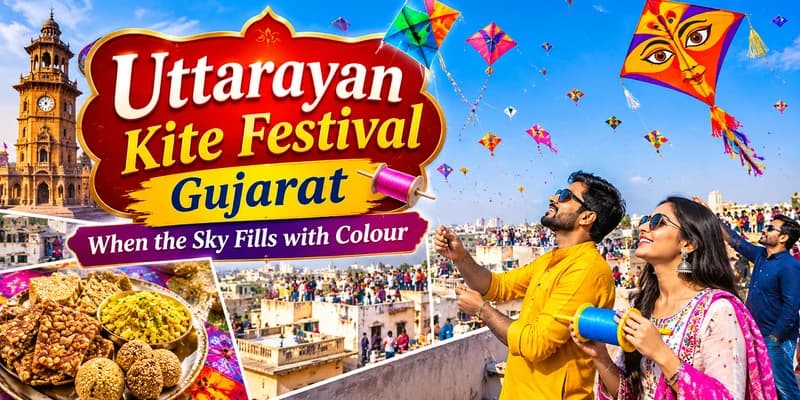
Uttarayan is Gujarat's spectacular kite festival, celebrated on 14 January, with a second day of Vasi Uttarayan on 15 January. Rooftops across the state fill with fighter kites from dawn to dusk and the government's International Kite Festival at Ahmedabad's Sabarmati Riverfront draws flyers from over 45 countries. This guide, from Experience My India, covers it.
Uttarayan is one of the most joyous and spectacular festivals in India, the day when the whole of Gujarat takes to its rooftops and the sky disappears behind countless colourful kites. Marking Makar Sankranti, the sun's turn to the north, it has grown from a royal pastime into a vast public celebration, crowned by the state's International Kite Festival. This guide, from the team behind Somnath Dwarka Tour Package, a unit of Experience My India, covers the festival's dates and timings, the International Kite Festival and its venues, the kites, strings and night lanterns, the history and food and everything you need to experience Uttarayan in Gujarat. The wider Makar Sankranti festival is covered in our Makar Sankranti guide.
What is the Uttarayan Kite Festival?
Uttarayan is the Gujarati name for Makar Sankranti, the festival that marks the sun's transition into the northern hemisphere and in Gujarat it is celebrated above all through kite-flying on a scale seen nowhere else. For one or two days in mid-January, families, friends and neighbours gather on rooftops across every city, town and village to fly fighter kites, battling to cut one another's strings amid cries of triumph, while master flyers display giant custom creations at official events. It is at once a religious observance of the sun's northward turn, a harvest-season celebration and a joyous, competitive community sport, all unfolding under a sky packed with colour. For visitors, the sheer spectacle of a Gujarati city's skyline filled with kites on Uttarayan morning is an unforgettable sight and joining a rooftop celebration is one of the great experiences of travelling in Gujarat.
The Uttarayan Kite Festival at a glance
What it is | Gujarat's kite-flying festival for Makar Sankranti |
Main day | 14 January, with Vasi Uttarayan on 15 January |
International Kite Festival | At the Sabarmati Riverfront, Ahmedabad |
Flyers from | Over 45 countries each year |
Flying hours | Dawn to dusk, roughly 6:00 AM to 7:00 PM |
After dark | Illuminated tukkal night kites and lanterns |
Famous cry | Kai Po Che, the victory shout when a kite is cut |
Dates and timings
Uttarayan falls on 14 January, a date fixed by the sun rather than the lunar calendar, so it lands on the same day almost every year, with the second day, Vasi Uttarayan, on 15 January. In 2027 the main festival is on Thursday 14 January, with Vasi Uttarayan on Friday 15 January and the state-sponsored International Kite Festival is expected to run from around 11 to 14 January. Here is how a festival day unfolds:
Main Uttarayan | 14 January 2027 |
Vasi Uttarayan | 15 January 2027 |
International Kite Festival | Around 11 to 14 January 2027 |
Terrace flying | Dawn to dusk, roughly 6:00 AM to 7:00 PM |
Sabarmati Riverfront grounds | Generally 10:00 AM to 5:00 PM |
Patang Bazaar, Ahmedabad | 24 hours in the week before the festival |
Night flying | Illuminated tukkals launched after dusk |
On the day itself the skies are densely packed with kites from dawn until dark, while the official Sabarmati Riverfront display area generally opens from 10:00 AM to 5:00 PM. In the run-up, the legendary Patang Bazaar operates around the clock for last-minute kite and string shopping and immediately after dusk flyers launch tukkals, illuminated paper lanterns attached to kite strings, turning the night sky into a sea of floating lights.
The International Kite Festival
Parallel to the rooftop celebrations, the Gujarat government hosts the International Kite Festival, which centres the major global displays and official events at the Sabarmati Riverfront in Ahmedabad. The state institutionalised the global event in 1989, launching the first international festival and it now accommodates kite enthusiasts from over 45 countries every year, who bring spectacular, massive and intricate custom creations to fly and display. For visitors, the Sabarmati Riverfront is the place to see world-class kite-making and flying, a dazzling, organised showcase that complements the spontaneous rooftop battles across the city. It has made Ahmedabad a global capital of kite-flying each January and it is the official heart of Uttarayan in Gujarat. The craftsmanship on show connects to the wider traditions in our famous art and craft of Gujarat guide.
Where Uttarayan is celebrated
Uttarayan is celebrated statewide, on every rooftop in Gujarat, but certain places are focal points. Ahmedabad is the main hub, with the official International Kite Festival at the Sabarmati Riverfront and the famous Raipur Darwaza Patang Bazaar, which becomes a 24-hour centre for kite and string shopping ahead of the festival. The terraces of major cities such as Surat, Vadodara, Rajkot and Bharuch are the heart of the community celebration and special public kite-flying showcases are also hosted at iconic venues including the Statue of Unity at Ekta Nagar, the Dhordo Tent City during the Rann of Kutch festival, Dholavira and the Blue Flag Shivrajpur Beach near Dwarka. Whether you want the grand official displays or an authentic neighbourhood rooftop, Gujarat offers the full range on Uttarayan.
Kites, manja and night tukkals
The kites of Uttarayan are made for battle. Flyers use fighter kites, the patangs, flown on glass-coated strings known as manja and the sport is competitive: the aim is to cut your opponents' strings and bring their kites down. When a kite is cut, the streets erupt with the famous victory cry of Kai Po Che, alongside Eypur, shouts that echo across the rooftops all day long. As dusk falls, the celebration takes a magical turn with the launch of tukkals, illuminated paper lanterns attached to kite strings, which fill the night sky with floating points of light. A word of caution for visitors: the glass-coated manja is sharp, so handle strings carefully and be mindful of kite lines, which is part of flying safely and responsibly during the festival.
History and evolution
Kite-flying in Gujarat dates back over a thousand years, evolving from a blended regional tradition into the massive community event seen today. Historically the sport was a pastime for kings, nawabs and royalty, who employed expert kite makers to build intricate designs and over the centuries it spread from the palaces to become a festival for people of all communities gathering on rooftops. The modern global chapter began in 1989, when the state institutionalised the event by launching the first International Kite Festival, which has since grown to welcome enthusiasts from over 45 countries. The festival also carries a deep mythological resonance, for in the Mahabharata, Bhishma Pitamah waited on his bed of arrows for the sun to turn northward, for Uttarayan, before leaving his mortal body, believing this path brings liberation, which gives the day its spiritual weight.
Significance and traditions
At its core, Uttarayan marks Makar Sankranti, the sun's transition into Makar Rashi and its northward journey, signifying the end of the harsh winter and the arrival of longer, warmer days and the harvest season. Flying kites high into the sky acts as a symbolic salute to the Sun God, Surya Dev, welcoming growth and positivity and historically the day on the rooftop encouraged families to soak up healthy winter sunlight after the cooler months. Above all it is a festival of social bonding, as rooftops turn into community celebration zones where families, friends and neighbours fly together from morning to night. The astronomical and pan-India significance of the festival is covered more fully in our Makar Sankranti guide.
The food of Uttarayan
No Uttarayan is complete without its seasonal feast, eaten on the rooftop between kite battles. The star dish is undhiyu, a rich, slow-cooked mixed winter-vegetable preparation that is one of Gujarat's great delicacies, traditionally paired with hot jalebi. The day also revolves around til-gud, the sesame-and-jaggery sweets and laddus eaten at Sankranti across India, crunchy peanut chikki and fresh green sorghum, ponkh, a seasonal treat. These winter foods, warming and energy-rich, are perfectly suited to a long day outdoors in the January sun. For more on the state's cuisine and sweets, see our Kathiyawadi food and Gujarati thali and famous sweets of Gujarat guides.
Tips for experiencing Uttarayan
A few pointers help you enjoy the festival:
Be on a rooftop by mid-morning on 14 January, when the skies are at their most densely packed with kites.
Visit the Sabarmati Riverfront in Ahmedabad for the International Kite Festival's world-class displays, roughly 10:00 AM to 5:00 PM.
Shop for kites and manja at Ahmedabad's Raipur Darwaza Patang Bazaar, open 24 hours in the week before.
Handle the glass-coated manja carefully, as it is sharp and watch for kite strings around you.
Stay into the evening for the magical tukkal night kites and lanterns after dusk.
Try the seasonal undhiyu, jalebi, til-gud, chikki and ponkh on the rooftop.
Book travel and stays early, as mid-January is peak festival season across Gujarat.
How to experience it and where to base
The best base for the International Kite Festival is Ahmedabad, home to the Sabarmati Riverfront and the Patang Bazaar, though the festival is celebrated with equal joy in Surat, Vadodara, Rajkot and across the state. Mid-January is also a lovely time to be in Gujarat more widely, pleasant and cool, so Uttarayan combines well with a longer tour. To build a trip around the festival season, see our Gujarat itinerary, which can take in the coastal pilgrimage to Somnath and Dwarka and the lions of Gir and our Somnath Dwarka taxi service can handle transport around the state.
Plan your Uttarayan visit
Experience My India can plan a trip around Uttarayan, arranging a rooftop or riverfront vantage for the kite festival, stays in Ahmedabad or elsewhere and transport, then weaving in the wider culture and pilgrimage of Gujarat. Our Gujarat tour packages and Somnath Dwarka tour packages can build the festival into a fuller January journey, with a stay at well-placed hotels.
Related guides
To plan your Gujarat festival trip, these related guides help:
Related guide | What it covers |
The state's great autumn festival of folk dance. | |
The four sacred dhams for a pilgrimage add-on to your trip. | |
The autumn full-moon festival in the Gujarat calendar. |
Plan your visit
Experience My India can arrange your Uttarayan and Gujarat festival trip. Browse more travel guides, message us on WhatsApp or call +91 73006 20809.

Harsh Rawat
Somnath–Dwarka circuit planning
Harsh Rawat runs Somnath Dwarka Tour Package on the ground in Gujarat, part of Experience My India. Since 2018 he has been planning and driving the Somnath–Dwarka circuit — the darshan timings, the road hours between temples and the stops worth adding — and the routes, fares and timings published across this site are the ones he maintains.