Gopi Talav, Dwarka: History, Gopi Chandan, Timings and Guide
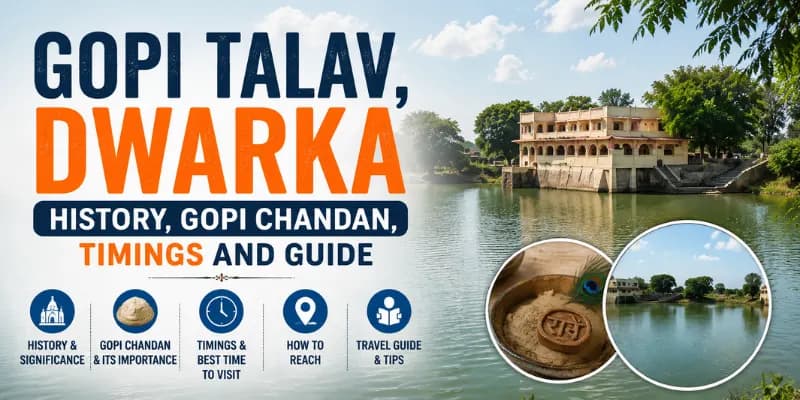
Gopi Talav is a sacred pond about 20 km from Dwarka, near the Nageshwar Jyotirlinga, where the gopis are believed to have merged with Lord Krishna after their last Raas Leela. It is the source of the yellow Gopi Chandan clay, is free to visit, and is open in daylight hours.
Away from the crowds of the main temple, Gopi Talav is one of the most quietly moving stops on a Dwarka pilgrimage. This guide, from the team behind Somnath Dwarka Tour Package, a unit of Experience My India, covers what Gopi Talav is, its history and legend, the sacred Gopi Chandan clay, the timings, the distance from Dwarka and how to reach it. Note that there is also a different Gopi Talav in the city of Surat; this guide is about the sacred Gopi Talav near Dwarka.
What is Gopi Talav in Dwarka?
Gopi Talav, also called Gopi Talab or Goprachar Tirth, is a small, sacred freshwater pond near Dwarka, ringed by bathing ghats and small shrines and surrounded by distinctive yellow clay. It is one of the most important religious places in the Dwarka pilgrimage circuit, deeply tied to the legend of Lord Krishna and the gopis of Vrindavan. Rather than a grand temple, it is a serene, natural spot and its fame comes from the sacred yellow clay found here, the Gopi Chandan, which pilgrims carry home. The pond is thought to be thousands of years old and forms part of the traditional Panch Dwarka and Dwarka darshan route.
Where is Gopi Talav located?
Gopi Talav is located at Samlasar, about 20 to 21 km north of Dwarka, on the road towards the Nageshwar Jyotirlinga and Bet Dwarka, roughly 5 km from the Nageshwar temple. Its address is near Nageshwar Road, Dwarka, Gujarat 361335. Because it sits on the same route as Nageshwar and the Okha ferry point for Bet Dwarka, it slots naturally into a north-Dwarka half-day and most travellers stop here between the temple town and the island.
The history and legend of Gopi Talav
The legend of Gopi Talav takes us to the heart of Lord Krishna's story. When Krishna left Vrindavan and moved his capital to Dwarka, the gopis, the cowherd girls who loved him dearly, could not bear the separation. They journeyed to Dwarka to see their beloved Kanha and here, on the full-moon night of Sharad Purnima, they performed their final Raas Leela with him. After the dance, unable to part from Krishna again, the gopis are believed to have surrendered their earthly forms and merged with the land, attaining moksha. According to tradition, their devotion turned the soil into the soft yellow clay found here to this day, the Gopi Chandan. Some accounts say Lord Krishna himself created the lake to fulfil the gopis' wish and promised to remain by it always, which is why the site is also known as Goprachar Tirth.
The site is woven into the wider Dwarka history and for devotees it carries an emotional weight that the grander temples cannot match, standing as a symbol of pure, selfless devotion.
What is Gopi Chandan?
Gopi Chandan is the smooth, pale-yellow clay found around Gopi Talav, believed to have formed from the gopis themselves. It holds a special place in Vaishnava tradition, where devotees apply it on the forehead and body as a sacred tilak. The Skanda Purana praises the gopi-chandana of Dwarka above ordinary sandalwood and tradition holds that marking oneself with it brings blessings comparable to a bath in the Ganga. Many believe the clay also has healing properties, especially for skin ailments. Pilgrims collect a small, respectful pinch of the clay as a sacred memento and it is best carried in a small cloth pouch.
Why is Gopi Talav famous?
Gopi Talav is famous for two reasons that are really one. First, it is the place of the gopis' final Raas Leela and their merging with Krishna, one of the most poignant episodes in his story, which gives the quiet pond enormous spiritual power. Second, it is the source of the sacred Gopi Chandan clay, prized across the Vaishnava world as a tilak. Together, the legend and the clay make Gopi Talav a cherished, if understated, stop, drawing pilgrims who want to connect with the devotional heart of Dwarka away from the busier shrines.
Gopi Talav timings and entry fee
The Dwarka Gopi Talav is a natural, open sacred site rather than a ticketed attraction:
Timings | Generally open in daylight hours, daily |
Entry fee | Free |
Best time | Early morning or late afternoon, for quiet and soft light |
Note | Gate timings can be seasonal; treat it as a daytime stop |
Unlike the Gopi Talav lake in Surat, the Dwarka pond has no fixed ticket or weekly closure. It is best treated as a daytime stop, so plan to visit between morning and early evening and confirm locally if you are travelling in the off-season.
Is Gopi Talav open today?
The Dwarka Gopi Talav is generally open every day during daylight hours, with no weekly holiday, so on most days the answer is yes. As it is an open-air sacred pond rather than a gated monument, access is rarely restricted, though very heavy monsoon rain can make the approach muddy. If your plans are tight, a quick check with your driver or hotel on the day is wise, especially in the rainy season.
Gopi Talav distance from Dwarka and how to reach
Gopi Talav is about 20 to 21 km from Dwarka, a drive of roughly 30 to 40 minutes and only about 5 km from the Nageshwar Jyotirlinga. The easiest way to visit is by car as part of the north-Dwarka circuit and our Dwarka to Nageshwar distance guide covers the same road. To reach Dwarka itself, the town has its own railway station, with the nearest airports at Jamnagar and Porbandar; see how to reach Dwarka. A Somnath Dwarka taxi service can combine Gopi Talav, Nageshwar and Bet Dwarka in one smooth trip.
Things to see and do at Gopi Talav
It is a simple, peaceful place, best enjoyed slowly:
Collect Gopi Chandan: respectfully take a small pinch of the sacred yellow clay as a memento or tilak.
The bathing ghats and shrines: the pond is ringed by ghats and small shrines where devotees offer prayers.
Birdlife and photography: the water attracts many birds and fish and the yellow clay makes for striking photos.
Quiet reflection: the calm, uncrowded setting is ideal for a peaceful pause in the pilgrimage.
Pair it with the Rukmini Devi temple and Gomti Ghat back in town.
Gopi Talav Dwarka versus Gopi Talav Surat
A quick clarification, since the name causes confusion in searches. This guide is about the sacred Gopi Talav near Dwarka, a religious pond tied to Lord Krishna and the source of Gopi Chandan. There is a completely separate Gopi Talav in the city of Surat, in south Gujarat, which is a modern, restored urban lake and recreation spot with boating, ticketed entry and set opening hours. The two share only a name; they are different places, hundreds of kilometres apart, with different purposes. If you are looking for the Surat lake's ticket price and timings, look for the Surat Gopi Talav specifically rather than this Dwarka pilgrimage site.
Best time to visit Gopi Talav
The best season is the cooler winter, October to March, in line with the best time to visit Dwarka, when the weather is pleasant for the short drive out and back. Within the day, early morning and late afternoon are the most rewarding, with soft light and fewer people. Sharad Purnima, the autumn full moon tied to the Raas Leela legend, is an especially meaningful time to visit, though also busier. Avoid the peak monsoon, when the approach can get muddy.
Tips for visiting Gopi Talav
A few pointers make the visit smoother and more respectful:
Carry a small cloth pouch if you wish to take a little Gopi Chandan home.
Take only a minimal pinch of clay; do not dig or scoop and do not litter.
Do not enter the water; it is a sacred reservoir, not a swimming spot.
Keep your voice low, as many visitors come here for quiet prayer.
Watch children carefully near the pond banks, where the clay edges can be soft.
Combine it with Nageshwar and Bet Dwarka, which lie on the same road.
Gopi Talav Dwarka at a glance
What it is | A sacred pond and the source of Gopi Chandan |
Location | Samlasar, near Nageshwar Road, Dwarka, Gujarat 361335 |
Distance from Dwarka | About 20 to 21 km, near the Nageshwar Jyotirlinga |
Legend | The gopis' last Raas Leela and merging with Krishna |
Famous for | Gopi Chandan, the sacred yellow clay |
Timings | Daylight hours, daily |
Entry fee | Free |
Combine Gopi Talav with the rest of Dwarka
Gopi Talav is a natural part of the north-Dwarka circuit, so it pairs easily with the city's other sights. Group it with Nageshwar and the Dwarka to Bet Dwarka distance route on the same road and back in town add the Dwarkadhish darshan, the Dwarka city guide sights and a Somnath extension if you have more days. Book Somnath Dwarka hotels near the temple and the Experience My India Somnath Dwarka tour packages can arrange the whole route with a car and driver.
Related guides
To plan the rest of your Dwarka trip, these Experience My India guides help:
Related guide | What it covers |
Darshan hours and ferry timings for Bet Dwarka. | |
What to eat around the temple town. | |
The season and festivals that shape when to travel. | |
Access for the Somnath end of the coast. | |
One and two day plans for a Somnath visit. | |
The Shiva temple set out in the sea at Dwarka. |
Plan your Dwarka trip
Experience My India can build Gopi Talav, Nageshwar, Bet Dwarka and the Dwarkadhish darshan into one smooth trip. Browse more travel guides, message us on WhatsApp or call +91 73006 20809.

Harsh Rawat
Somnath–Dwarka circuit planning
Harsh Rawat runs Somnath Dwarka Tour Package on the ground in Gujarat, part of Experience My India. Since 2018 he has been planning and driving the Somnath–Dwarka circuit — the darshan timings, the road hours between temples and the stops worth adding — and the routes, fares and timings published across this site are the ones he maintains.